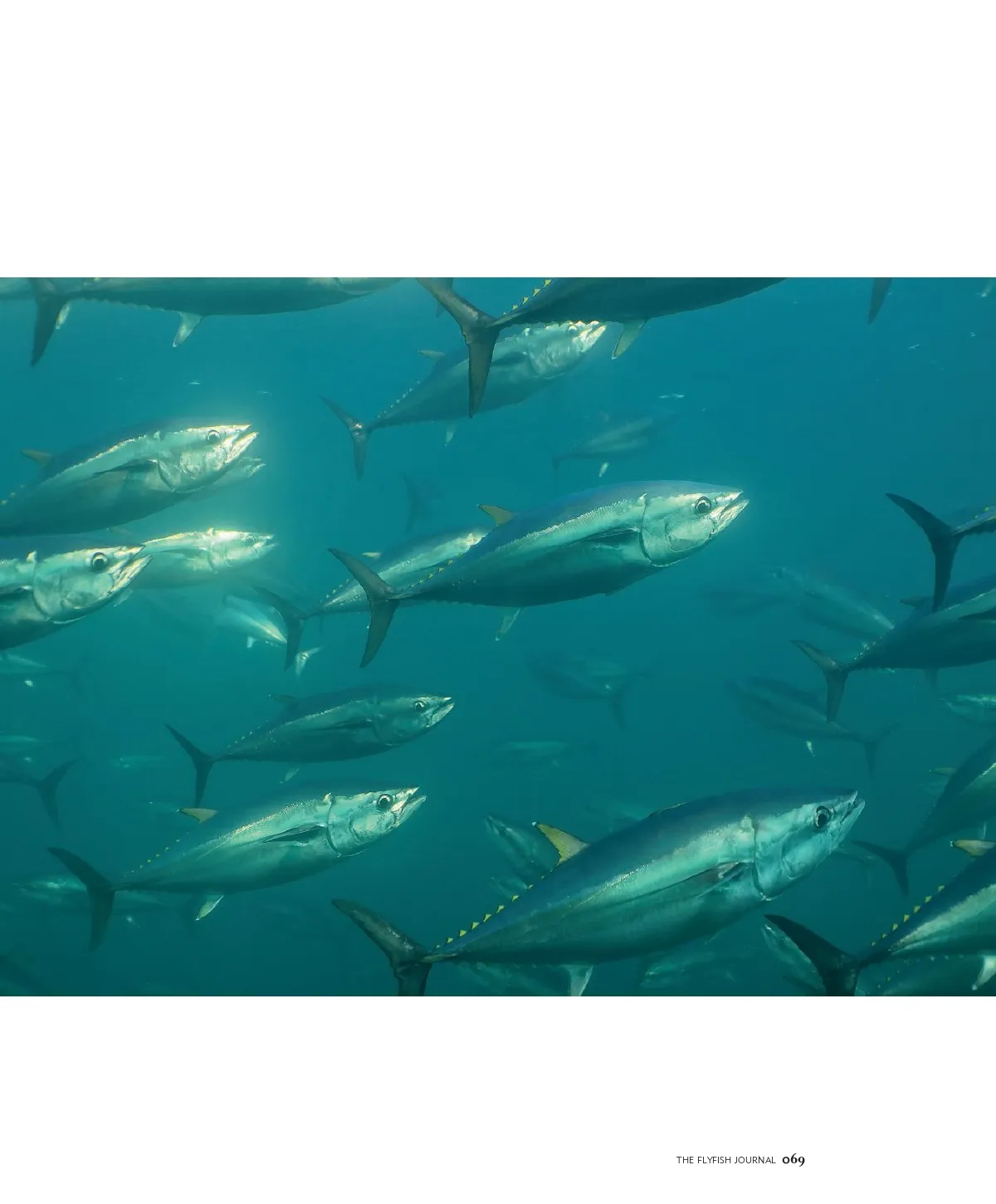
RIGHT Bluefin tuna school after a feeding frenzy. During summer and autumn big schools of tuna push big balls of anchovies close to the ocean’s surface. When the hunt is on, the water appears to actually boil. In the Bay of Biscay, young fish in the 20-to-120-pound range—perfect fly-rod fish—congregate and grow quickly on an abundant diet of fat-rich anchovies. Photo: Lilian Haristoy Bluefin travel on the surface in the afternoon, di-gesting their food in the warm waters after feeding heavily in the morning. “You have to be careful of the sun angle because if the sun is behind you and you cast a shadow on the fish, they’re gone,” Art told me. “You can’t change the engine’s RPMs, because any shift in pitch spooks the fish as well. The teamwork is precise. The guy in the tower controlling the boat has to posi-tion it just right to get a throw, and it’s almost as excit-ing as being on the pulpit. Almost. But being up there ready to stick a tuna is like being on a deer stand. Or being in combat.” Despite the occasional high reward—a big tuna with the right fat content can sell for $20,000 back at the dock—Art gave up harpooning because it didn’t provide a reliable enough income for a guy with a fam-ily. When he started his charter business, he chased bluefin with clients but that also proved unreliable. “You just never know when you will see them,” he said, “and then once you hook one, you don’t know what you have. It could be a 200-pounder, doable on conventional rod and reel, but it could also be a thou-sand-pounder. With a fly rod, you’re looking for those 40-pound fish or smaller.” Anything bigger is a fool’s errand. One year in the early 2000s, something unusual occurred. In August, massive schools of bay ancho-vies, silversides and young menhaden (known as pea-nut bunker in the Northeast) invaded the nearshore region of Rhode Island. The shorelines became a baitfish stew, with the usual large bluefish (not to be confused with blue fin ) and Atlantic bonito following the bait. My friend Jeremy Cameron heard reports of skipjack and bluefin tuna in the mix. Reports of small bluefin close to shore are not that unusual, but skip-jack are an anomaly on the New England coastline. Not only did the abundant baitfish pull tuna closer to shore, but they also sucked the atypical skipjack out of the Gulf Stream. Jeremy called with urgency in his voice. He knew how much I wanted to catch a bluefin and he had a trip planned with Captain Mike Warecke and author Pete McDonald, whose book, The Blitz , chronicles a year spent chasing saltwater species up and down the Eastern seaboard. Fueled by caffeine and nicotine in varied forms and with little regard for meals, we chased schools of bait and their various predators for four long days, leav-ing before sunrise and pulling into the harbor after dark each night. On our first day out, fish busted the surface constantly, a mixture of skipjack, bluefish and large bo-nito. Bluefish can cut through 30-pound fluorocarbon like it’s fly-tying thread, but we were afraid if we used wire, the bluefin would shy away from it. We could rec-ognize the quick splashy rises of bonito, and the splashy but slightly less pushy eruptions of bluefish. The skipjack were a new species to us, but their schools had a distinct, very tightly packed boil when on the attack. Later in the day we finally saw bluefin, and there was no mistaking their pattern: The hits were powerful, similar to bonito but with a lot more push. The next day, I was fast to a fish right away, though it was unclear what species it was because the schools were so often mixed. Thinking it was a bluefish, I pur-posely broke it off before realizing it was the largest bonito I had ever hooked—there were bluefin nearby and I wanted my fly back in the water. When I finally hooked a bluefin, there was no question—line sang off the reel and just kept going. And going some more. I have no idea exactly how far that fish took me into my backing, but I had plenty and it took more than any other fish I’ve hooked anywhere, at any time. After two long runs the fish steamed straight back at the boat; at first, I thought I’d dropped it but after some furious reeling, it came tight. 068 BLUEFINS
The Flyfish Journal Volume 11, Issue 1: Page 68