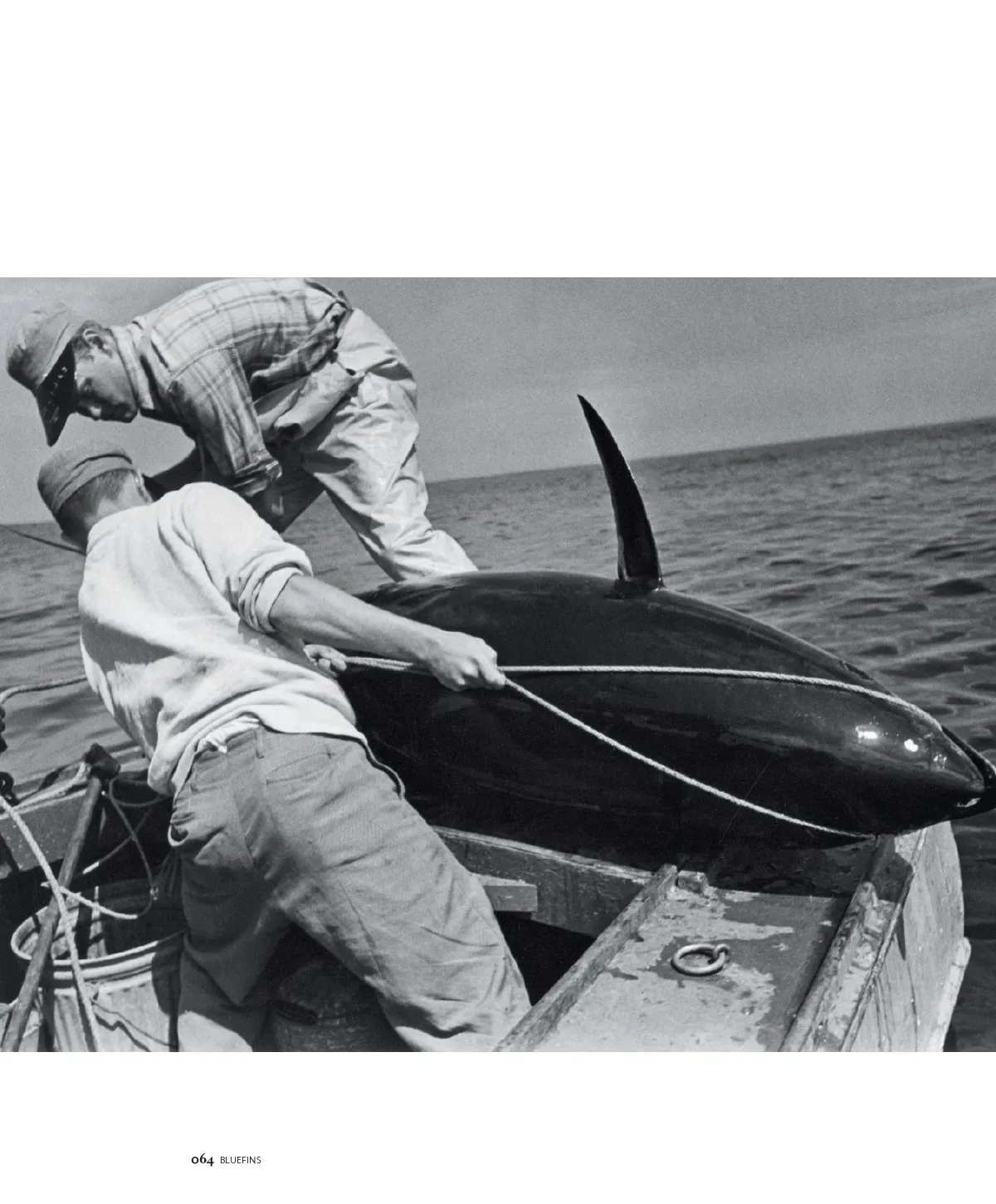
Tony positioned the boat as a school came straight on, splitting the bow as they frothed through a mass of sand eels. One veered off and attacked my fly. “I’m on!” I yelled. Then just as quickly, “I’m off!” The improved blood knot between my 40-pound leader and 30-pound tippet came in with a dishearten-ing pigtail. For the rest of the summer, the flyfishing guides in Chatham called me Tom Brokemoff. One doesn’t normally expect to find casting ob-stacles miles offshore, but acres of adult sand eels do a good job attracting whales, dolphins and seabirds large enough to eat the six-inch baitfish. Bluefin fol-low the whales, picking up crippled bait as the whales breach to stun them or form huge bubble circles to trap and disorient them. It makes sense to throw behind whales if tuna aren’t busting the surface, but you’d better make sure the whale you throw to is the last one in line. Shearwaters—a large pelagic seabird—can dive more than 100 feet to chase baitfish and squid, and unlike bluefin they’re dumb enough to grab just about any fly you throw at the tuna. Even a class 5 sinking line won’t get deep enough to avoid them. On a trip with Captain Nat Moody of First Light Anglers out of Gloucester, MA, a whale-watching boat pulled up as Nat and I sheepishly worked to unhook several hapless shearwaters with heavy gloves, amid much squawking and whirling circles of beaks and claws. Not exactly what Little Johnny and his parents expected to see on their whale-watching tour that day. LEFT Carl Safina devotes an entire third of his leg-endary book, Song for the Blue Ocean, to bluefin. In another book, Tuna , Richard Ellis spent more than 300 pages on his love story with bluefin. My favorite book on the fish, Douglass Whynott’s Giant Bluefin , tells the story of fishers who chase bluefin with hand-thrown harpoons; reading that book, I learned that these guys who depend on bluefin for their livelihood, who can go for weeks without a throw of their har-poon, have just as much trouble sleeping the night before a trip as me. Art Sawayer, a Cape Cod com-mercial fisherman turned charter boat captain, often regales me with tales of his three years harpooning tuna in Cape Cod Bay. “It’s a very secretive group,” he told me once. “And it’s not for everybody. You have to get used to stand-ing on the pulpit, a 10-inch-wide piece of corrugated aluminum, for hours on end.” Art did his stint before the days of airplane spotters, when harpooners could go several days before getting close enough to a tuna to throw the harpoon. In three years, he stuck 16 tuna, and had about a 40 percent success rate on sinking the harpoon. “Dick Nickeson and Gil Fessenden lashing a 400-pound tuna to the stern, circa 1935-1955.” Photo: Arthur Griffin courtesy of the Griffin Museum of Photography THE FLYFISH JOURNAL 065
The Flyfish Journal Volume 11, Issue 1: Page 65