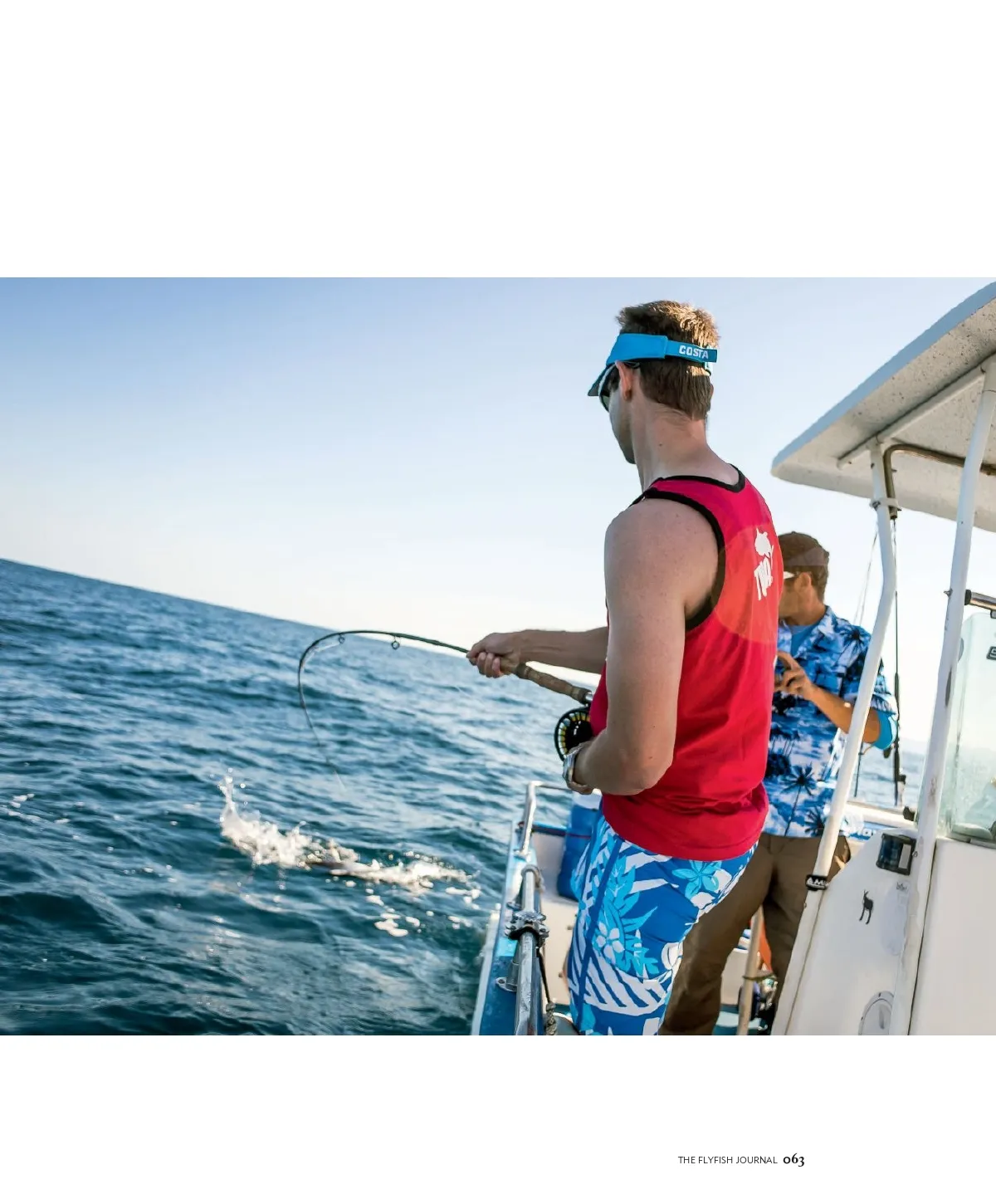
RIGHT The end of the fight. A feeling of relief fills the whole crew and especially the angler holding the rod. Sakari Siipilehto brings a bluefin within reach near St. Cyprien off the Mediterranean coast of France. Photo: Jari Koski I t’s ludicrous for a guy who lives in the dairy farm country of Vermont to be obsessed with a pelagic fish that seldom comes within 10 miles of the mainland. It’s a five-hour drive to the ocean, I don’t own a boat and you must be willing to immediately drop everything when a school comes close enough to shore to intercept them. Trying to catch one on a fly rod is the height of silliness. But if you flyfish long enough, you find there are aspects of the sport you love because of familiarity and comfort; and there are those that move you way outside your bubble into the realm of quixotic, adrenaline-fueled pursuit. Chasing bluefin tuna on the fly is the angling equivalent of tilting at windmills. Bluefin are unique and remarkable for many rea-sons. Their colors are elusive and shimmering, com-bining olives, blues, grays, browns and whites into a subtle patina that changes with every flip of their tails. Their bodies are more than muscular, with a sensual hardness that rivals the abs of any video fitness star. Although all tunas can thermoregulate and thus are functionally warm-blooded, this ability is most highly developed in bluefin, allowing the fish to handle water temperatures from very cold to tropical. They can basi-cally swim anyplace in the ocean they please. They are so hydrodynamically evolved that their eyes and fins fit into recesses in their bodies. North Atlantic bluefin, which grow bigger and faster than populations in the south Atlantic or Pacific, migrate from New England to the Mediterranean in waters over 50 feet deep, al-ways staying close to abundant baitfish. No one has ever seen them spawn. Bluefin are commonly seen in near-shore waters in New England from early spring through April. They can reach a full ton if lucky enough to escape the sushi market. The world record on rod and reel was caught in 1979 off Nova Scotia and weighed 1,496 pounds. By contrast, the fly-rod record is 196 pounds, and even that fish is hard to believe on 20-pound tippet. It must have taken hours to land, and because IGFA rules require that an engine be out of gear during the entire fight, it would not have been possible to follow it with the boat. My obsession began about 20 years ago. I was fishing a striped-bass blitz off Cape Cod with my friend Tony Biski, a charter boat captain who, in the early days when he didn’t have constant bookings and gas was cheap, would take me out to scout new locations because he knew I’d cast all day. It was one of those dark and drizzly calm days that envelop you in the cozy feeling that a storm won’t blow up on the horizon and the fish will be stupid. Tony noticed fish breaking to the side of the main activity, throwing bigger plumes than stripers do and moving faster. They looked to me like large false albacore. “Shit, I think those are small bluefin,” Tony said. We threw flies to no avail and made plans to chase them later that week. Tony wanted the prestige of hav-ing a fly-caught bluefin landed on his boat. Days passed. The Chatham fog held the shoreline in a bear hug until the wind picked up. Tony and I finally got our chance: gentle south winds, no fog, no whitecaps. We ran 18 miles offshore in a 20-foot Jones Brothers—not an endeavor to take lightly—looking for the wisps of whale smoke on the horizon that indi-cate schools of sand eels and possibly bluefin. It didn’t take long to find the whales, a pod of humpbacks, and scores of bluefin crashing through schools of bait. The only creatures I’ve seen that maraud schools of bait-fish with the same violence as bluefin are porpoises. Bluefin typically come to the surface for only brief moments, sometimes 30 seconds, occasionally a few minutes—though I’ve heard of schools feeding at the surface for hours, I have never had the thrill of wit-nessing that spectacle. 062 BLUEFINS
The Flyfish Journal Volume 11, Issue 1: Page 62