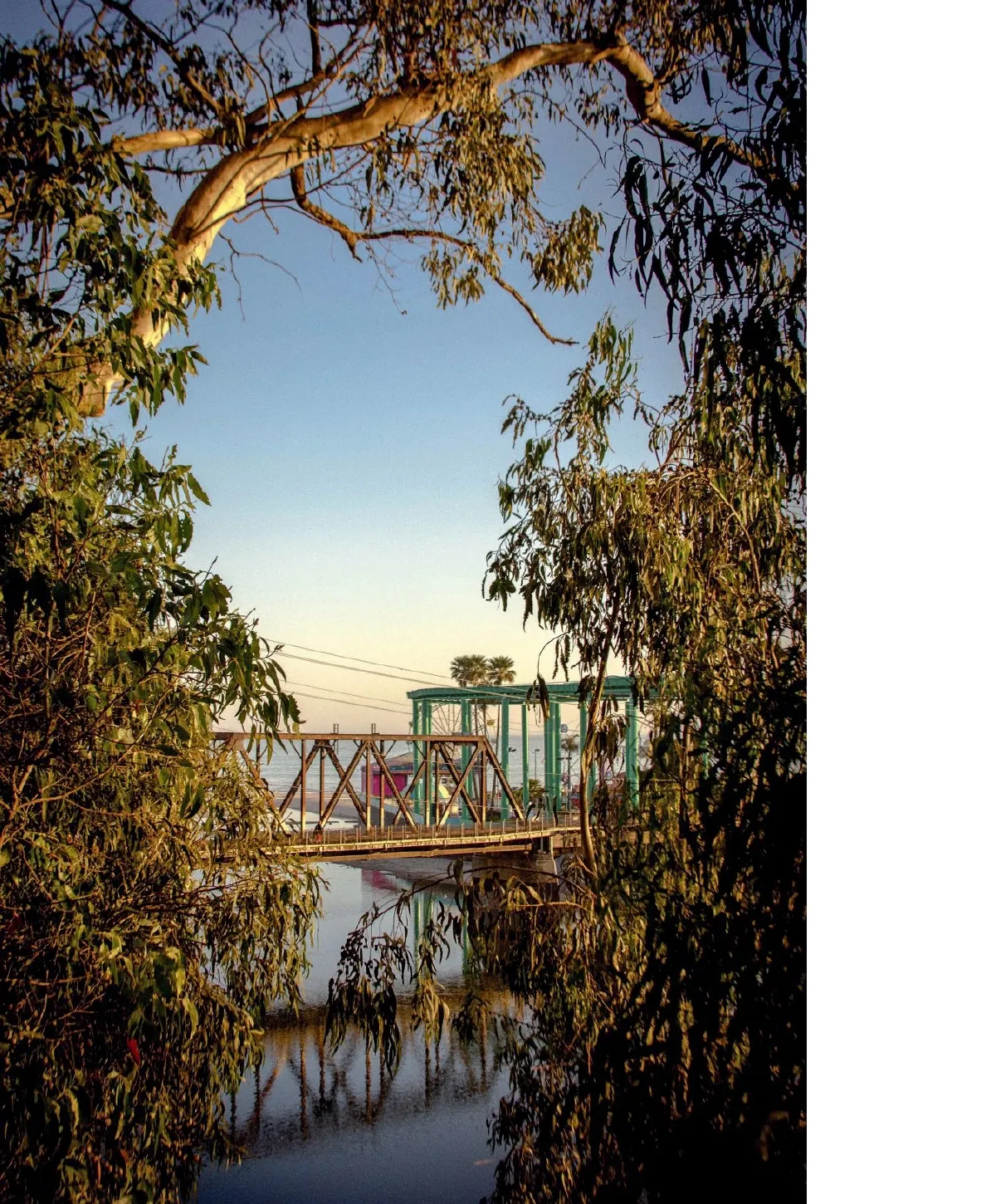
“A nd the story it told of a river that flowed, made me sad to think it was dead.” — “ The Horse with No Name,” an American song popular during a time when the San Lorenzo River still had fish in it. Vampires are so hot right now, but think back to those ever-pale, never-dying vampires in The Lost Boys (1987) lead by bottle-blonde Kiefer Sutherland (channeling Billy Idol). They’re sexy, they’re deadly, they’re hot -blooded, tempting and taunting the mortal Michael, swinging under a foggy train bridge in “Santa Carla.” As a rumbling train menaces the menacing vamps, they squeak and squawk at Michael to hang with them—so to speak. Teetering between cold human mortality and hot vampire immortality, Michael lets go, taking a symbolic drop of faith into a new, eternal, bloody life: “Never grow old, never die.” HOT! But the fiction of that Lost Boys train bridge in Santa Carla in reality is the 115-year-old train trestle over the troubled waters of the San Lorenzo River, which runs through Santa Cruz, CA, and forms a boundary between the surf-arbitrary designations of “midtown” and the “west side.” The trestle connects Seabright to the Boardwalk with 300 feet of wood, steel, creosote, asbestos and other early 20th century toxicities, anchored on two concrete supports about 30 miles from the source of the river in the Santa Cruz Mountains, and about 1,000 feet from where those waters flow into Monterey Bay. The bridge provides a pedestrian walkway that over-looks the estuary of the San Lorenzo River, a changeable body of water that warps and woofs with tides, seasons, sandbars, swell, heavy equipment, floods, droughts, sewage spills, civic needs—and little kids making dams. There was a time when the estuary was loaded with sal-monids—fresh out of the salty Pacific blue and into the brack—shake, shake, shaking off the relentless ocean perils of sharks and orcas and ravenous pinnipeds, and now facing a different threat: humans in boots and boats using a wide variety of weaponry to claim them—dyna-mite, spears, salmon eggs, lures, flies. All those silvery, strong fish holding in the estuary, waiting for rain, with one thing on their minds—swim-ming hard upstream to get some. The San Lorenzo es-tuary was like the waiting room in a bordello for steel-head, coho salmon and other anadromous fish—the river was famed around the city, the county, the state, the country and even the world as the finest fishing river south of the Golden Gate. From the Gold Rush circa 1848 to just before the Silicon Rush circa 2000, the San Lorenzo was renowned as home and habitat to tens of thousands of healthy, vital steelhead and coho salmon, according to everything from the San Lorenzo Valley Water District to Wikipedia to the Santa Cruz Sentinel to local legend. But that was then and this is now, and well into the Silicon Rush of the 21st Century, the fish population is coughing up blood, growing old and dying, ceasing to exist, unwell and perilously close to no more, threat-ened by a tiramisu of t y rannies : overdevelopment, overpopulation, overfishing, water diversion, water pollution and climate change. Home is not as sweet as home once was. LEFT This railroad trestle spanning the San Lorenzo River was built in 1904 by the Southern Pacific Railroad. The foreground’s eucalyptus trees are a frequent resting place for raptors, great blue heron and cormorants drying their wings and searching for their next meal. Photo: Crystal Birns HEY NINETEEN 72 Way back when in 1972, I was a fresh-faced, eager, wide-eyed transplant from the Valley, moved by di-vorce and an adventurous, VW-driving, semi-hippie mom from Santa Clara to Santa Cruz. My younger brother and I were displaced from a solid, stable and happy ’60s home to a whole new society—like Buck in Call of the Wild , and very much like Michael Emerson and his younger brother Sam in The Lost Boys . Divorce and broken homes have driven more than a few depressed kids to find solace in the secrets of the sea, and I was one of them. Mom bought a house on Plum and Owen in the Seabright area—aka mid-town—for about $25,000, a house that is now worth a million and a half and maybe more. She had a touch of Madame Winchester and couldn’t stop renovating, so she employed Dennis T., a surfer who listened to KFAT alternative radio relentlessly and relentlessly smoked Camel Unfiltereds and had the hacking death-cough to go with it. Dennis surfed the Yacht Harbor and the Rivermouth in the winter, and the Lane and up the coast the rest of the time. THE FLYFISH JOURNAL 047
The Flyfish Journal Volume 11, Issue 1: Page 47