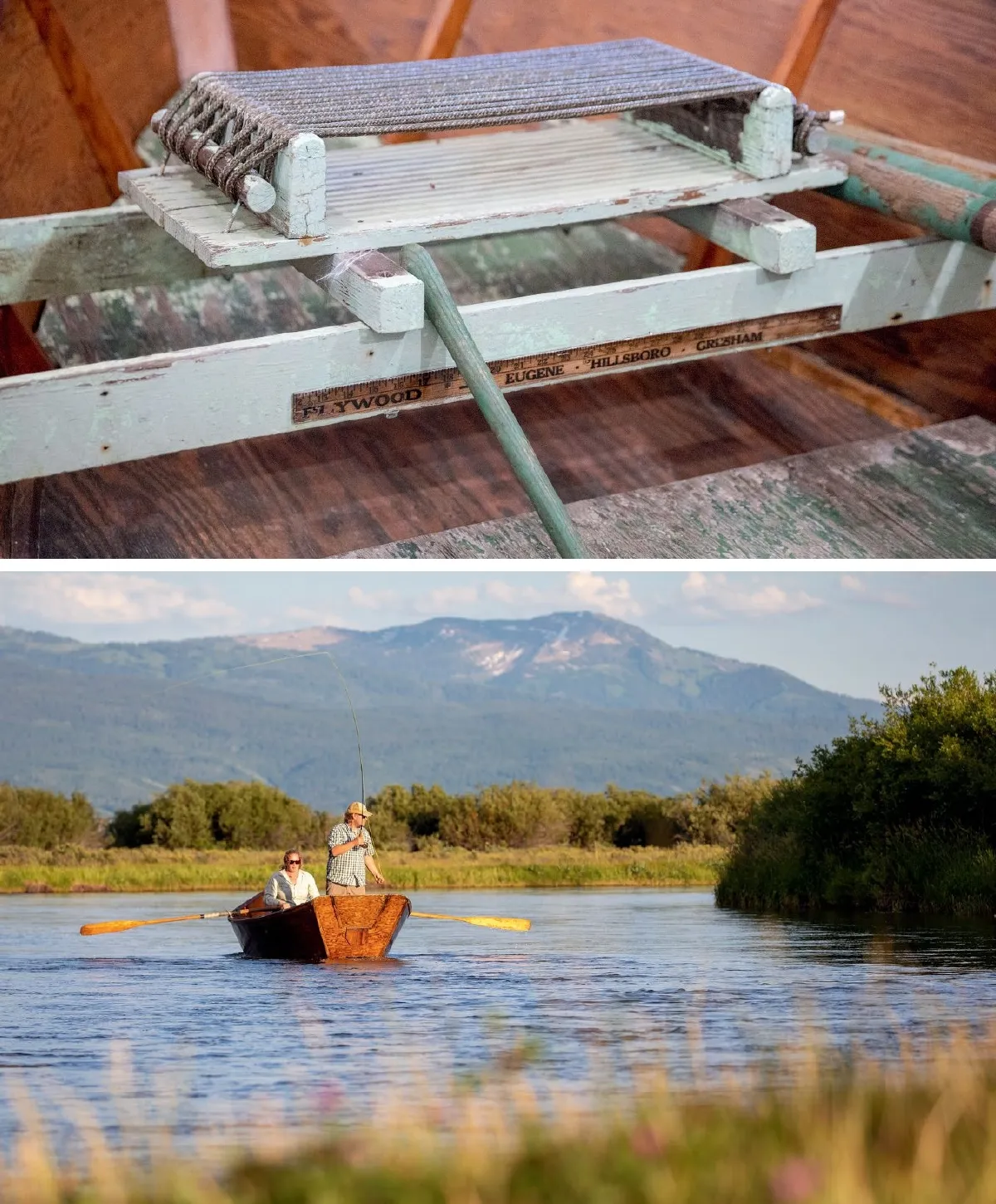
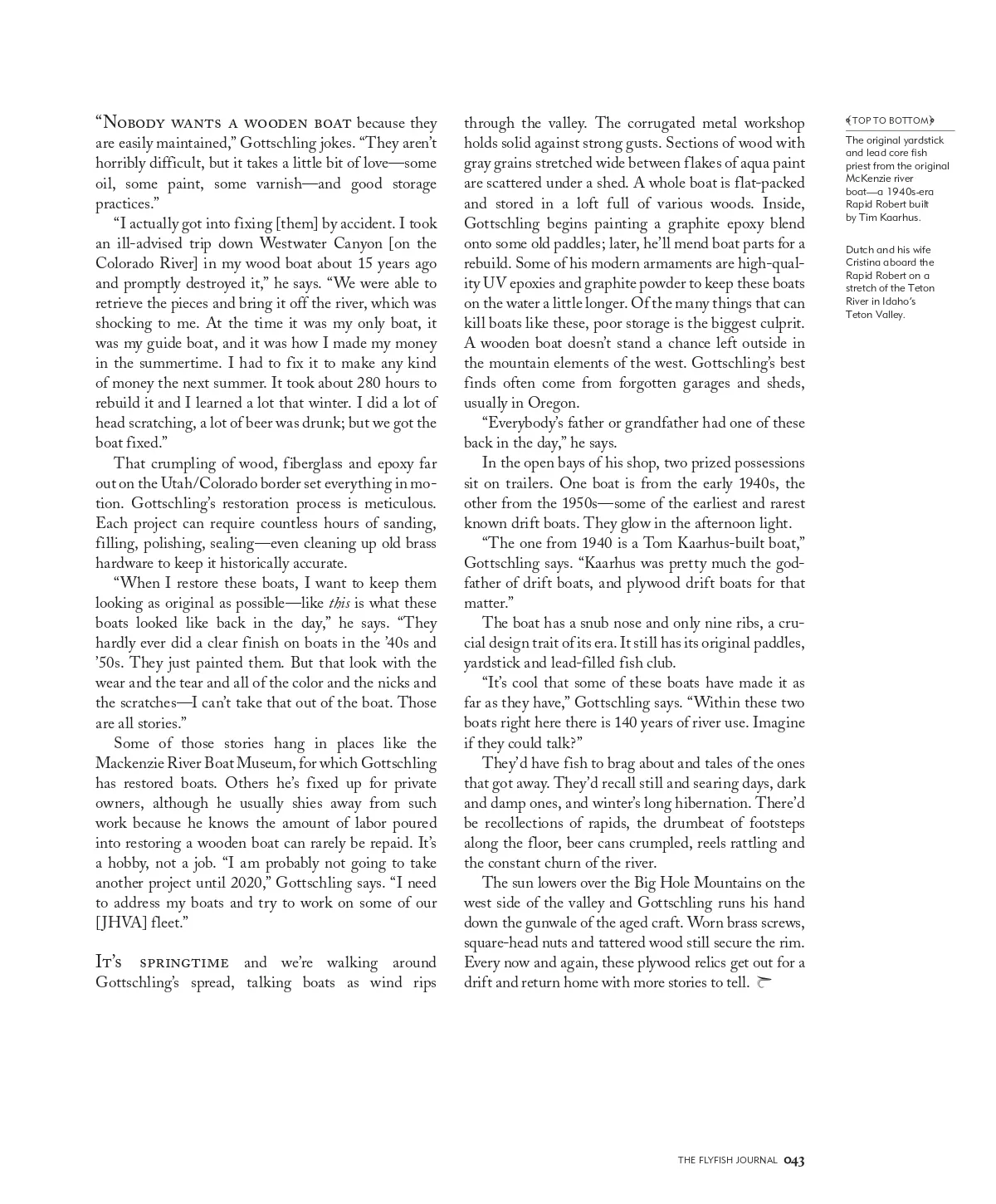
“Nobody wants a wooden boat because they are easily maintained,” Gottschling jokes. “They aren’t horribly difficult, but it takes a little bit of love—some oil, some paint, some varnish—and good storage practices.” “I actually got into fixing [them] by accident. I took an ill-advised trip down Westwater Canyon [on the Colorado River] in my wood boat about 15 years ago and promptly destroyed it,” he says. “We were able to retrieve the pieces and bring it off the river, which was shocking to me. At the time it was my only boat, it was my guide boat, and it was how I made my money in the summertime. I had to fix it to make any kind of money the next summer. It took about 280 hours to rebuild it and I learned a lot that winter. I did a lot of head scratching, a lot of beer was drunk; but we got the boat fixed.” That crumpling of wood, fiberglass and epoxy far out on the Utah/Colorado border set everything in mo-tion. Gottschling’s restoration process is meticulous. Each project can require countless hours of sanding, filling, polishing, sealing—even cleaning up old brass hardware to keep it historically accurate. “When I restore these boats, I want to keep them looking as original as possible—like this is what these boats looked like back in the day,” he says. “They hardly ever did a clear finish on boats in the ’40s and ’50s. They just painted them. But that look with the wear and the tear and all of the color and the nicks and the scratches—I can’t take that out of the boat. Those are all stories.” Some of those stories hang in places like the Mackenzie River Boat Museum, for which Gottschling has restored boats. Others he’s fixed up for private owners, although he usually shies away from such work because he knows the amount of labor poured into restoring a wooden boat can rarely be repaid. It’s a hobby, not a job. “I am probably not going to take another project until 2020,” Gottschling says. “I need to address my boats and try to work on some of our [JHVA] fleet.” It’s springtime and we’re walking around Gottschling’s spread, talking boats as wind rips through the valley. The corrugated metal workshop holds solid against strong gusts. Sections of wood with gray grains stretched wide between flakes of aqua paint are scattered under a shed. A whole boat is flat-packed and stored in a loft full of various woods. Inside, Gottschling begins painting a graphite epoxy blend onto some old paddles; later, he’ll mend boat parts for a rebuild. Some of his modern armaments are high-qual-ity UV epoxies and graphite powder to keep these boats on the water a little longer. Of the many things that can kill boats like these, poor storage is the biggest culprit. A wooden boat doesn’t stand a chance left outside in the mountain elements of the west. Gottschling’s best finds often come from forgotten garages and sheds, usually in Oregon. “Everybody’s father or grandfather had one of these back in the day,” he says. In the open bays of his shop, two prized possessions sit on trailers. One boat is from the early 1940s, the other from the 1950s—some of the earliest and rarest known drift boats. They glow in the afternoon light. “The one from 1940 is a Tom Kaarhus-built boat,” Gottschling says. “Kaarhus was pretty much the god-father of drift boats, and plywood drift boats for that matter.” The boat has a snub nose and only nine ribs, a cru-cial design trait of its era. It still has its original paddles, yardstick and lead-filled fish club. “It’s cool that some of these boats have made it as far as they have,” Gottschling says. “Within these two boats right here there is 140 years of river use. Imagine if they could talk?” They’d have fish to brag about and tales of the ones that got away. They’d recall still and searing days, dark and damp ones, and winter’s long hibernation. There’d be recollections of rapids, the drumbeat of footsteps along the floor, beer cans crumpled, reels rattling and the constant churn of the river. The sun lowers over the Big Hole Mountains on the west side of the valley and Gottschling runs his hand down the gunwale of the aged craft. Worn brass screws, square-head nuts and tattered wood still secure the rim. Every now and again, these plywood relics get out for a drift and return home with more stories to tell. TOP TO BOTTOM The original yardstick and lead core fish priest from the original McKenzie river boat—a 1940s-era Rapid Robert built by Tim Kaarhus. Dutch and his wife Cristina aboard the Rapid Robert on a stretch of the Teton River in Idaho’s Teton Valley. THE FLYFISH JOURNAL 043
The Flyfish Journal Volume 11, Issue 1: Page 43