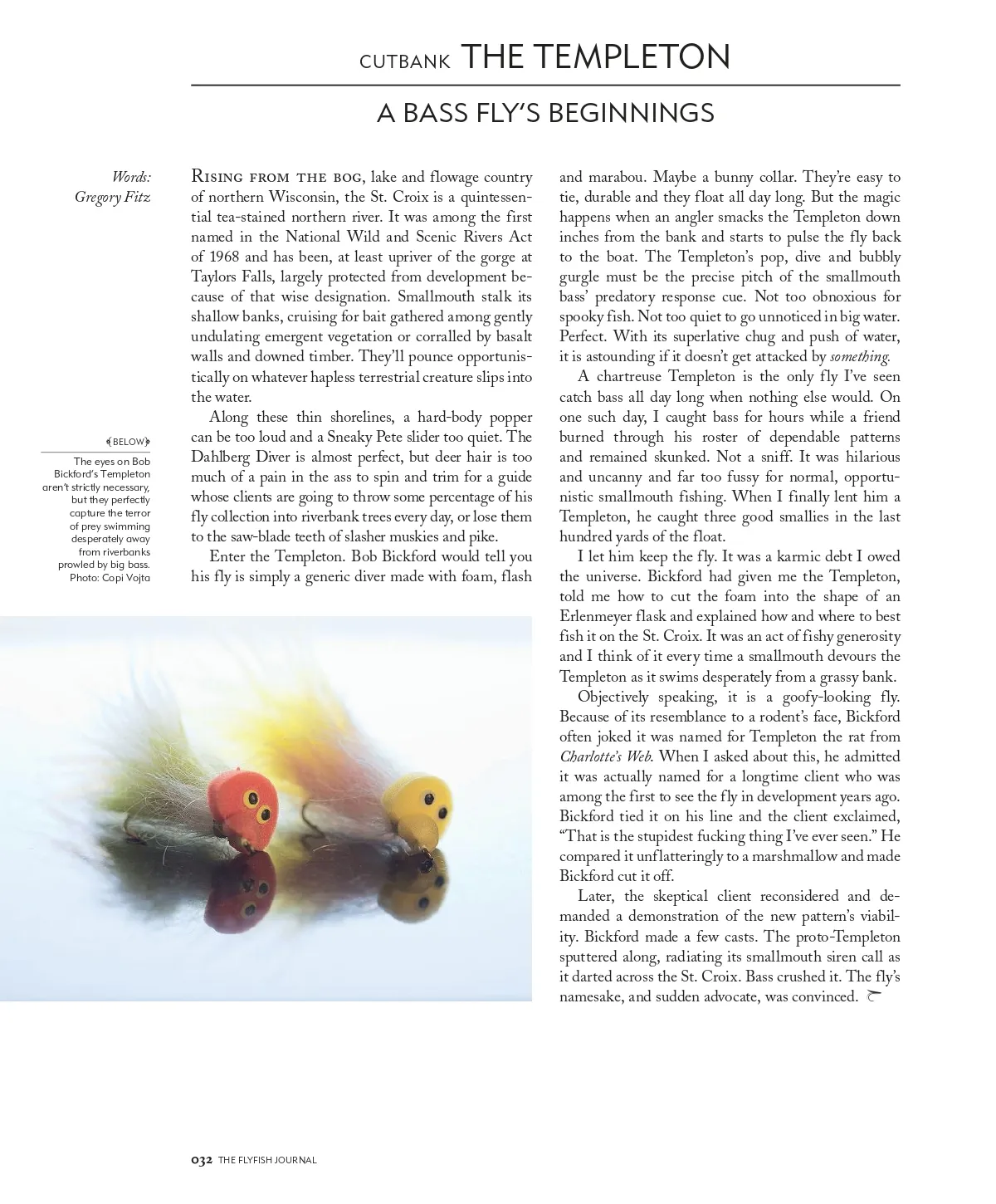
CUTBANK THE TEMPLETON A BASS FLY’S BEGINNINGS Words: Gregory Fitz Rising from the bog , lake and flowage country of northern Wisconsin, the St. Croix is a quintessen-tial tea-stained northern river. It was among the first named in the National Wild and Scenic Rivers Act of 1968 and has been, at least upriver of the gorge at Taylors Falls, largely protected from development be-cause of that wise designation. Smallmouth stalk its shallow banks, cruising for bait gathered among gently undulating emergent vegetation or corralled by basalt walls and downed timber. They’ll pounce opportunis-tically on whatever hapless terrestrial creature slips into the water. Along these thin shorelines, a hard-body popper can be too loud and a Sneaky Pete slider too quiet. The Dahlberg Diver is almost perfect, but deer hair is too much of a pain in the ass to spin and trim for a guide whose clients are going to throw some percentage of his fly collection into riverbank trees every day, or lose them to the saw-blade teeth of slasher muskies and pike. Enter the Templeton. Bob Bickford would tell you his fly is simply a generic diver made with foam, flash BELOW The eyes on Bob Bickford’s Templeton aren’t strictly necessary, but they perfectly capture the terror of prey swimming desperately away from riverbanks prowled by big bass. Photo: Copi Vojta and marabou. Maybe a bunny collar. They’re easy to tie, durable and they float all day long. But the magic happens when an angler smacks the Templeton down inches from the bank and starts to pulse the fly back to the boat. The Templeton’s pop, dive and bubbly gurgle must be the precise pitch of the smallmouth bass’ predatory response cue. Not too obnoxious for spooky fish. Not too quiet to go unnoticed in big water. Perfect. With its superlative chug and push of water, it is astounding if it doesn’t get attacked by something. A chartreuse Templeton is the only fly I’ve seen catch bass all day long when nothing else would. On one such day, I caught bass for hours while a friend burned through his roster of dependable patterns and remained skunked. Not a sniff. It was hilarious and uncanny and far too fussy for normal, opportu-nistic smallmouth fishing. When I finally lent him a Templeton, he caught three good smallies in the last hundred yards of the float. I let him keep the fly. It was a karmic debt I owed the universe. Bickford had given me the Templeton, told me how to cut the foam into the shape of an Erlenmeyer flask and explained how and where to best fish it on the St. Croix. It was an act of fishy generosity and I think of it every time a smallmouth devours the Templeton as it swims desperately from a grassy bank. Objectively speaking, it is a goofy-looking fly. Because of its resemblance to a rodent’s face, Bickford often joked it was named for Templeton the rat from Charlotte’s Web . When I asked about this, he admitted it was actually named for a longtime client who was among the first to see the fly in development years ago. Bickford tied it on his line and the client exclaimed, “That is the stupidest fucking thing I’ve ever seen.” He compared it unflatteringly to a marshmallow and made Bickford cut it off. Later, the skeptical client reconsidered and de-manded a demonstration of the new pattern’s viabil-ity. Bickford made a few casts. The proto-Templeton sputtered along, radiating its smallmouth siren call as it darted across the St. Croix. Bass crushed it. The fly’s namesake, and sudden advocate, was convinced. 032 THE FLYFISH JOURNAL
The Flyfish Journal Volume 11, Issue 1: Page 32