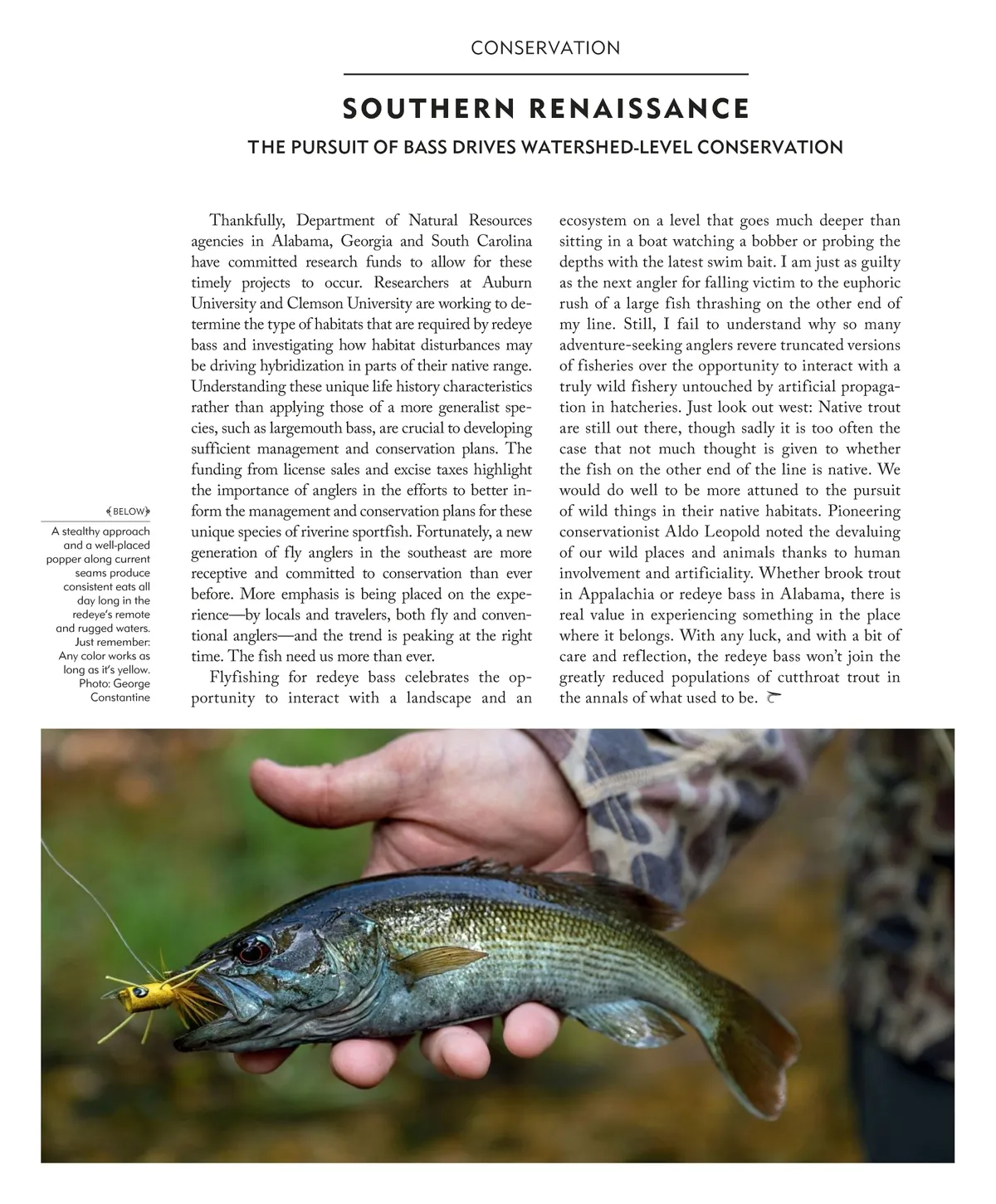
CONSERVATION SOUTHERN RENAISSANCE THE PURSUIT OF BASS DRIVES WATERSHED-LEVEL CONSERVATION • BELOW • A stealthy approach and a well-placed popper along current seams produce consistent eats all day long in the redeye’s remote and rugged waters. Just remember: Any color works as long as it’s yellow. Photo: George Constantine Thankfully, Department of Natural Resources agencies in Alabama, Georgia and South Carolina have committed research funds to allow for these timely projects to occur. Researchers at Auburn University and Clemson University are working to de-termine the type of habitats that are required by redeye bass and investigating how habitat disturbances may be driving hybridization in parts of their native range. Understanding these unique life history characteristics rather than applying those of a more generalist spe-cies, such as largemouth bass, are crucial to developing sufficient management and conservation plans. The funding from license sales and excise taxes highlight the importance of anglers in the efforts to better in-form the management and conservation plans for these unique species of riverine sportfish. Fortunately, a new generation of fly anglers in the southeast are more receptive and committed to conservation than ever before. More emphasis is being placed on the expe-rience—by locals and travelers, both fly and conven-tional anglers—and the trend is peaking at the right time. The fish need us more than ever. Flyfishing for redeye bass celebrates the op-portunity to interact with a landscape and an ecosystem on a level that goes much deeper than sitting in a boat watching a bobber or probing the depths with the latest swim bait. I am just as guilty as the next angler for falling victim to the euphoric rush of a large fish thrashing on the other end of my line. Still, I fail to understand why so many adventure-seeking anglers revere truncated versions of fisheries over the opportunity to interact with a truly wild fishery untouched by artificial propaga-tion in hatcheries. Just look out west: Native trout are still out there, though sadly it is too often the case that not much thought is given to whether the fish on the other end of the line is native. We would do well to be more attuned to the pursuit of wild things in their native habitats. Pioneering conservationist Aldo Leopold noted the devaluing of our wild places and animals thanks to human involvement and artificiality. Whether brook trout in Appalachia or redeye bass in Alabama, there is real value in experiencing something in the place where it belongs. With any luck, and with a bit of care and reflection, the redeye bass won’t join the greatly reduced populations of cutthroat trout in the annals of what used to be.
The Flyfish Journal The Flyfish Journal 15.4: Page 98