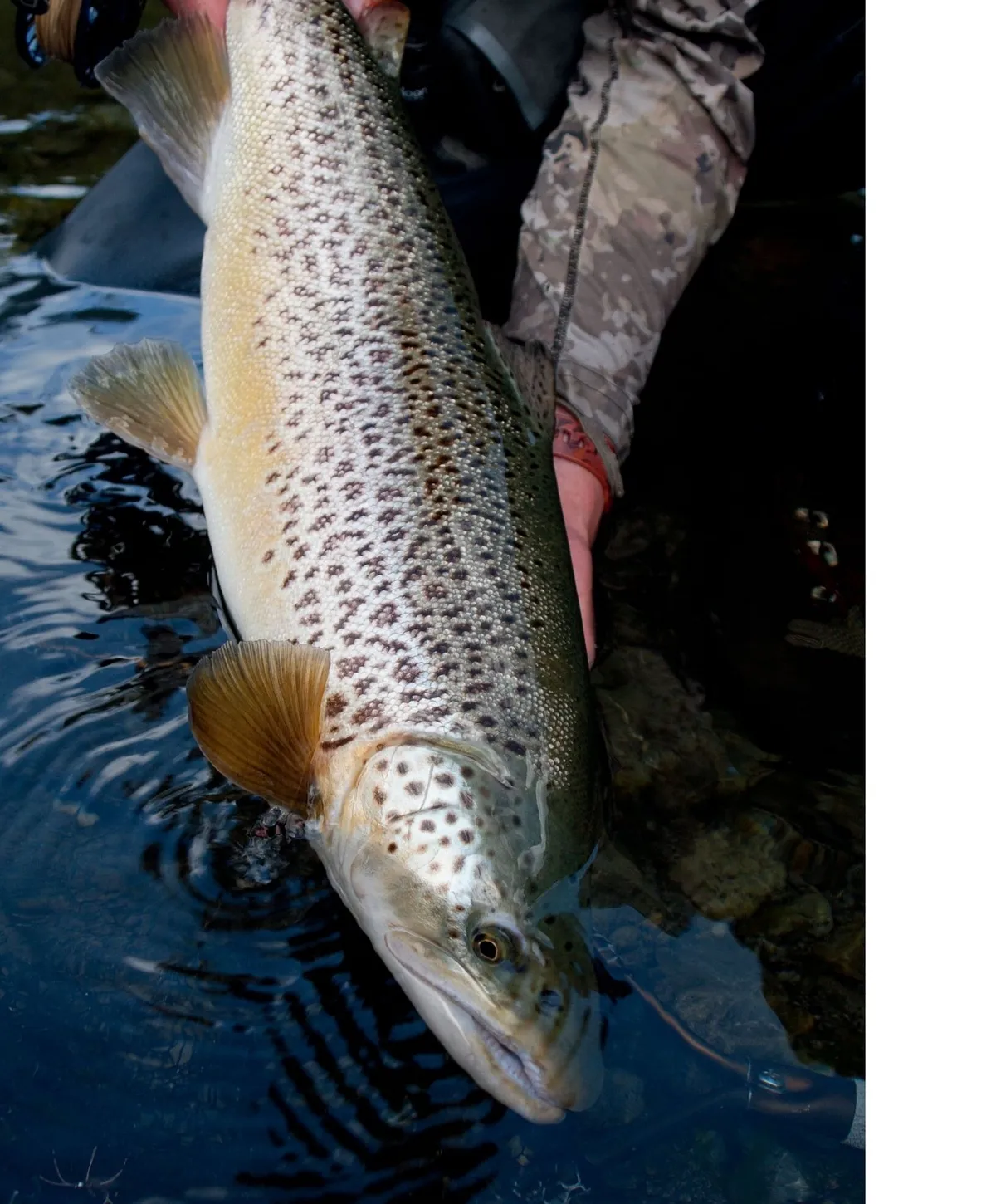
The summer had been hot and the water was low; large, pale, medicine-ball-sized stones, once part of the riverbed, now formed the bank and we boulder-hopped our way from pool to pool. Johnny is younger, fitter and more accustomed to this terrain and we fell into a happy rhythm—well, happy for me—of him outpacing me between pools and then sussing out the opportunities ahead of my arrival. I would lift my head from my hopscotching ap-proach to assess the situation. Sometimes Johnny would simply be waiting, no fish, but at others he would be frozen like a German pointer, gaze held mid-river, before slowly sinking to his haunches. He would put his hand palm-down, as I neared, indicat-ing “fish at home.” We had done battle with a couple of smaller rainbows in the 3-pound range, one lost, one caught, when this happy scenario played out beneath a steepling cliff face that had witnessed a recent landslide. A now-deceased tree was halfway down that slide, about 50 feet above us, and the tor-rent of scree and debris that had accompanied its descent had changed the character of the river be-low. Water finds a way, of course, and it had simply diverted around this fresh deposit and reformed a channel. Just below, a small stream entered. “Brown,” Johnny said, pointing to a smudgy shape holding a little way down from where the stream came in. With the water low, many of the fish were stationing themselves in faster, more oxygenated wa-ter, which made spotting trickier. Having just about made out the fish after asking for the third time, I listened as Johnny outlined the plan of attack. Anticipation building, I made my way 50 yards downstream in the crouched, scuffling fashion of a soldier moving house-to-house avoiding fire, before hooking a 90-degree turn and entering the river as stealthily as I could with excitable feet. With my angles altered I called for direction as I made my way back upstream. “He still there?” “Yep. You see that big dry rock entering the water just up to your right?” “Yes.” “You see the two currents coming together up-stream of that?” “Yes.” “Aim for that V, he’s just downstream of that.” With the clarity of the water, leaders 18-to 20-feet long and accurate casting are imperative. Your first cast is the most important as you might not get a second. I’m not going to lie and say I nailed every cast—I d idn’t—but this one landed w ith appreciable grace in a mirror-like bit of water between the two currents and my blue humpy began drifting lazily back toward me. As it did so a muscular silhouette rose with unhurried confidence through the water column in time to the rising exhilaration in me, and then a big triangular snout appeared where my dry fly had been moments before. A pause, and I lifted. In the countless flyfishing videos we all watch they simulate this moment well, slowing down the foot-age, removing the sound, as the fish takes and the angler raises their rod. This is the moment. This is the moment you’ve driven half a day for, the moment you’ve been daydreaming about while work colleagues thought they were talking to you, the moment that has compelled you to spend more money on gear than you’d ever admit to your wife, husband or yourself. You’re now directly connected to six pounds of very angry trout in full flight mode. All hell breaks loose. Big fish in small, gin-clear water present many chal-lenges; you overcome one simply to reach another. Any momentary satisfaction at hooking up better quickly be replaced by a renewed focus or you’ll be left with slack line, a straightened rod and some choice words drifting away on the mountain air. The big brown barrelled its way through the length of the pool and up into the shallow water at its head. I jumped out onto the bankside boulders and followed as quickly as I could with arched rod held high. The fish was now trying to thump through a stretch that was more rock than water. Spray plumed into the air as its paddle tail thrust powerfully, body half-in and half-out of the water like a salmon run-ning up to spawn, its olive back, golden flanks and fat black spots glinting in the sun. • LEFT • The North Island headwater catchment this cracking fish calls home is known for its rugged isolation and prolific greywacke sandstone. With gin-clear water and consistent streambed color, resident fish take on a distinctive grey/green camouflage. The fin perfect specimen accepted a metallic blue blowfly—the go-to dry fly for guide Johnny Gummer. Photo: James Fuller THE FLYFISH JOURNAL 075
The Flyfish Journal The Flyfish Journal 15.4: Page 73