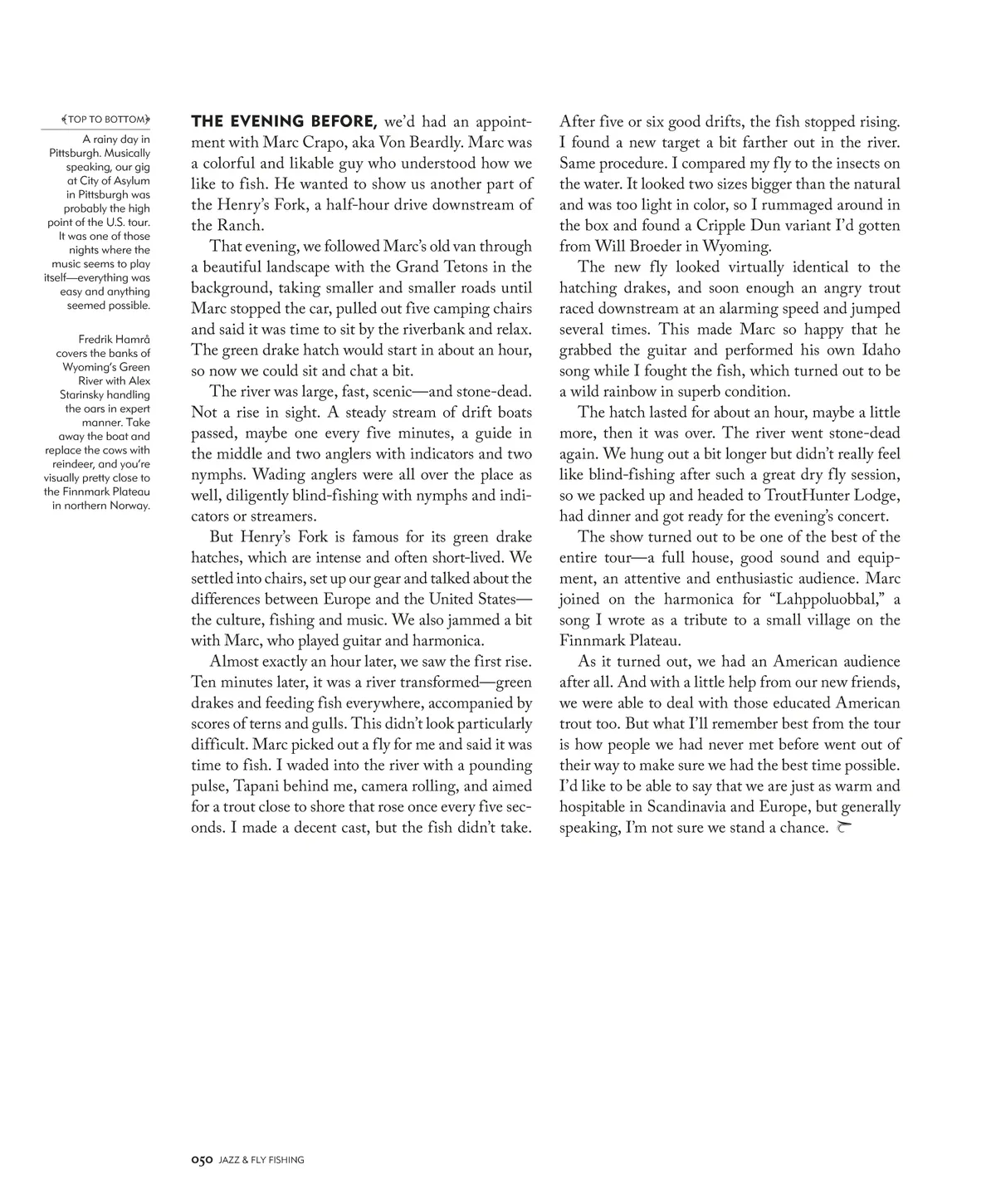
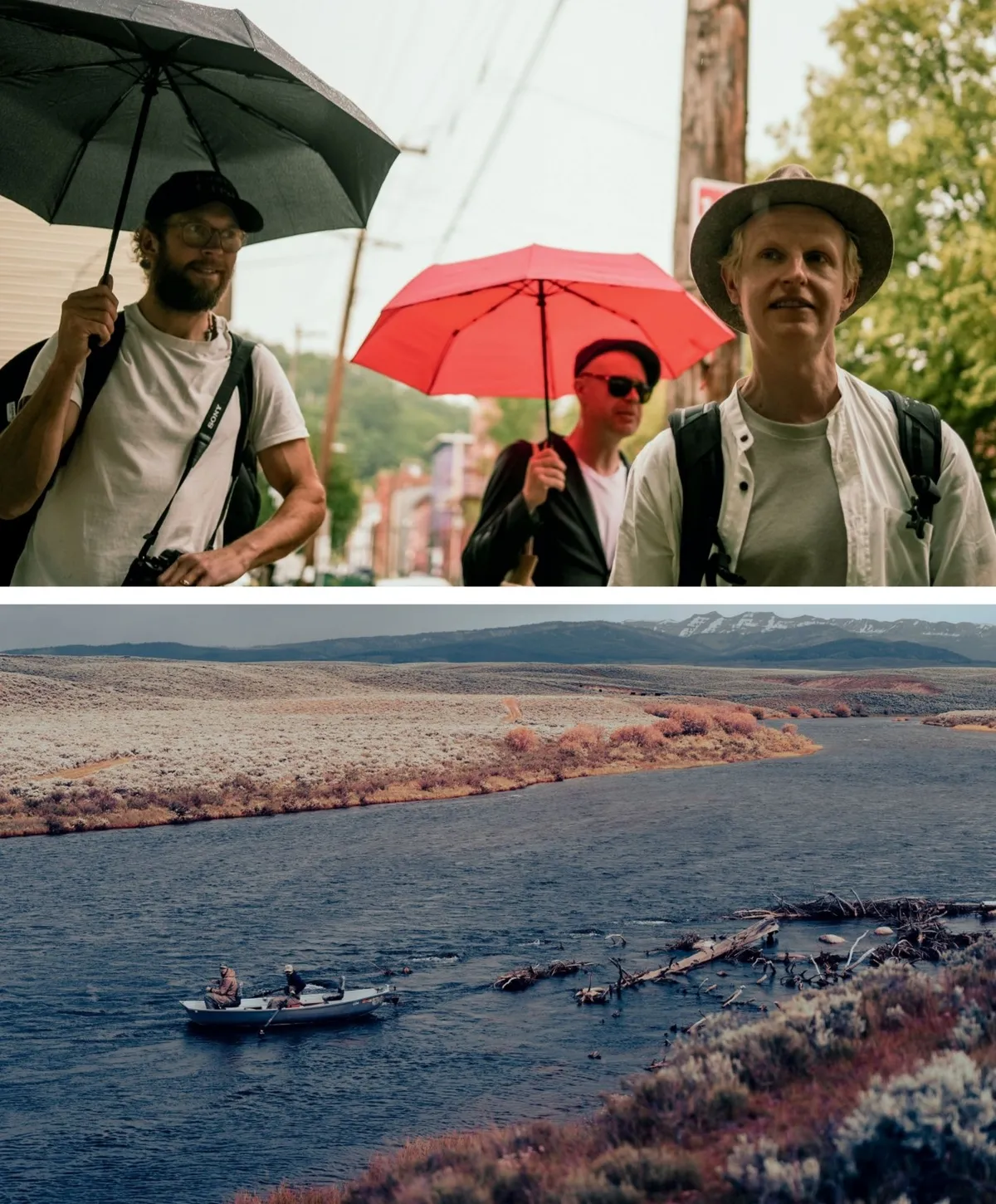
• TOP TO BOTTOM • A rainy day in Pittsburgh. Musically speaking, our gig at City of Asylum in Pittsburgh was probably the high point of the U.S. tour. It was one of those nights where the music seems to play itself—everything was easy and anything seemed possible. Fredrik Hamrå covers the banks of Wyoming’s Green River with Alex Starinsky handling the oars in expert manner. Take away the boat and replace the cows with reindeer, and you’re visually pretty close to the Finnmark Plateau in northern Norway. THE EVENING BEFORE, we’d had an appoint-ment with Marc Crapo, aka Von Beardly. Marc was a colorful and likable guy who understood how we like to fish. He wanted to show us another part of the Henry’s Fork, a half-hour drive downstream of the Ranch. That evening, we followed Marc’s old van through a beautiful landscape with the Grand Tetons in the background, taking smaller and smaller roads until Marc stopped the car, pulled out five camping chairs and said it was time to sit by the riverbank and relax. The green drake hatch would start in about an hour, so now we could sit and chat a bit. The river was large, fast, scenic—and stone-dead. Not a rise in sight. A steady stream of drift boats passed, maybe one every five minutes, a guide in the middle and two anglers with indicators and two nymphs. Wading anglers were all over the place as well, diligently blind-fishing with nymphs and indi-cators or streamers. But Henry’s Fork is famous for its green drake hatches, which are intense and often short-lived. We settled into chairs, set up our gear and talked about the differences between Europe and the United States— the culture, fishing and music. We also jammed a bit with Marc, who played guitar and harmonica. Almost exactly an hour later, we saw the first rise. Ten minutes later, it was a river transformed—green drakes and feeding fish everywhere, accompanied by scores of terns and gulls. This didn’t look particularly difficult. Marc picked out a fly for me and said it was time to fish. I waded into the river with a pounding pulse, Tapani behind me, camera rolling, and aimed for a trout close to shore that rose once every five sec-onds. I made a decent cast, but the fish didn’t take. After five or six good drifts, the fish stopped rising. I found a new target a bit farther out in the river. Same procedure. I compared my fly to the insects on the water. It looked two sizes bigger than the natural and was too light in color, so I rummaged around in the box and found a Cripple Dun variant I’d gotten from Will Broeder in Wyoming. The new fly looked virtually identical to the hatching drakes, and soon enough an angry trout raced downstream at an alarming speed and jumped several times. This made Marc so happy that he grabbed the guitar and performed his own Idaho song while I fought the fish, which turned out to be a wild rainbow in superb condition. The hatch lasted for about an hour, maybe a little more, then it was over. The river went stone-dead again. We hung out a bit longer but didn’t really feel like blind-fishing after such a great dry fly session, so we packed up and headed to TroutHunter Lodge, had dinner and got ready for the evening’s concert. The show turned out to be one of the best of the entire tour—a full house, good sound and equip-ment, an attentive and enthusiastic audience. Marc joined on the harmonica for “Lahppoluobbal,” a song I wrote as a tribute to a small village on the Finnmark Plateau. As it turned out, we had an American audience after all. And with a little help from our new friends, we were able to deal with those educated American trout too. But what I’ll remember best from the tour is how people we had never met before went out of their way to make sure we had the best time possible. I’d like to be able to say that we are just as warm and hospitable in Scandinavia and Europe, but generally speaking, I’m not sure we stand a chance. 050 JAZZ & FLY FISHING
The Flyfish Journal The Flyfish Journal 15.4: Page 48