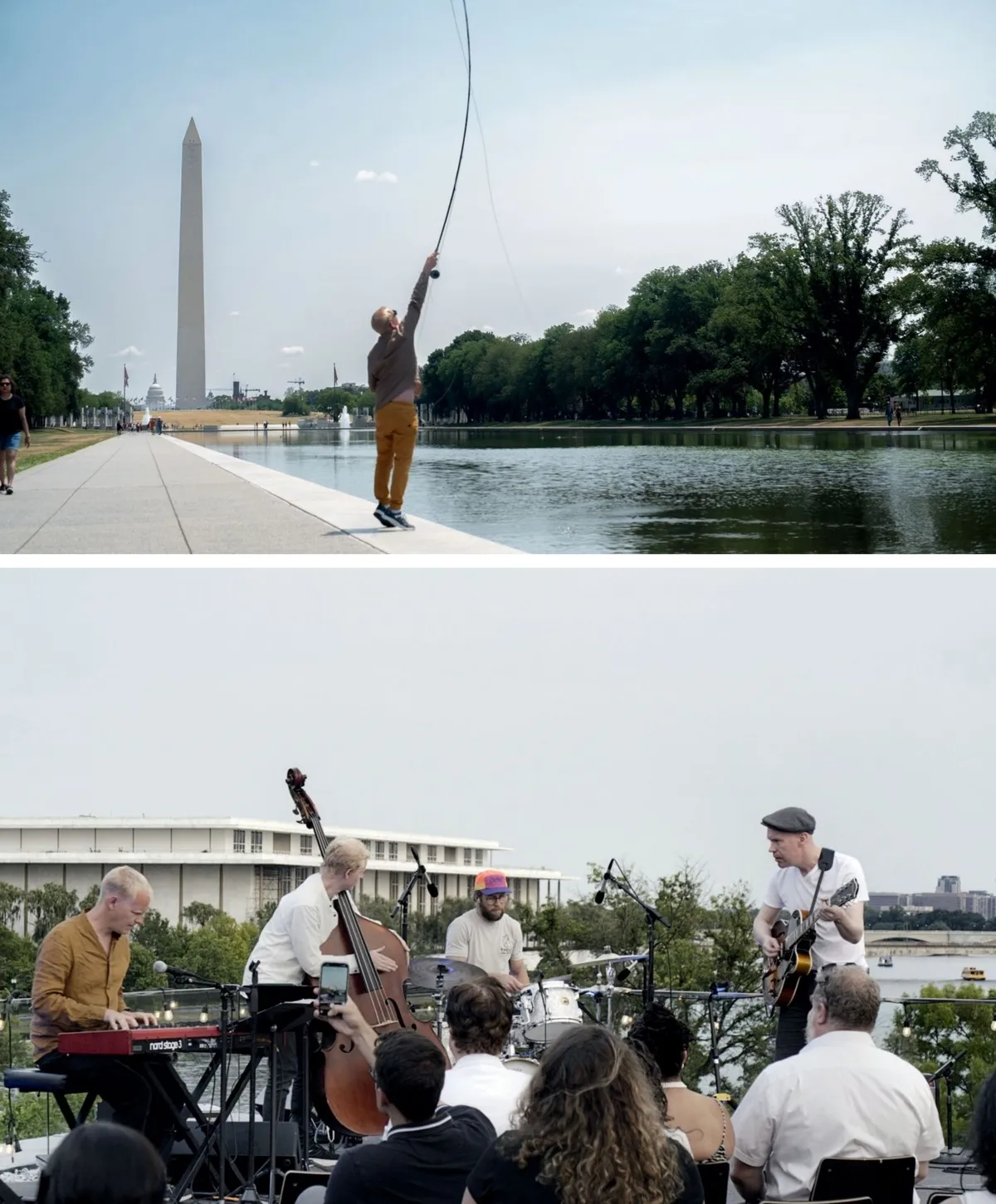
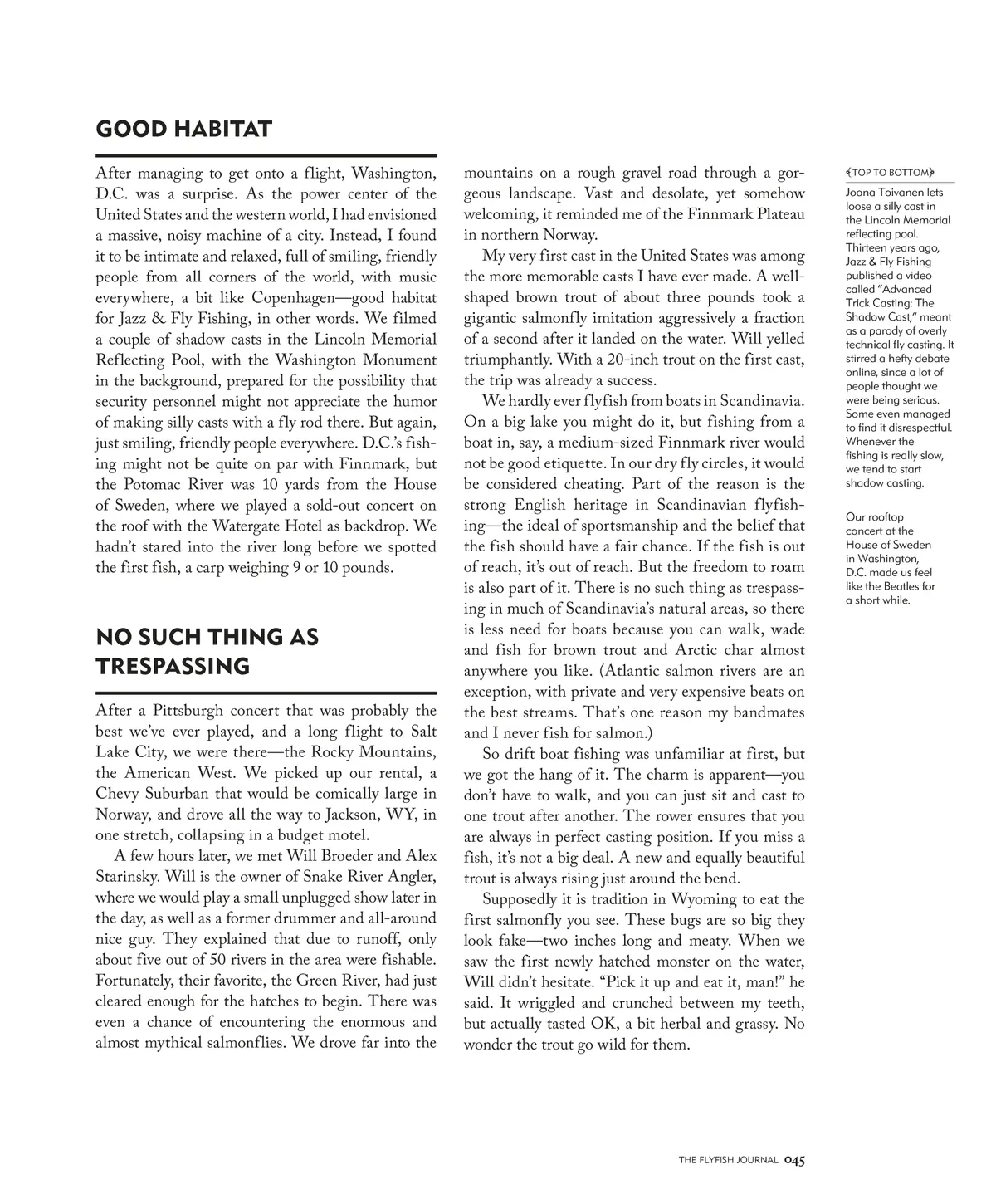
GOOD HABITAT After managing to get onto a flight, Washington, D.C. was a surprise. As the power center of the United States and the western world, I had envisioned a massive, noisy machine of a city. Instead, I found it to be intimate and relaxed, full of smiling, friendly people from all corners of the world, with music everywhere, a bit like Copenhagen—good habitat for Jazz & Fly Fishing, in other words. We filmed a couple of shadow casts in the Lincoln Memorial Reflecting Pool, with the Washington Monument in the background, prepared for the possibility that security personnel might not appreciate the humor of making silly casts with a fly rod there. But again, just smiling, friendly people everywhere. D.C.’s fish-ing might not be quite on par with Finnmark, but the Potomac River was 10 yards from the House of Sweden, where we played a sold-out concert on the roof with the Watergate Hotel as backdrop. We hadn’t stared into the river long before we spotted the first fish, a carp weighing 9 or 10 pounds. mountains on a rough gravel road through a gor-geous landscape. Vast and desolate, yet somehow welcoming, it reminded me of the Finnmark Plateau in northern Norway. My very first cast in the United States was among the more memorable casts I have ever made. A well-shaped brown trout of about three pounds took a gigantic salmonfly imitation aggressively a fraction of a second after it landed on the water. Will yelled triumphantly. With a 20-inch trout on the first cast, the trip was already a success. We hardly ever flyfish from boats in Scandinavia. On a big lake you might do it, but fishing from a boat in, say, a medium-sized Finnmark river would not be good etiquette. In our dry fly circles, it would be considered cheating. Part of the reason is the strong English heritage in Scandinavian flyfish-ing—the ideal of sportsmanship and the belief that the fish should have a fair chance. If the fish is out of reach, it’s out of reach. But the freedom to roam is also part of it. There is no such thing as trespass-ing in much of Scandinavia’s natural areas, so there is less need for boats because you can walk, wade and fish for brown trout and Arctic char almost anywhere you like. (Atlantic salmon rivers are an exception, with private and very expensive beats on the best streams. That’s one reason my bandmates and I never fish for salmon.) So drift boat fishing was unfamiliar at first, but we got the hang of it. The charm is apparent—you don’t have to walk, and you can just sit and cast to one trout after another. The rower ensures that you are always in perfect casting position. If you miss a fish, it’s not a big deal. A new and equally beautiful trout is always rising just around the bend. Supposedly it is tradition in Wyoming to eat the first salmonfly you see. These bugs are so big they look fake—two inches long and meaty. When we saw the first newly hatched monster on the water, Will didn’t hesitate. “Pick it up and eat it, man!” he said. It wriggled and crunched between my teeth, but actually tasted OK, a bit herbal and grassy. No wonder the trout go wild for them. • TOP TO BOTTOM • Joona Toivanen lets loose a silly cast in the Lincoln Memorial reflecting pool. Thirteen years ago, Jazz & Fly Fishing published a video called “Advanced Trick Casting: The Shadow Cast,” meant as a parody of overly technical fly casting. It stirred a hefty debate online, since a lot of people thought we were being serious. Some even managed to find it disrespectful. Whenever the fishing is really slow, we tend to start shadow casting. Our rooftop concert at the House of Sweden in Washington, D.C. made us feel like the Beatles for a short while. NO SUCH THING AS TRESPASSING After a Pittsburgh concert that was probably the best we’ve ever played, and a long flight to Salt Lake City, we were there—the Rocky Mountains, the American West. We picked up our rental, a Chevy Suburban that would be comically large in Norway, and drove all the way to Jackson, WY, in one stretch, collapsing in a budget motel. A few hours later, we met Will Broeder and Alex Starinsky. Will is the owner of Snake River Angler, where we would play a small unplugged show later in the day, as well as a former drummer and all-around nice guy. They explained that due to runoff, only about five out of 50 rivers in the area were fishable. Fortunately, their favorite, the Green River, had just cleared enough for the hatches to begin. There was even a chance of encountering the enormous and almost mythical salmonflies. We drove far into the THE FLYFISH JOURNAL 045
The Flyfish Journal The Flyfish Journal 15.4: Page 43