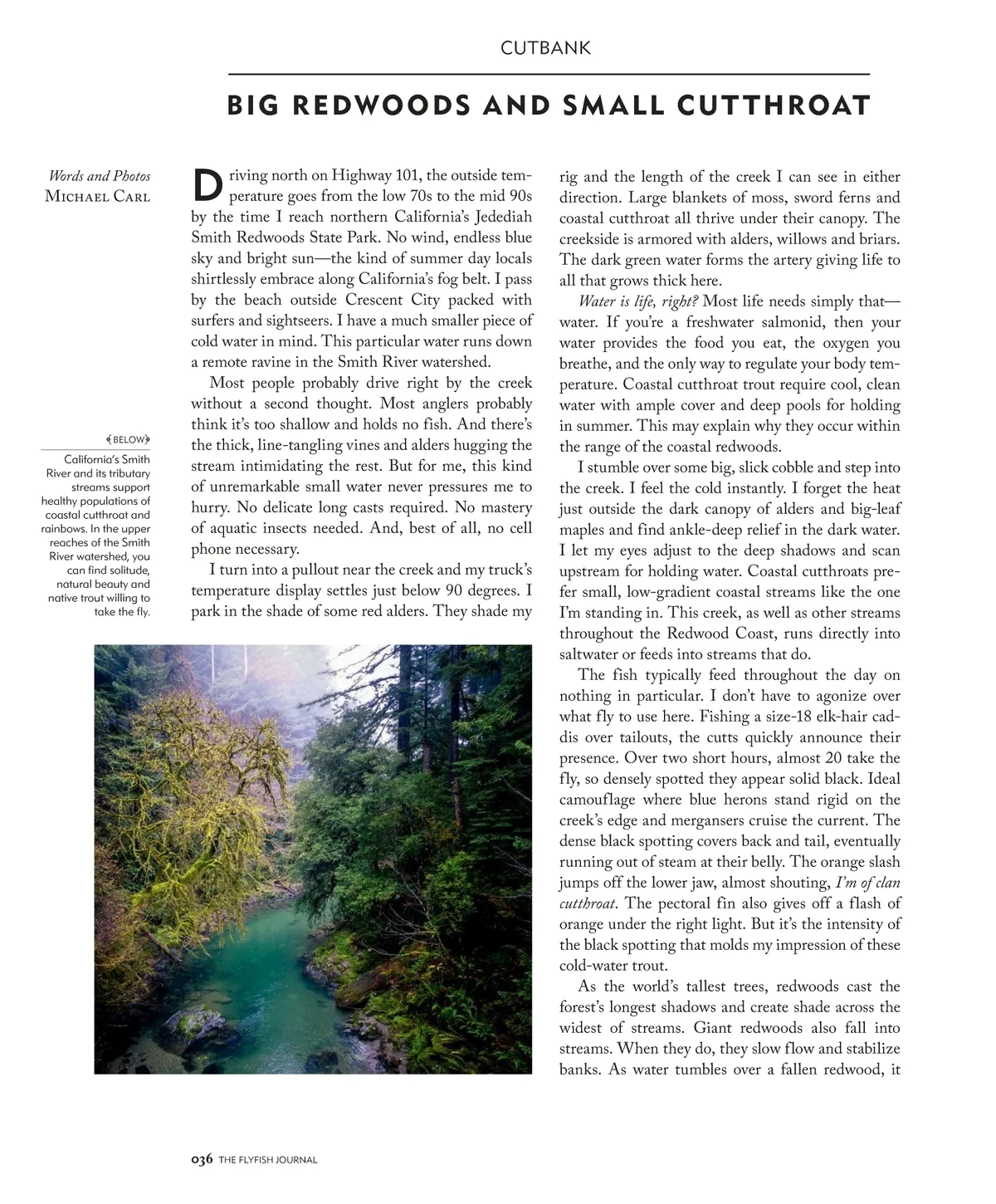
• LEFT TO RIGHT • An opportunity presented and an opportunistic eat by a native cutthroat. Fly selection isn’t as important as a clean drift. Walking past big trees in search of coastal cutts near Jedediah Smith Redwoods State Park in Northern California. eventually scours a deep pool. The bubble curtain of turbulence creates overhead cover from predators. Young trout and salmon seek out these pools where they ride out the low flows of summer. A redwood growing near a stream bank has no intention, no predetermined goal. But its cooling shade and its binding roots have consequence over time. Why do the cutthroat dwell here? Is it because of the giant trees? I’m betting their proximity is no accident. Just look at a map of the Pacific temper-ate rainforest. It’s basically the range map of coastal cutts. I have a strong feeling this forest, this place along the Pacific Ocean, built their house. Take out old-growth redwoods or mature Doug firs and that has consequence for all salmonids. Standing in the center of an intertwined world of branches, vines, leaves and mosses, I see new growth sprouting around moldering matter in decay. A small-ish black bird, probably a dipper, darts off a leafed is-land of wet rocks. I hold my gaze downstream, imag-ining the path of the dipper. The creek pours faintly through a shallow riffle and slows against a tangle of matted roots exposed within a cutbank. I filter cold creek water to drink and find a downed log uphol-stered in broom moss to sit on. I think back on the cutthroat’s black spotting. I imagine the spots blend-ing into the shadow world of this primeval rainforest, slipping completely undetected into the dark waters of this creek. Beyond camouflage, the spotting speaks to me of connection. It speaks of dedication. It speaks of dwelling in a place of dappled light and swimming under the shadows of great trees. THE FLYFISH JOURNAL 037
The Flyfish Journal The Flyfish Journal 15.4: Page 35