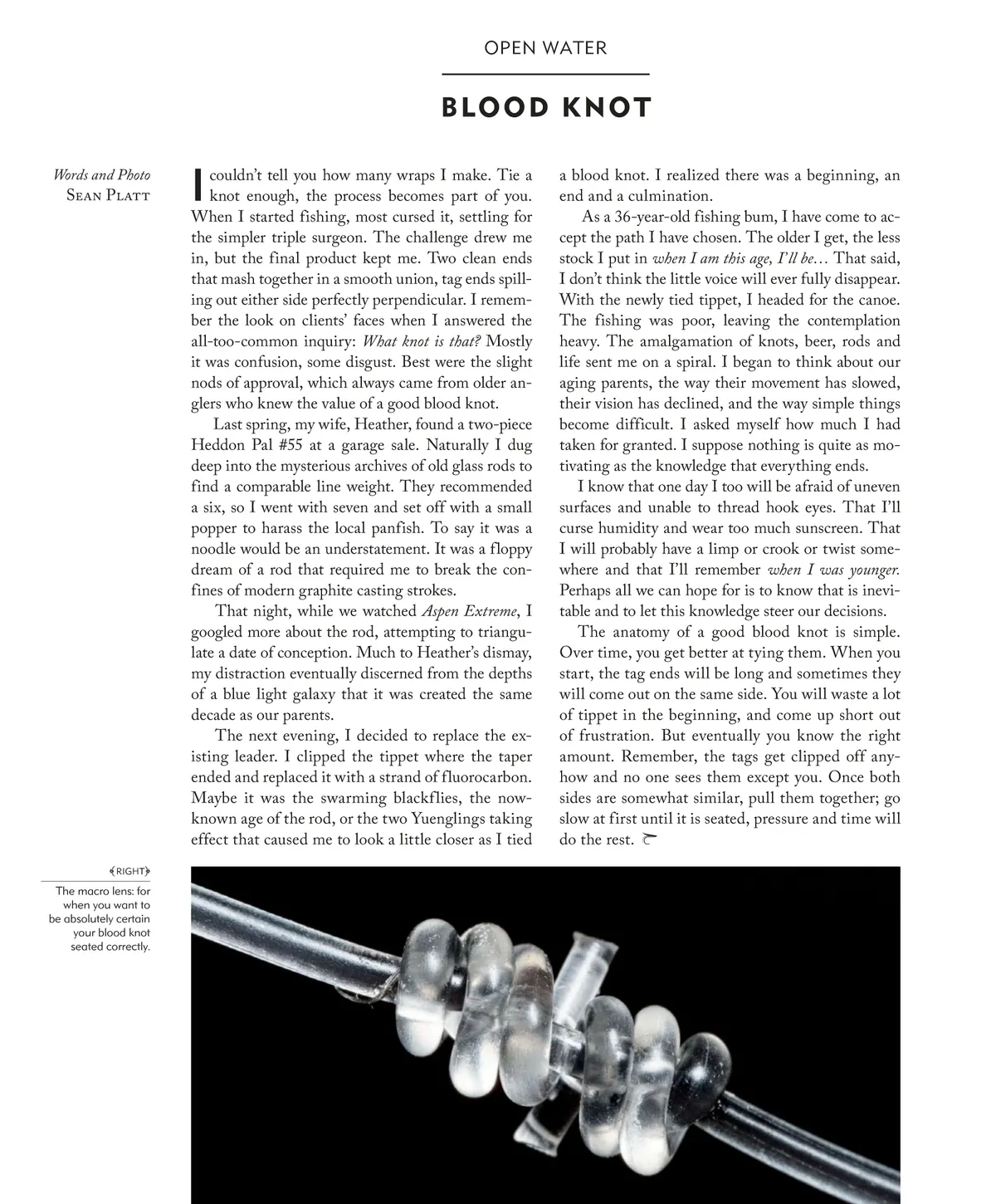
OPEN WATER BLOOD KNOT Words and Photo Sean Platt couldn’t tell you how many wraps I make. Tie a knot enough, the process becomes part of you. When I started fishing, most cursed it, settling for the simpler triple surgeon. The challenge drew me in, but the final product kept me. Two clean ends that mash together in a smooth union, tag ends spill-ing out either side perfectly perpendicular. I remem-ber the look on clients’ faces when I answered the all-too-common inquiry: What knot is that? Mostly it was confusion, some disgust. Best were the slight nods of approval, which always came from older an-glers who knew the value of a good blood knot. Last spring, my wife, Heather, found a two-piece Heddon Pal #55 at a garage sale. Naturally I dug deep into the mysterious archives of old glass rods to find a comparable line weight. They recommended a six, so I went with seven and set off with a small popper to harass the local panfish. To say it was a noodle would be an understatement. It was a floppy dream of a rod that required me to break the con-fines of modern graphite casting strokes. That night, while we watched Aspen Extreme , I googled more about the rod, attempting to triangu-late a date of conception. Much to Heather’s dismay, my distraction eventually discerned from the depths of a blue light galaxy that it was created the same decade as our parents. The next evening, I decided to replace the ex-isting leader. I clipped the tippet where the taper ended and replaced it with a strand of fluorocarbon. Maybe it was the swarming blackflies, the now-known age of the rod, or the two Yuenglings taking effect that caused me to look a little closer as I tied I a blood knot. I realized there was a beginning, an end and a culmination. As a 36-year-old fishing bum, I have come to ac-cept the path I have chosen. The older I get, the less stock I put in when I am this age, I’ll be… That said, I don’t think the little voice will ever fully disappear. With the newly tied tippet, I headed for the canoe. The fishing was poor, leaving the contemplation heavy. The amalgamation of knots, beer, rods and life sent me on a spiral. I began to think about our aging parents, the way their movement has slowed, their vision has declined, and the way simple things become difficult. I asked myself how much I had taken for granted. I suppose nothing is quite as mo-tivating as the knowledge that everything ends. I know that one day I too will be afraid of uneven surfaces and unable to thread hook eyes. That I’ll curse humidity and wear too much sunscreen. That I will probably have a limp or crook or twist some-where and that I’ll remember when I was younger. Perhaps all we can hope for is to know that is inevi-table and to let this knowledge steer our decisions. The anatomy of a good blood knot is simple. Over time, you get better at tying them. When you start, the tag ends will be long and sometimes they will come out on the same side. You will waste a lot of tippet in the beginning, and come up short out of frustration. But eventually you know the right amount. Remember, the tags get clipped off any-how and no one sees them except you. Once both sides are somewhat similar, pull them together; go slow at first until it is seated, pressure and time will do the rest. • RIGHT • The macro lens: for when you want to be absolutely certain your blood knot seated correctly.
The Flyfish Journal The Flyfish Journal 15.4: Page 30