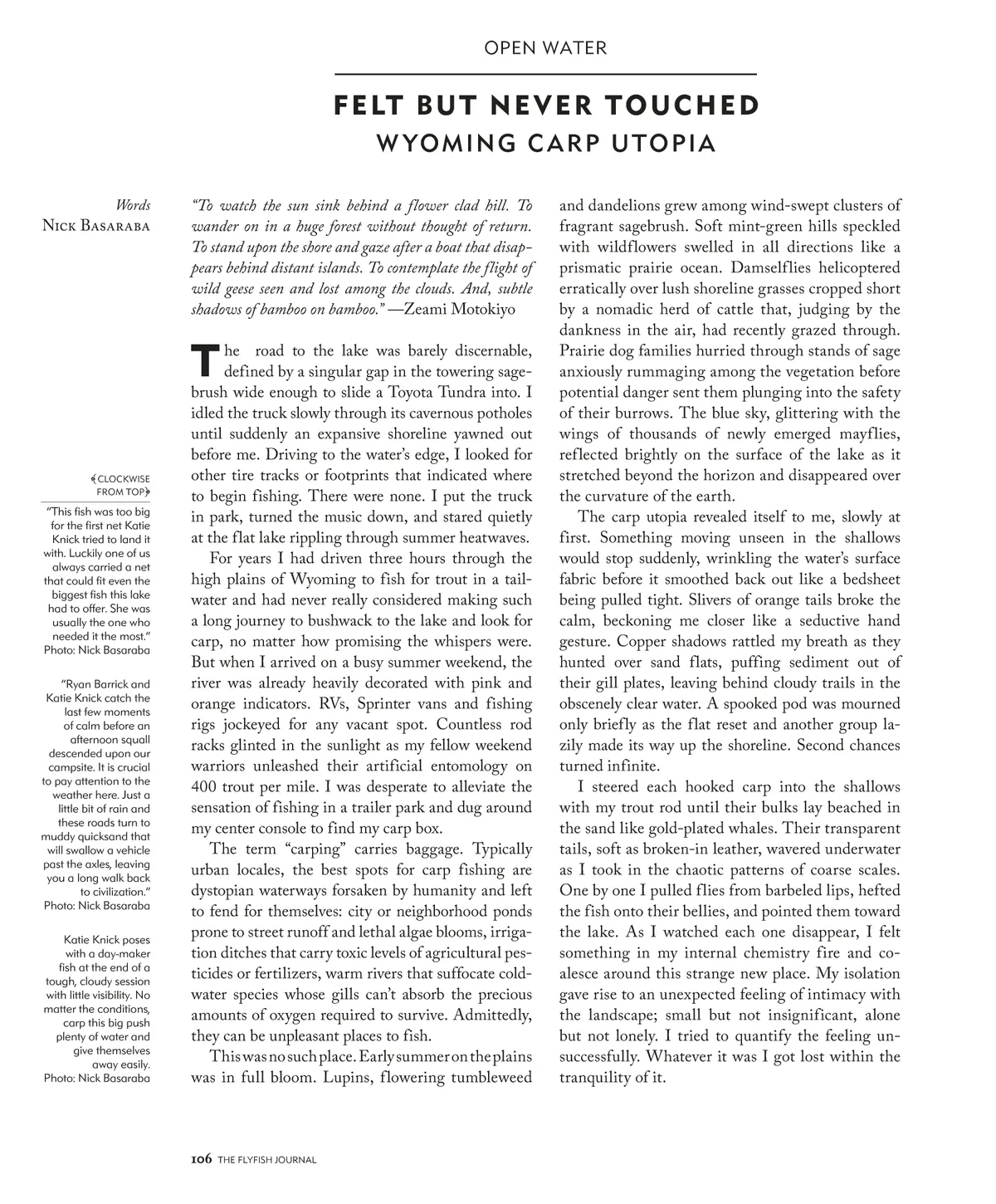
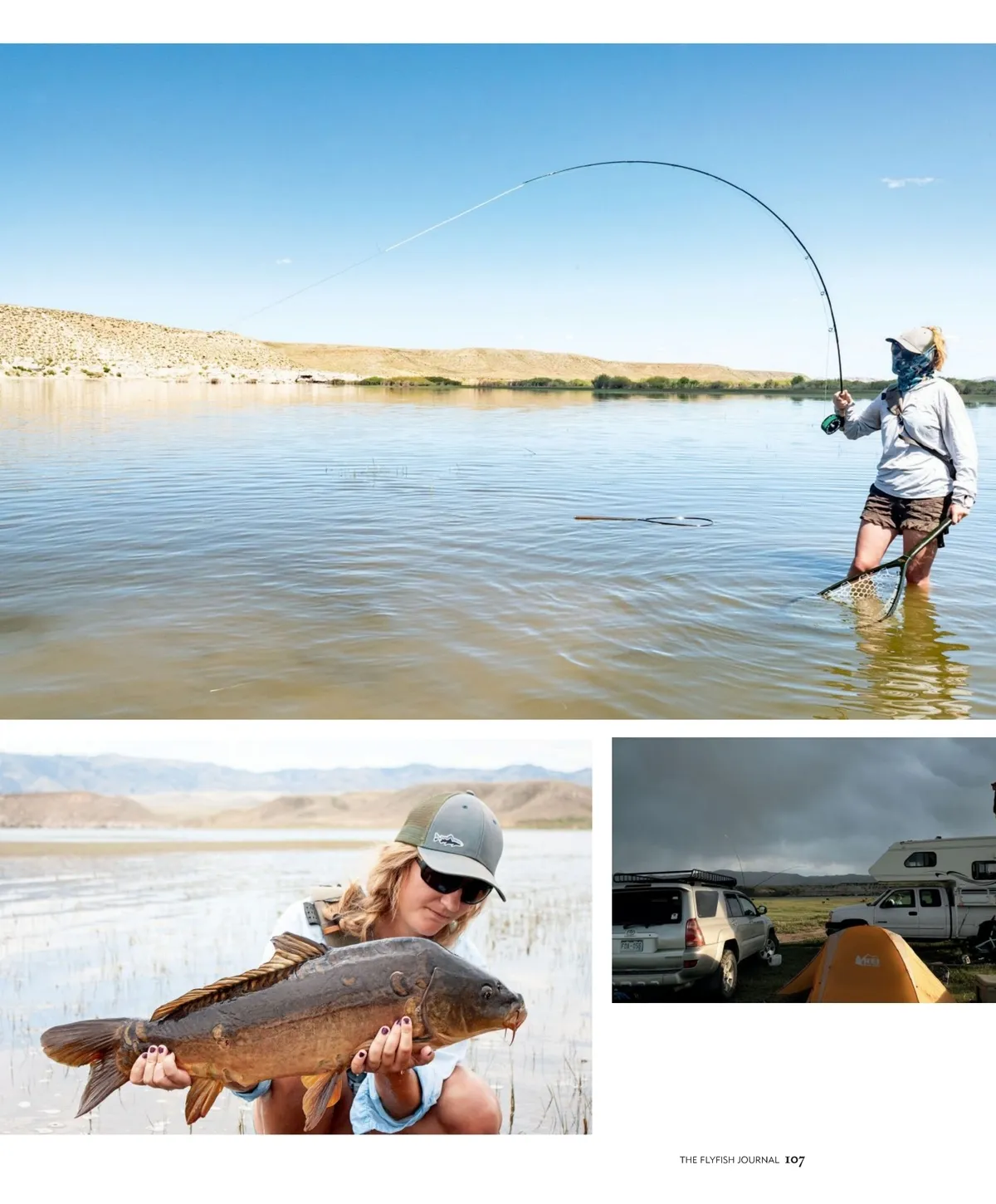
OPEN WATER FELT BUT NEVER TOUCHED WYOMING CARP UTOPIA Words Nick Basaraba “To watch the sun sink behind a flower clad hill. To wander on in a huge forest without thought of return. To stand upon the shore and gaze after a boat that disap-pears behind distant islands. To contemplate the flight of wild geese seen and lost among the clouds. And, subtle shadows of bamboo on bamboo.” — Zeami Motokiyo he road to the lake was barely discernable, defined by a singular gap in the towering sage-brush wide enough to slide a Toyota Tundra into. I idled the truck slowly through its cavernous potholes until suddenly an expansive shoreline yawned out before me. Driving to the water’s edge, I looked for other tire tracks or footprints that indicated where to begin fishing. There were none. I put the truck in park, turned the music down, and stared quietly at the flat lake rippling through summer heatwaves. For years I had driven three hours through the high plains of Wyoming to fish for trout in a tail-water and had never really considered making such a long journey to bushwack to the lake and look for carp, no matter how promising the whispers were. But when I arrived on a busy summer weekend, the river was already heavily decorated with pink and orange indicators. RVs, Sprinter vans and fishing rigs jockeyed for any vacant spot. Countless rod racks glinted in the sunlight as my fellow weekend warriors unleashed their artificial entomology on 400 trout per mile. I was desperate to alleviate the sensation of fishing in a trailer park and dug around my center console to find my carp box. The term “carping” carries baggage. Typically urban locales, the best spots for carp fishing are dystopian waterways forsaken by humanity and left to fend for themselves: city or neighborhood ponds prone to street runoff and lethal algae blooms, irriga-tion ditches that carry toxic levels of agricultural pes-ticides or fertilizers, warm rivers that suffocate cold-water species whose gills can’t absorb the precious amounts of oxygen required to survive. Admittedly, they can be unpleasant places to fish. T h i s w a s n o s u c h p l a c e . E a r l y s u m m e r on t h e p l a i n s was in full bloom. Lupins, flowering tumbleweed T • CLOCKWISE FROM TOP • “This fish was too big for the first net Katie Knick tried to land it with. Luckily one of us always carried a net that could fit even the biggest fish this lake had to offer. She was usually the one who needed it the most.” Photo: Nick Basaraba “Ryan Barrick and Katie Knick catch the last few moments of calm before an afternoon squall descended upon our campsite. It is crucial to pay attention to the weather here. Just a little bit of rain and these roads turn to muddy quicksand that will swallow a vehicle past the axles, leaving you a long walk back to civilization.” Photo: Nick Basaraba Katie Knick poses with a day-maker fish at the end of a tough, cloudy session with little visibility. No matter the conditions, carp this big push plenty of water and give themselves away easily. Photo: Nick Basaraba and dandelions grew among wind-swept clusters of fragrant sagebrush. Soft mint-green hills speckled with wildflowers swelled in all directions like a prismatic prairie ocean. Damselflies helicoptered erratically over lush shoreline grasses cropped short by a nomadic herd of cattle that, judging by the dankness in the air, had recently grazed through. Prairie dog families hurried through stands of sage anxiously rummaging among the vegetation before potential danger sent them plunging into the safety of their burrows. The blue sky, glittering with the wings of thousands of newly emerged mayflies, reflected brightly on the surface of the lake as it stretched beyond the horizon and disappeared over the curvature of the earth. The carp utopia revealed itself to me, slowly at first. Something moving unseen in the shallows would stop suddenly, wrinkling the water’s surface fabric before it smoothed back out like a bedsheet being pulled tight. Slivers of orange tails broke the calm, beckoning me closer like a seductive hand gesture. Copper shadows rattled my breath as they hunted over sand f lats, puff ing sediment out of their gill plates, leaving behind cloudy trails in the obscenely clear water. A spooked pod was mourned only briefly as the flat reset and another group la-zily made its way up the shoreline. Second chances turned infinite. I steered each hooked carp into the shallows with my trout rod until their bulks lay beached in the sand like gold-plated whales. Their transparent tails, soft as broken-in leather, wavered underwater as I took in the chaotic patterns of coarse scales. One by one I pulled flies from barbeled lips, hefted the fish onto their bellies, and pointed them toward the lake. As I watched each one disappear, I felt something in my internal chemistry fire and co-alesce around this strange new place. My isolation gave rise to an unexpected feeling of intimacy with the landscape; small but not insignificant, alone but not lonely. I tried to quantify the feeling un-successfully. Whatever it was I got lost within the tranquility of it. 106 THE FLYFISH JOURNAL
The Flyfish Journal The Flyfish Journal 15.4: Page 104