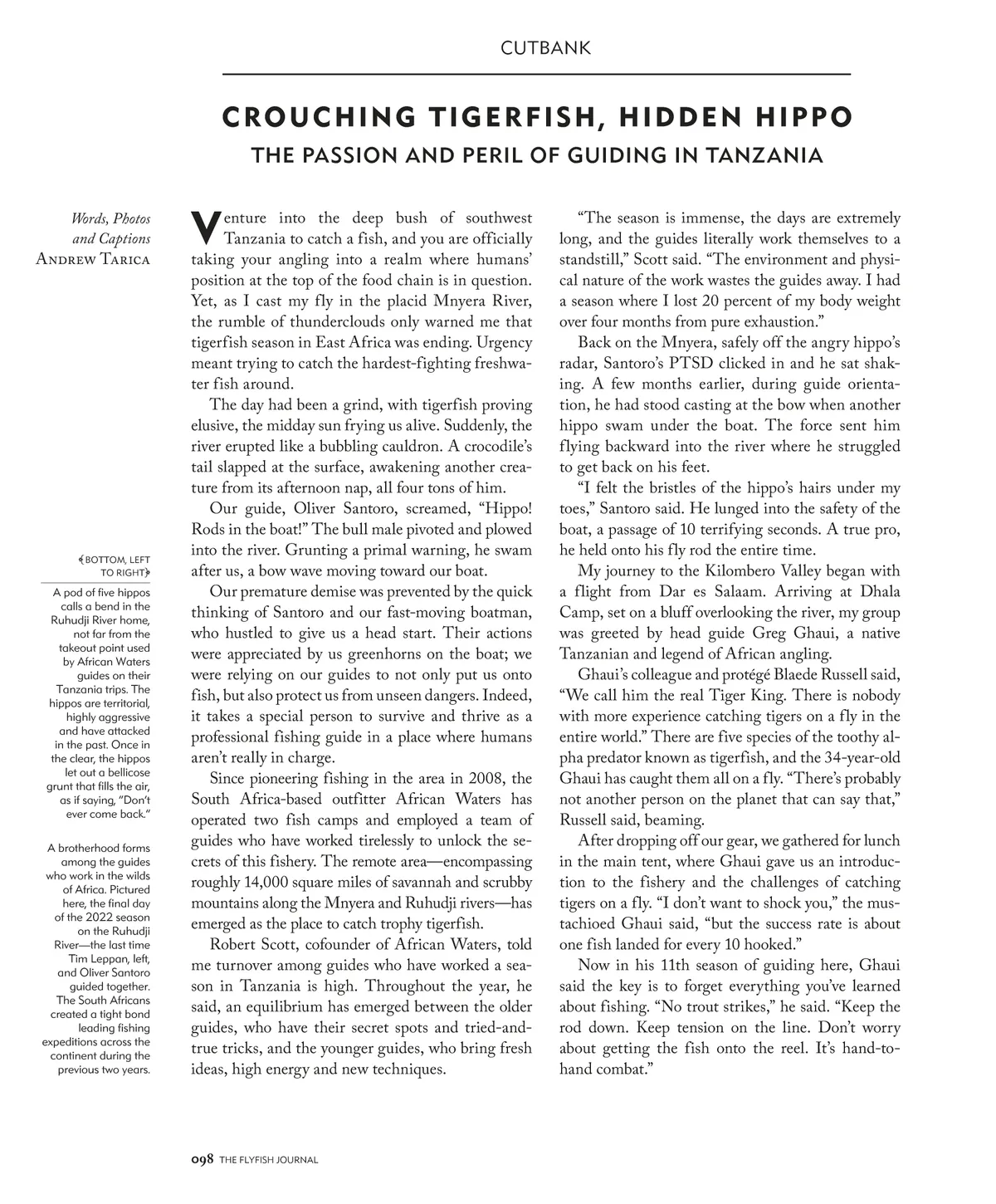
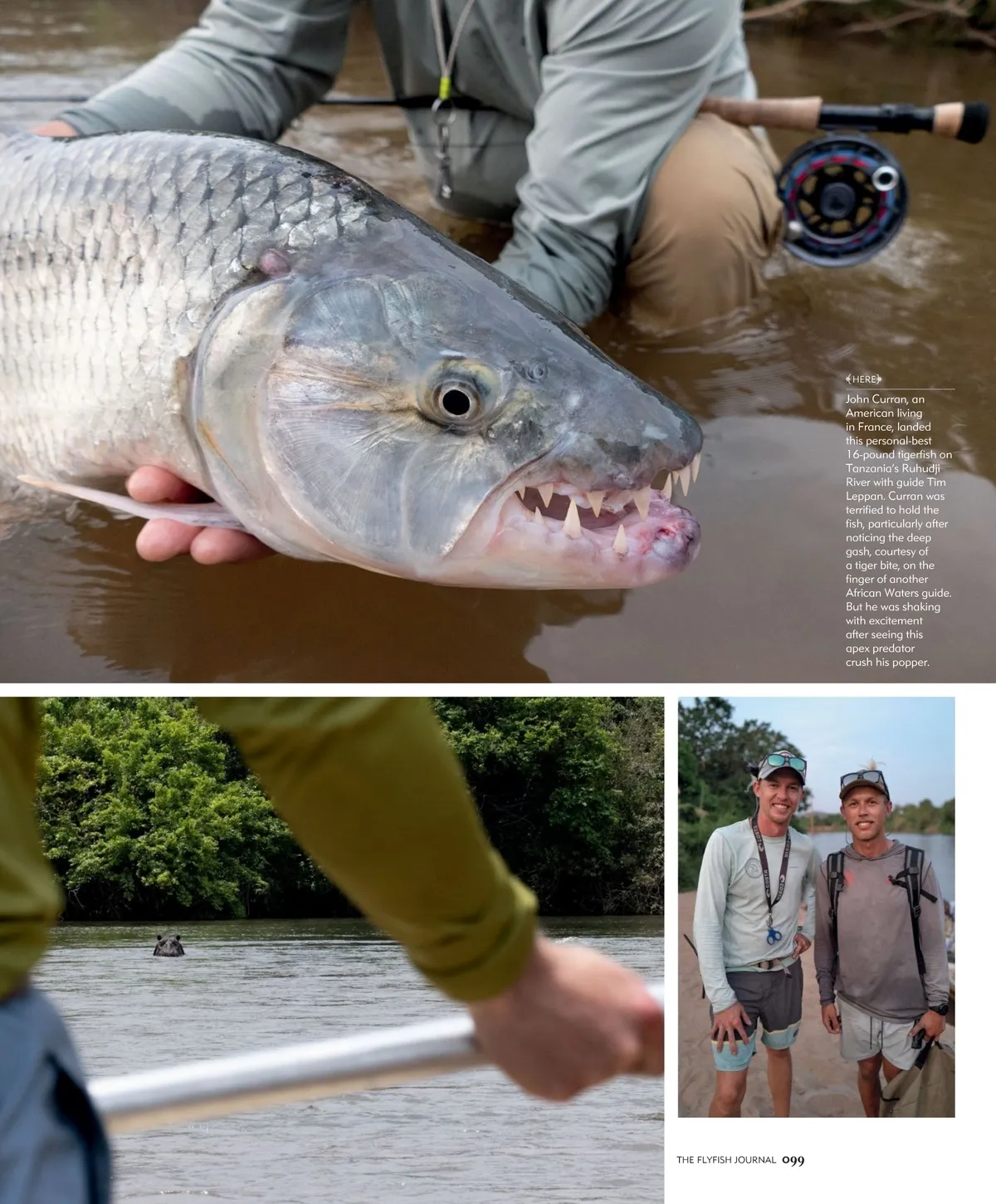
CUTBANK CROUCHING TIGERFISH, HIDDEN HIPPO THE PASSION AND PERIL OF GUIDING IN TANZANIA Words, Photos and Captions Andrew Tarica • BOTTOM, LEFT TO RIGHT • A pod of five hippos calls a bend in the Ruhudji River home, not far from the takeout point used by African Waters guides on their Tanzania trips. The hippos are territorial, highly aggressive and have attacked in the past. Once in the clear, the hippos let out a bellicose grunt that fills the air, as if saying, “Don’t ever come back.” A brotherhood forms among the guides who work in the wilds of Africa. Pictured here, the final day of the 2022 season on the Ruhudji River—the last time Tim Leppan, left, and Oliver Santoro guided together. The South Africans created a tight bond leading fishing expeditions across the continent during the previous two years. enture into the deep bush of southwest Tanzania to catch a fish, and you are officially taking your angling into a realm where humans’ position at the top of the food chain is in question. Yet, as I cast my fly in the placid Mnyera River, the rumble of thunderclouds only warned me that tigerfish season in East Africa was ending. Urgency meant trying to catch the hardest-fighting freshwa-ter fish around. The day had been a grind, with tigerfish proving elusive, the midday sun frying us alive. Suddenly, the river erupted like a bubbling cauldron. A crocodile’s tail slapped at the surface, awakening another crea-ture from its afternoon nap, all four tons of him. Our guide, Oliver Santoro, screamed, “Hippo! Rods in the boat!” The bull male pivoted and plowed into the river. Grunting a primal warning, he swam after us, a bow wave moving toward our boat. Our premature demise was prevented by the quick thinking of Santoro and our fast-moving boatman, who hustled to give us a head start. Their actions were appreciated by us greenhorns on the boat; we were relying on our guides to not only put us onto fish, but also protect us from unseen dangers. Indeed, it takes a special person to survive and thrive as a professional fishing guide in a place where humans aren’t really in charge. Since pioneering fishing in the area in 2008, the South Africa-based outfitter African Waters has operated two fish camps and employed a team of guides who have worked tirelessly to unlock the se-crets of this fishery. The remote area—encompassing roughly 14,000 square miles of savannah and scrubby mountains along the Mnyera and Ruhudji rivers—has emerged as the place to catch trophy tigerfish. Robert Scott, cofounder of African Waters, told me turnover among guides who have worked a sea-son in Tanzania is high. Throughout the year, he said, an equilibrium has emerged between the older guides, who have their secret spots and tried-and-true tricks, and the younger guides, who bring fresh ideas, high energy and new techniques. V “The season is immense, the days are extremely long, and the guides literally work themselves to a standstill,” Scott said. “The environment and physi-cal nature of the work wastes the guides away. I had a season where I lost 20 percent of my body weight over four months from pure exhaustion.” Back on the Mnyera, safely off the angry hippo’s radar, Santoro’s PTSD clicked in and he sat shak-ing. A few months earlier, during guide orienta-tion, he had stood casting at the bow when another hippo swam under the boat. The force sent him flying backward into the river where he struggled to get back on his feet. “I felt the bristles of the hippo’s hairs under my toes,” Santoro said. He lunged into the safety of the boat, a passage of 10 terrifying seconds. A true pro, he held onto his fly rod the entire time. My journey to the Kilombero Valley began with a flight from Dar es Salaam. Arriving at Dhala Camp, set on a bluff overlooking the river, my group was greeted by head guide Greg Ghaui, a native Tanzanian and legend of African angling. Ghaui’s colleague and protégé Blaede Russell said, “We call him the real Tiger King. There is nobody with more experience catching tigers on a fly in the entire world.” There are five species of the toothy al-pha predator known as tigerfish, and the 34-year-old Ghaui has caught them all on a fly. “There’s probably not another person on the planet that can say that,” Russell said, beaming. After dropping off our gear, we gathered for lunch in the main tent, where Ghaui gave us an introduc-tion to the fishery and the challenges of catching tigers on a fly. “I don’t want to shock you,” the mus-tachioed Ghaui said, “but the success rate is about one fish landed for every 10 hooked.” Now in his 11th season of guiding here, Ghaui said the key is to forget everything you’ve learned about fishing. “No trout strikes,” he said. “Keep the rod down. Keep tension on the line. Don’t worry about getting the fish onto the reel. It’s hand-to-hand combat.” 098 THE FLYFISH JOURNAL
The Flyfish Journal The Flyfish Journal 15.3: Page 98