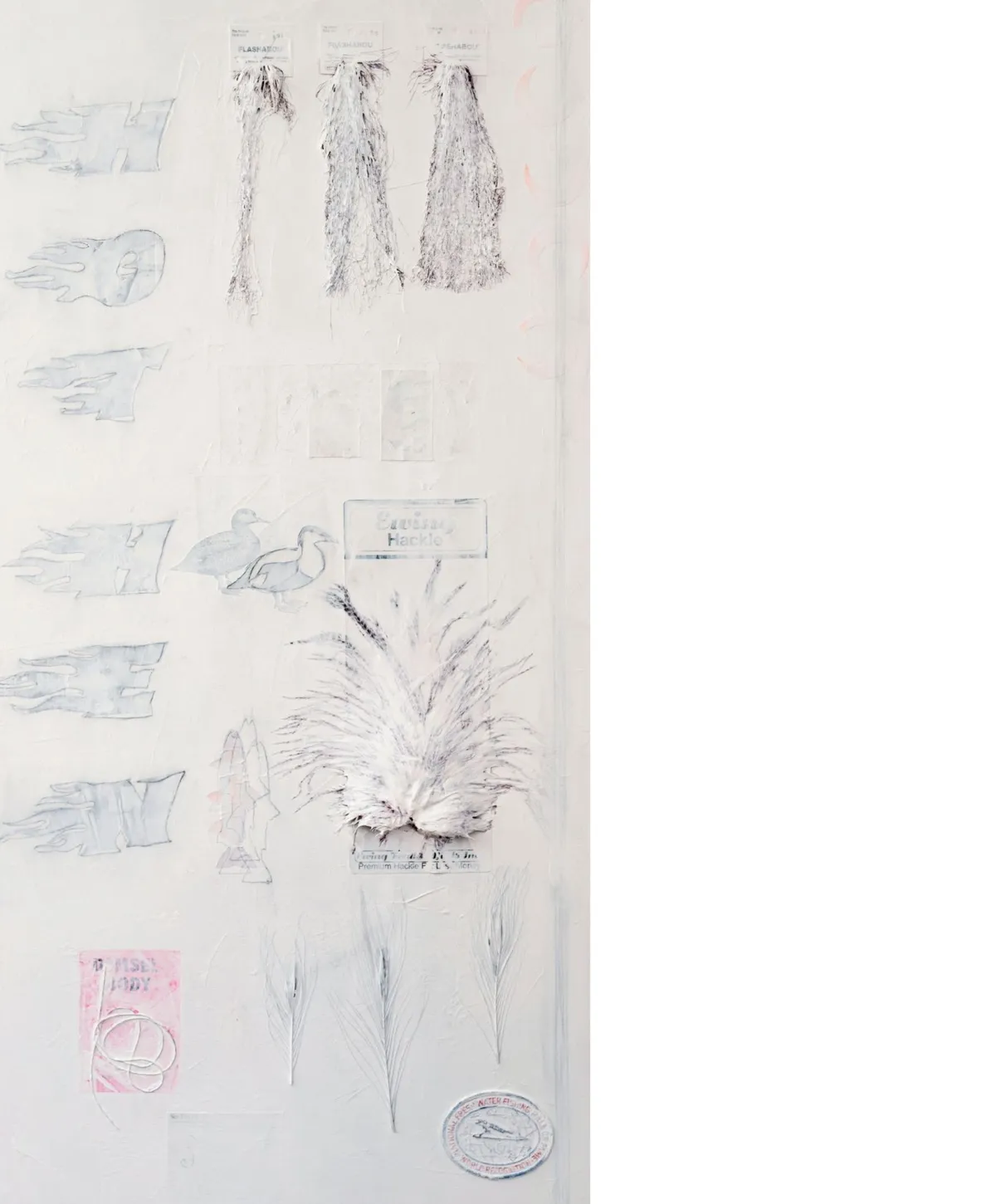
• LEFT • Hot Hen 2024 Mixed Media 24”x48” After unpacking a box of his books in my living room, I sat on the floor in front of the bookcase, tired from crying. I missed him. This grief was new to me. It was exhausting and confusing. My teary gaze danced across the full shelf of Jim Harrison books in front of me, a writer James had taught me to love. The copy of A Good Day to Die caught my eye. Speaking out loud to James as if he were there, I told him, selfishly, there was no good day for him to die. I pulled the book off the shelf, a retired (or stolen) first edition from the Tompkins County Public Library in Ithaca, NY. On the inside of the cover, overlaying the library card, I found scrawled: “To James,” with the signature, “Jim Harrison.” My tears turned to laughter when I realized James had indeed been listening and this was exactly how he would tell me that he was OK and everything would be fine. He was letting me know that, after all, it had been a good day to die. Black bins full of his books and tying materials were packed away and stacked in my garage, the most convenient place for my family to store them. For two years I’d see the totes in my garage among the seasonal ebb and flow of dirt bikes and various ungulate quarters. Not much of a fly-tyer, I never bothered to open the bins. On a bright summer day while working on cya-notype prints, the thought occurred to me to search the bins for feathers beyond the pheasant and grouse I had harvested the season before. Upon opening the first tote, I was met with an overwhelming volume of colors and textures. There were exotic-colored feath-ers, dozens of packs of Flashabou, craft fur, deer and elk hair, rabbit and squirrel in every natural and un-natural color. Eyes, legs, tails, hooks and other fly components in every size were all packed away neatly awaiting use. The energy of the boxes in front of me was crushing, as if I had opened a Pandora’s Box of grief and creativity. Before anyone puts pen to paper, brush to can-vas, or hook to vice, there is potential creative en-ergy around us. It sits waiting in our materials, our brains, our hands and our souls. It stays there until we pick up the pen, brush or bobbin. As I looked through the tying materials in front of me, I won-dered what happens to this energy when we die. What happens when the only thing left of an artist are the materials gathered and the dreams of what they would become? I sat in the garage for hours sorting through the bins, collecting whatever materials caught my eye. As I set each one aside, I felt the soul of my friend and mentor. The energy of someone who taught me life is best practiced as art radiated from the heaps of feathers, fur and flash. Here I was staring squarely at James’ creativity, and it was staring back, challenging mine. What started as a violent clash of grief and creativ-ity ended with their harmony. The result is a collec-tion of works fabricated with unlikely mediums—a tale of two artists and what happens when one leaves the other behind. THE FLYFISH JOURNAL 095
The Flyfish Journal The Flyfish Journal 15.3: Page 95