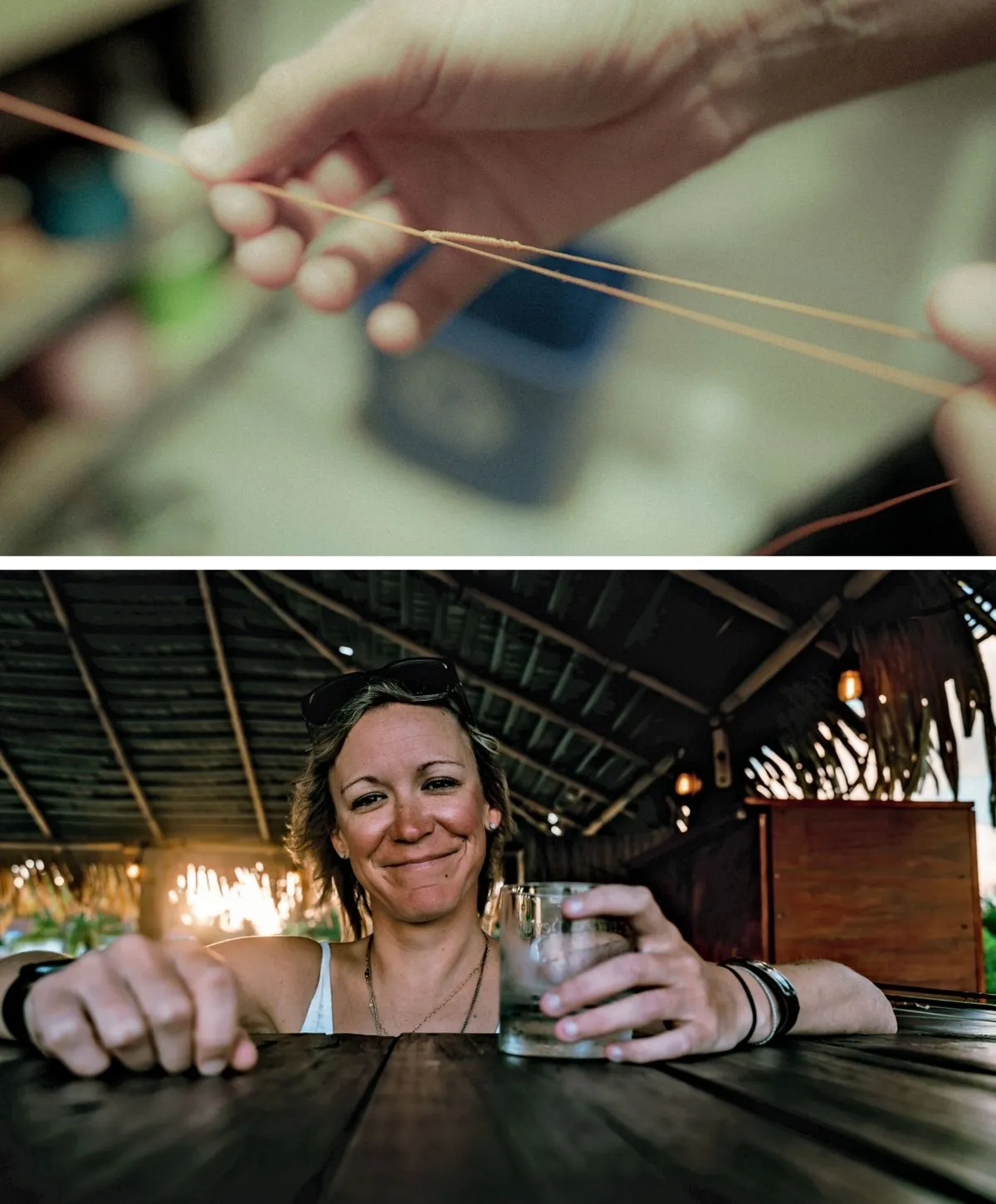
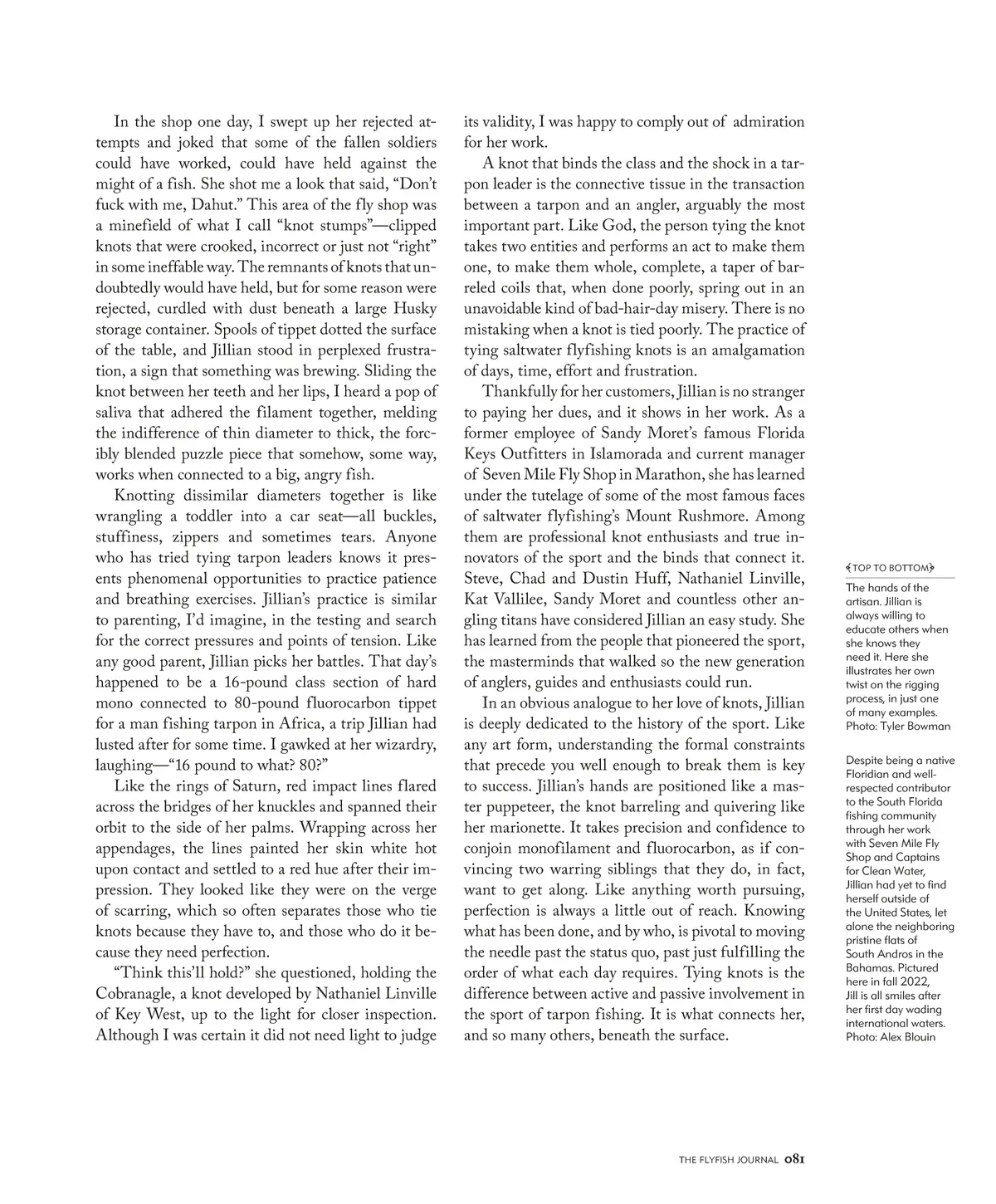
In the shop one day, I swept up her rejected at-tempts and joked that some of the fallen soldiers could have worked, could have held against the might of a fish. She shot me a look that said, “Don’t fuck with me, Dahut.” This area of the fly shop was a minefield of what I call “knot stumps”—clipped knots that were crooked, incorrect or just not “right” in some ineffable way. The remnants of knots that un-doubtedly would have held, but for some reason were rejected, curdled with dust beneath a large Husky storage container. Spools of tippet dotted the surface of the table, and Jillian stood in perplexed frustra-tion, a sign that something was brewing. Sliding the knot between her teeth and her lips, I heard a pop of saliva that adhered the filament together, melding the indifference of thin diameter to thick, the forc-ibly blended puzzle piece that somehow, some way, works when connected to a big, angry fish. Knotting dissimilar diameters together is like wrangling a toddler into a car seat—all buckles, stuffiness, zippers and sometimes tears. Anyone who has tried tying tarpon leaders knows it pres-ents phenomenal opportunities to practice patience and breathing exercises. Jillian’s practice is similar to parenting, I’d imagine, in the testing and search for the correct pressures and points of tension. Like any good parent, Jillian picks her battles. That day’s happened to be a 16-pound class section of hard mono connected to 80-pound fluorocarbon tippet for a man fishing tarpon in Africa, a trip Jillian had lusted after for some time. I gawked at her wizardry, laughing—“16 pound to what? 80?” Like the rings of Saturn, red impact lines flared across the bridges of her knuckles and spanned their orbit to the side of her palms. Wrapping across her appendages, the lines painted her skin white hot upon contact and settled to a red hue after their im-pression. They looked like they were on the verge of scarring, which so often separates those who tie knots because they have to, and those who do it be-cause they need perfection. “Think this’ll hold?” she questioned, holding the Cobranagle, a knot developed by Nathaniel Linville of Key West, up to the light for closer inspection. Although I was certain it did not need light to judge its validity, I was happy to comply out of admiration for her work. A knot that binds the class and the shock in a tar-pon leader is the connective tissue in the transaction between a tarpon and an angler, arguably the most important part. Like God, the person tying the knot takes two entities and performs an act to make them one, to make them whole, complete, a taper of bar-reled coils that, when done poorly, spring out in an unavoidable kind of bad-hair-day misery. There is no mistaking when a knot is tied poorly. The practice of tying saltwater flyfishing knots is an amalgamation of days, time, effort and frustration. Thankfully for her customers, Jillian is no stranger to paying her dues, and it shows in her work. As a former employee of Sandy Moret’s famous Florida Keys Outfitters in Islamorada and current manager of Seven Mile Fly Shop in Marathon, she has learned under the tutelage of some of the most famous faces of saltwater flyfishing’s Mount Rushmore. Among them are professional knot enthusiasts and true in-novators of the sport and the binds that connect it. Steve, Chad and Dustin Huff, Nathaniel Linville, Kat Vallilee, Sandy Moret and countless other an-gling titans have considered Jillian an easy study. She has learned from the people that pioneered the sport, the masterminds that walked so the new generation of anglers, guides and enthusiasts could run. In an obvious analogue to her love of knots, Jillian is deeply dedicated to the history of the sport. Like any art form, understanding the formal constraints that precede you well enough to break them is key to success. Jillian’s hands are positioned like a mas-ter puppeteer, the knot barreling and quivering like her marionette. It takes precision and confidence to conjoin monofilament and f luorocarbon, as if con-vincing two warring siblings that they do, in fact, want to get along. Like anything worth pursuing, perfection is always a little out of reach. Knowing what has been done, and by who, is pivotal to moving the needle past the status quo, past just fulfilling the order of what each day requires. Tying knots is the difference between active and passive involvement in the sport of tarpon fishing. It is what connects her, and so many others, beneath the surface. • TOP TO BOTTOM • The hands of the artisan. Jillian is always willing to educate others when she knows they need it. Here she illustrates her own twist on the rigging process, in just one of many examples. Photo: Tyler Bowman Despite being a native Floridian and well-respected contributor to the South Florida fishing community through her work with Seven Mile Fly Shop and Captains for Clean Water, Jillian had yet to find herself outside of the United States, let alone the neighboring pristine flats of South Andros in the Bahamas. Pictured here in fall 2022, Jill is all smiles after her first day wading international waters. Photo: Alex Blouin THE FLYFISH JOURNAL 081
The Flyfish Journal The Flyfish Journal 15.3: Page 81