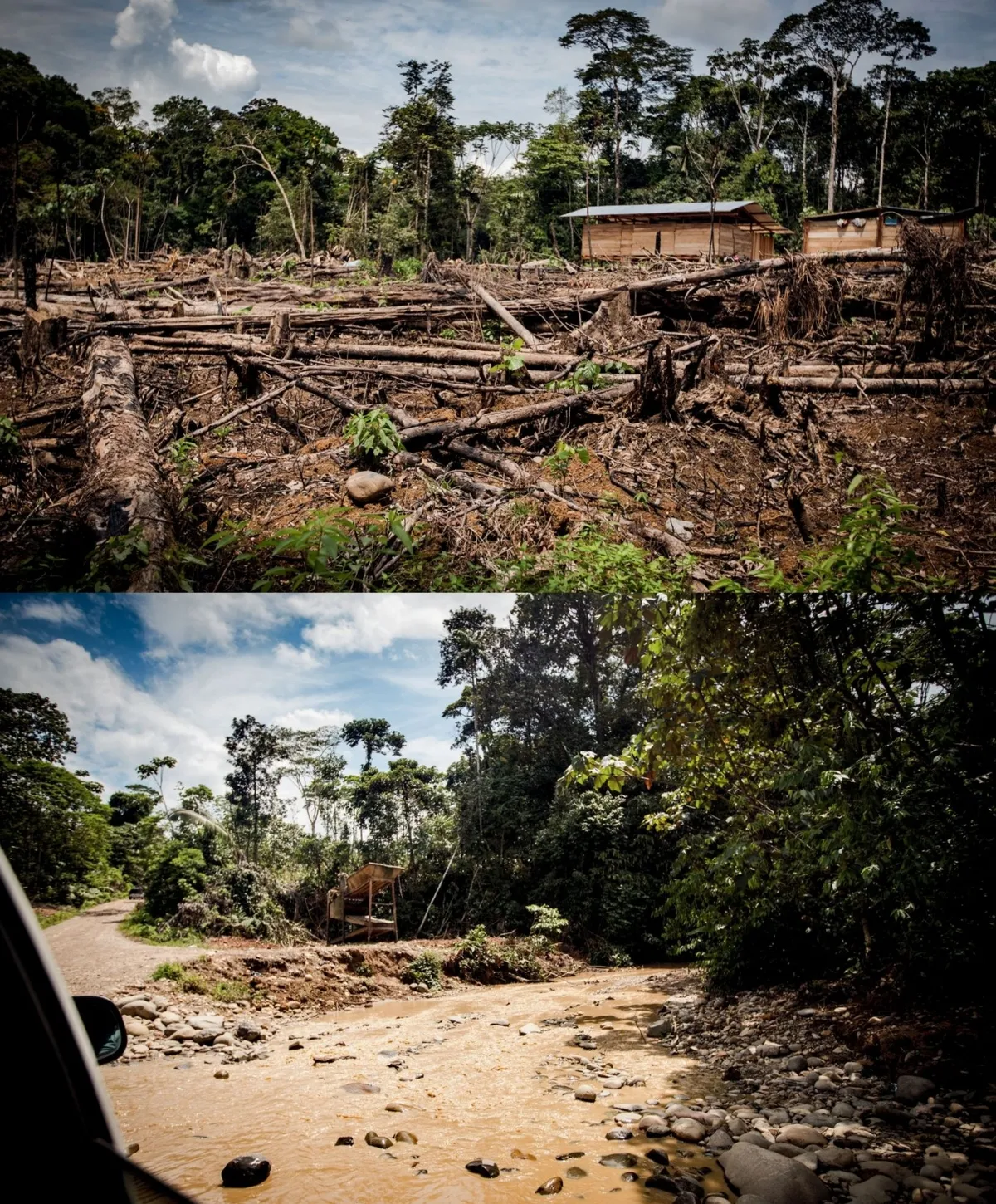
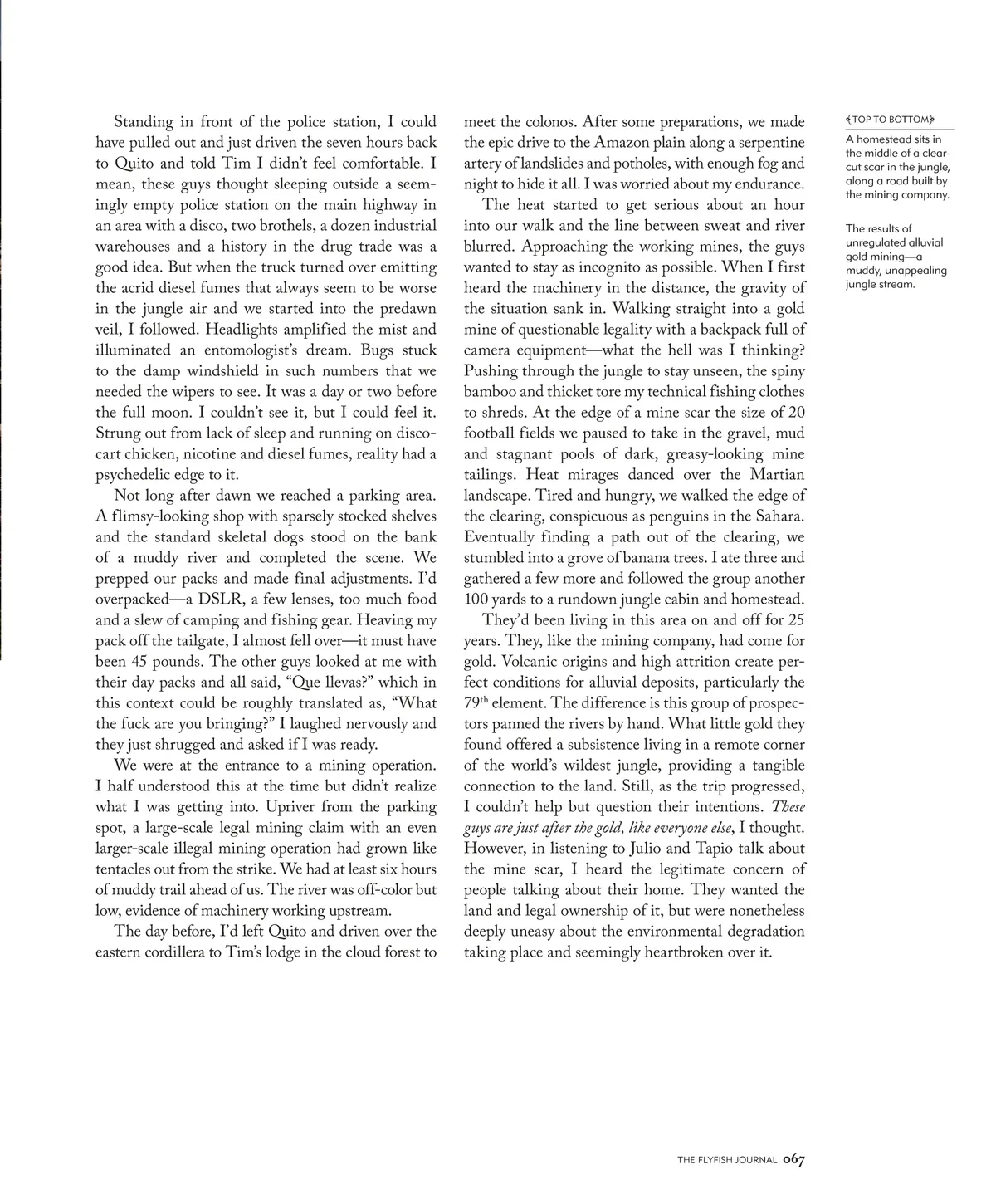
Standing in front of the police station, I could have pulled out and just driven the seven hours back to Quito and told Tim I didn’t feel comfortable. I mean, these guys thought sleeping outside a seem-ingly empty police station on the main highway in an area with a disco, two brothels, a dozen industrial warehouses and a history in the drug trade was a good idea. But when the truck turned over emitting the acrid diesel fumes that always seem to be worse in the jungle air and we started into the predawn veil, I followed. Headlights amplified the mist and illuminated an entomologist’s dream. Bugs stuck to the damp windshield in such numbers that we needed the wipers to see. It was a day or two before the full moon. I couldn’t see it, but I could feel it. Strung out from lack of sleep and running on disco-cart chicken, nicotine and diesel fumes, reality had a psychedelic edge to it. Not long after dawn we reached a parking area. A flimsy-looking shop with sparsely stocked shelves and the standard skeletal dogs stood on the bank of a muddy river and completed the scene. We prepped our packs and made final adjustments. I’d overpacked—a DSLR, a few lenses, too much food and a slew of camping and fishing gear. Heaving my pack off the tailgate, I almost fell over—it must have been 45 pounds. The other guys looked at me with their day packs and all said, “Que llevas?” which in this context could be roughly translated as, “What the fuck are you bringing?” I laughed nervously and they just shrugged and asked if I was ready. We were at the entrance to a mining operation. I half understood this at the time but didn’t realize what I was getting into. Upriver from the parking spot, a large-scale legal mining claim with an even larger-scale illegal mining operation had grown like tentacles out from the strike. We had at least six hours of muddy trail ahead of us. The river was off-color but low, evidence of machinery working upstream. The day before, I’d left Quito and driven over the eastern cordillera to Tim’s lodge in the cloud forest to meet the colonos. After some preparations, we made the epic drive to the Amazon plain along a serpentine artery of landslides and potholes, with enough fog and night to hide it all. I was worried about my endurance. The heat started to get serious about an hour into our walk and the line between sweat and river blurred. Approaching the working mines, the guys wanted to stay as incognito as possible. When I first heard the machinery in the distance, the gravity of the situation sank in. Walking straight into a gold mine of questionable legality with a backpack full of camera equipment—what the hell was I thinking? Pushing through the jungle to stay unseen, the spiny bamboo and thicket tore my technical fishing clothes to shreds. At the edge of a mine scar the size of 20 football fields we paused to take in the gravel, mud and stagnant pools of dark, greasy-looking mine tailings. Heat mirages danced over the Martian landscape. Tired and hungry, we walked the edge of the clearing, conspicuous as penguins in the Sahara. Eventually finding a path out of the clearing, we stumbled into a grove of banana trees. I ate three and gathered a few more and followed the group another 100 yards to a rundown jungle cabin and homestead. They’d been living in this area on and off for 25 years. They, like the mining company, had come for gold. Volcanic origins and high attrition create per-fect conditions for alluvial deposits, particularly the 79 th element. The difference is this group of prospec-tors panned the rivers by hand. What little gold they found offered a subsistence living in a remote corner of the world’s wildest jungle, providing a tangible connection to the land. Still, as the trip progressed, I couldn’t help but question their intentions. These guys are just after the gold, like everyone else , I thought. However, in listening to Julio and Tapio talk about the mine scar, I heard the legitimate concern of people talking about their home. They wanted the land and legal ownership of it, but were nonetheless deeply uneasy about the environmental degradation taking place and seemingly heartbroken over it. • TOP TO BOTTOM • A homestead sits in the middle of a clear-cut scar in the jungle, along a road built by the mining company. The results of unregulated alluvial gold mining—a muddy, unappealing jungle stream. THE FLYFISH JOURNAL 067
The Flyfish Journal The Flyfish Journal 15.3: Page 67