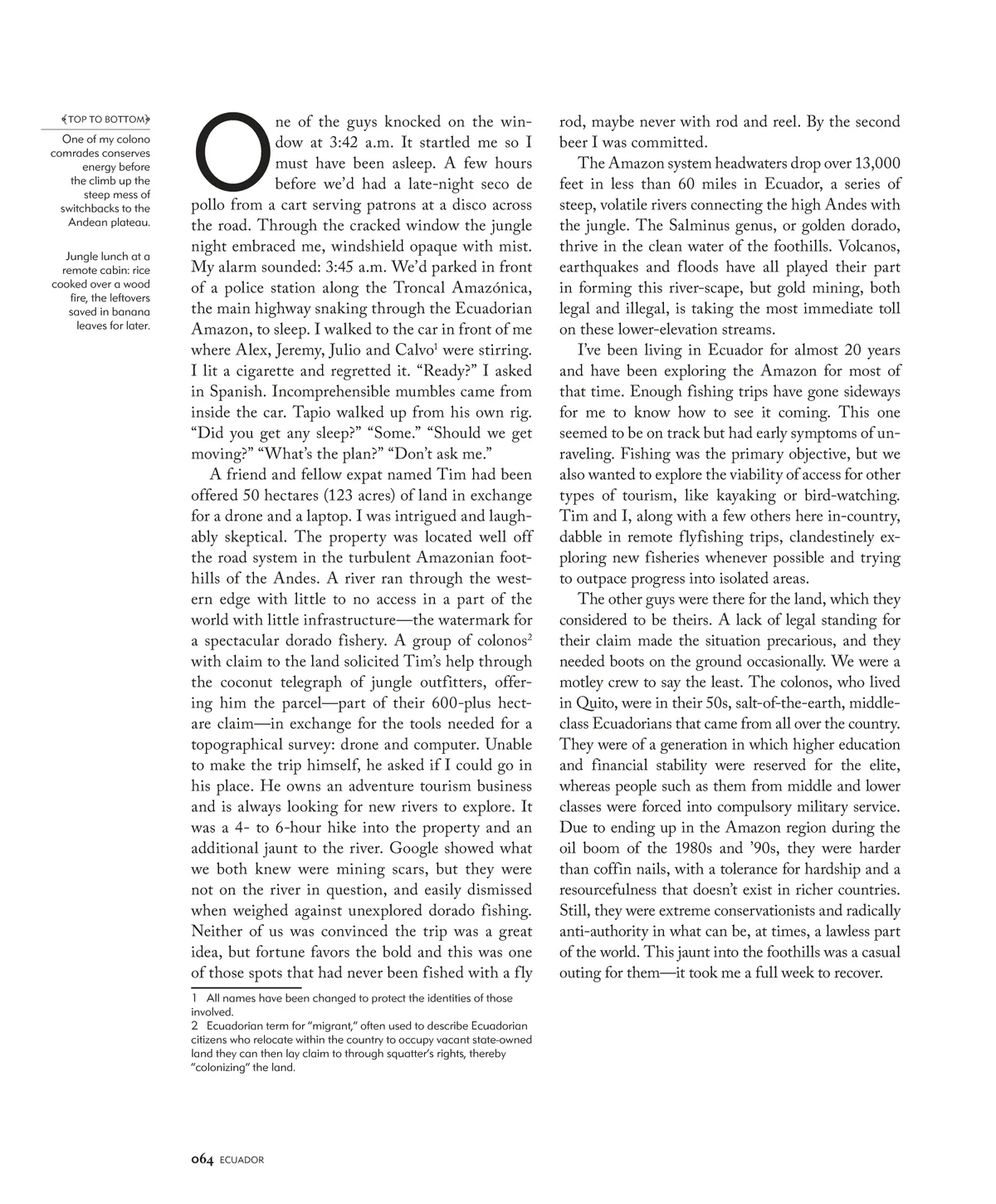
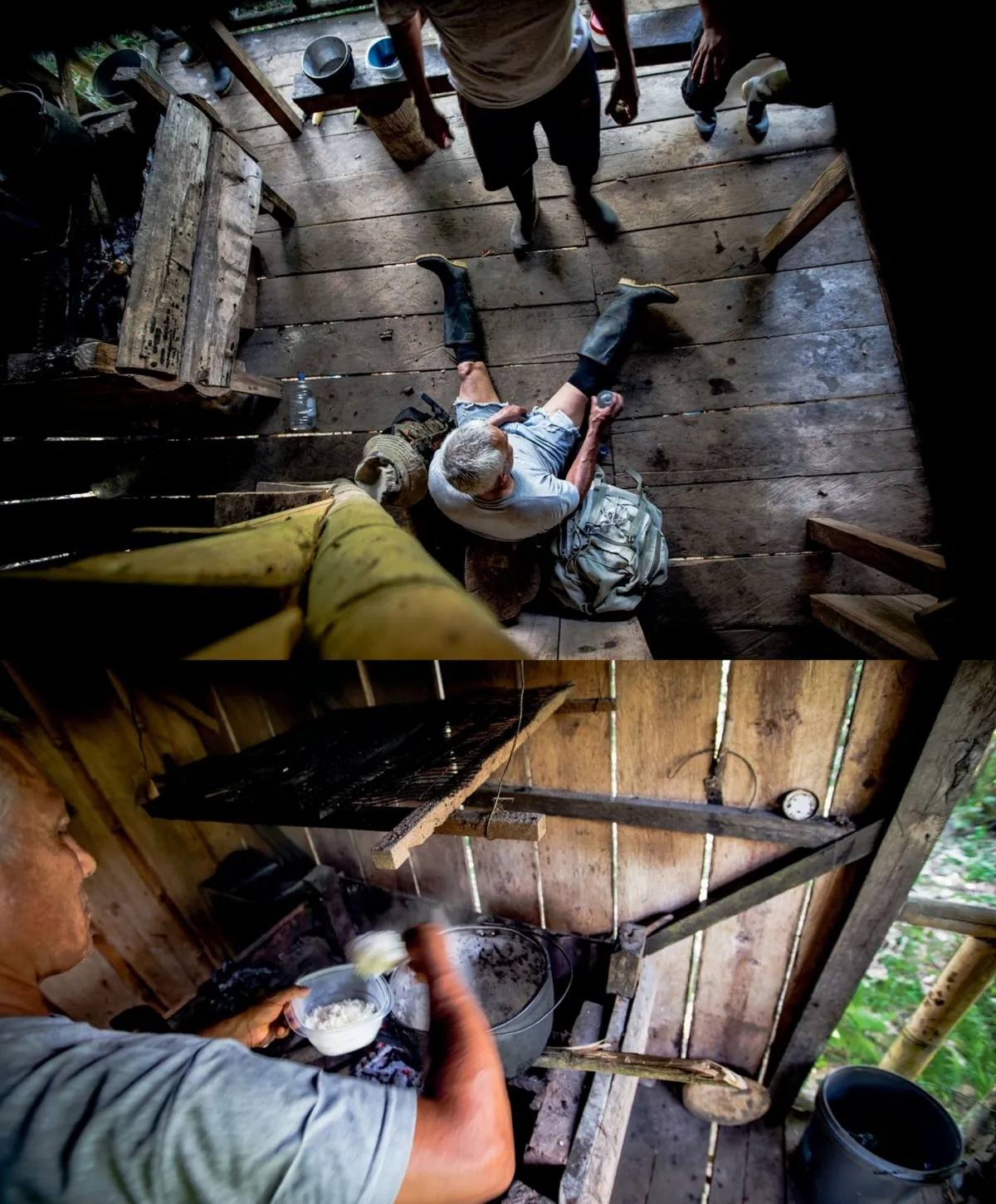
• TOP TO BOTTOM • One of my colono comrades conserves energy before the climb up the steep mess of switchbacks to the Andean plateau. Jungle lunch at a remote cabin: rice cooked over a wood fire, the leftovers saved in banana leaves for later. ne of the guys knocked on the win-dow at 3:42 a.m. It startled me so I must have been asleep. A few hours before we’d had a late-night seco de pollo from a cart serving patrons at a disco across the road. Through the cracked window the jungle night embraced me, windshield opaque with mist. My alarm sounded: 3:45 a.m. We’d parked in front of a police station along the Troncal Amazónica, the main highway snaking through the Ecuadorian Amazon, to sleep. I walked to the car in front of me where Alex, Jeremy, Julio and Calvo 1 were stirring. I lit a cigarette and regretted it. “Ready?” I asked in Spanish. Incomprehensible mumbles came from inside the car. Tapio walked up from his own rig. “Did you get any sleep?” “Some.” “Should we get moving?” “What’s the plan?” “Don’t ask me.” A friend and fellow expat named Tim had been offered 50 hectares (123 acres) of land in exchange for a drone and a laptop. I was intrigued and laugh-ably skeptical. The property was located well off the road system in the turbulent Amazonian foot-hills of the Andes. A river ran through the west-ern edge with little to no access in a part of the world with little infrastructure—the watermark for a spectacular dorado fishery. A group of colonos 2 with claim to the land solicited Tim’s help through the coconut telegraph of jungle outfitters, offer-ing him the parcel—part of their 600-plus hect-are claim—in exchange for the tools needed for a topographical survey: drone and computer. Unable to make the trip himself, he asked if I could go in his place. He owns an adventure tourism business and is always looking for new rivers to explore. It was a 4-to 6-hour hike into the property and an additional jaunt to the river. Google showed what we both knew were mining scars, but they were not on the river in question, and easily dismissed when weighed against unexplored dorado fishing. Neither of us was convinced the trip was a great idea, but fortune favors the bold and this was one of those spots that had never been fished with a fly 1 All names have been changed to protect the identities of those involved. 2 Ecuadorian term for “migrant,” often used to describe Ecuadorian citizens who relocate within the country to occupy vacant state-owned land they can then lay claim to through squatter’s rights, thereby “colonizing” the land. O rod, maybe never with rod and reel. By the second beer I was committed. The Amazon system headwaters drop over 13,000 feet in less than 60 miles in Ecuador, a series of steep, volatile rivers connecting the high Andes with the jungle. The Salminus genus, or golden dorado, thrive in the clean water of the foothills. Volcanos, earthquakes and floods have all played their part in forming this river-scape, but gold mining, both legal and illegal, is taking the most immediate toll on these lower-elevation streams. I’ve been living in Ecuador for almost 20 years and have been exploring the Amazon for most of that time. Enough fishing trips have gone sideways for me to know how to see it coming. This one seemed to be on track but had early symptoms of un-raveling. Fishing was the primary objective, but we also wanted to explore the viability of access for other types of tourism, like kayaking or bird-watching. Tim and I, along with a few others here in-country, dabble in remote flyfishing trips, clandestinely ex-ploring new fisheries whenever possible and trying to outpace progress into isolated areas. The other guys were there for the land, which they considered to be theirs. A lack of legal standing for their claim made the situation precarious, and they needed boots on the ground occasionally. We were a motley crew to say the least. The colonos, who lived in Quito, were in their 50s, salt-of-the-earth, middle-class Ecuadorians that came from all over the country. They were of a generation in which higher education and financial stability were reserved for the elite, whereas people such as them from middle and lower classes were forced into compulsory military service. Due to ending up in the Amazon region during the oil boom of the 1980s and ’90s, they were harder than coffin nails, with a tolerance for hardship and a resourcefulness that doesn’t exist in richer countries. Still, they were extreme conservationists and radically anti-authority in what can be, at times, a lawless part of the world. This jaunt into the foothills was a casual outing for them—it took me a full week to recover. 064 ECUADOR
The Flyfish Journal The Flyfish Journal 15.3: Page 64