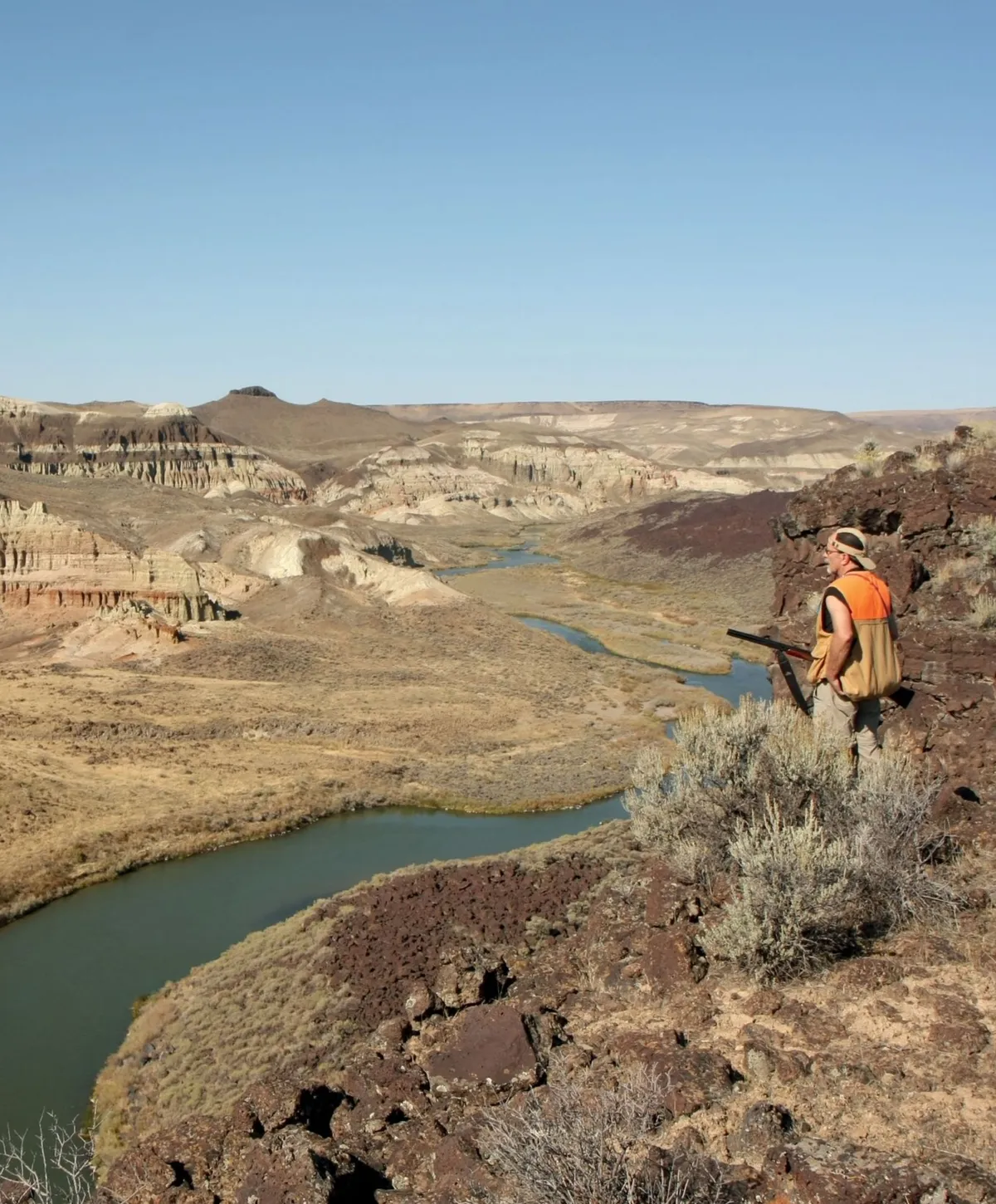
“What the hell?” I could tell Steve was trying to make sense of it, too. “Rabbit?” “Right...I think. Big suckers though.” “Jacks—they’re jackrabbits. What the hell do we do with those?” “Hare,” I told him, for indeed they are as different from a cottontail as duck is from grouse. Moore stopped in front of us and held them up with a piratical grin. “Look what daddy brought home!” Moore, our kayak ninja and neophyte hunter, knew we were hoping for dinner when we sent him off earlier in the day to see what he could find. He told us he’d climbed to the canyon rim and found these two hopping through the wheat fields up top. But jacks? Rumored to be stringy dark meat and not at all cottontail-like, we were nevertheless honor bound to cook them. By this time Callie had joined us at river’s edge. “Yum,” she said. “Slow cook, with rosemary and red potatoes, a salad. Bon appétit.” There is a lot of canyon to explore here. You will likely spot bighorn sheep traversing a steep canyon wall in single file. On several small mesas above the river bottom we found rock walls, built, we discovered after consulting an anthropologist at Oregon State University, by Basque shepherds. We found pictographs on some of the huge basalt stones and caves once inhabited by fisher-folk like ourselves, though they’d been here for salmon, steelhead and lamprey. You might want to consider eating locally. Space for supplies in the boats is dearly limited. Ice likely won’t make the cut (although we managed dry ice) and meat won’t last very long. Harvesting fish and partridge to provide a protein-rich entree to ac-company the carbs, hardy kale and chard brought from our gardens at home worked well. The up-land hunting season had just opened and several of us brought light-gauge shotguns and were able to add fresh game to each night’s meal. We ate only a single meal of bass to comply with recommenda-tions concerning mercury in the watershed. Callie kept us well fed with pan-fried bass and partridge and Cajun-blackened quail. Kneeling in the sand, she made fresh tamales from a sack of masa and we ate our share of beans. Steve helped out, dressing whatever fresh game we might have for the day. Callie is highly self-reliant; she once soloed 72 days in the Patagonian wilds for the Alone TV series. Perhaps the best meal we had was that jackrabbit cacciatore. It was fall-off-the-bone delicious after roasting half a day in the Dutchie. At night, after cleaning up, we would settle onto still-warm sand and Callie would bring out her ukulele. We’d build up the fire with sticks of bone-dry juniper as the mercury dropped and Steve would bake a surprise dessert in the oven. And always there was the song of the river, changing subtly from one camp to the next. My wife, a yoga practitioner, occasionally refer-ences a Zen koan about “original face,” as in, “What is your original face before your parents were born?” Leaving the house one day, I quipped that I was go-ing to look for my original fisherman. The Owyhee is a good place to find it if you’re missing yours. • LEFT • Steve Thomsen on the canyon rim above camp, Chalk Basin in the distance. Rhyolite and colored sediment stratify canyon walls like a cake. The gentle gradient of receding palisades along this stretch of river made for good hiking and chukar hunting. Photo: Steve Thomsen THE FLYFISH JOURNAL 049
The Flyfish Journal The Flyfish Journal 15.3: Page 49