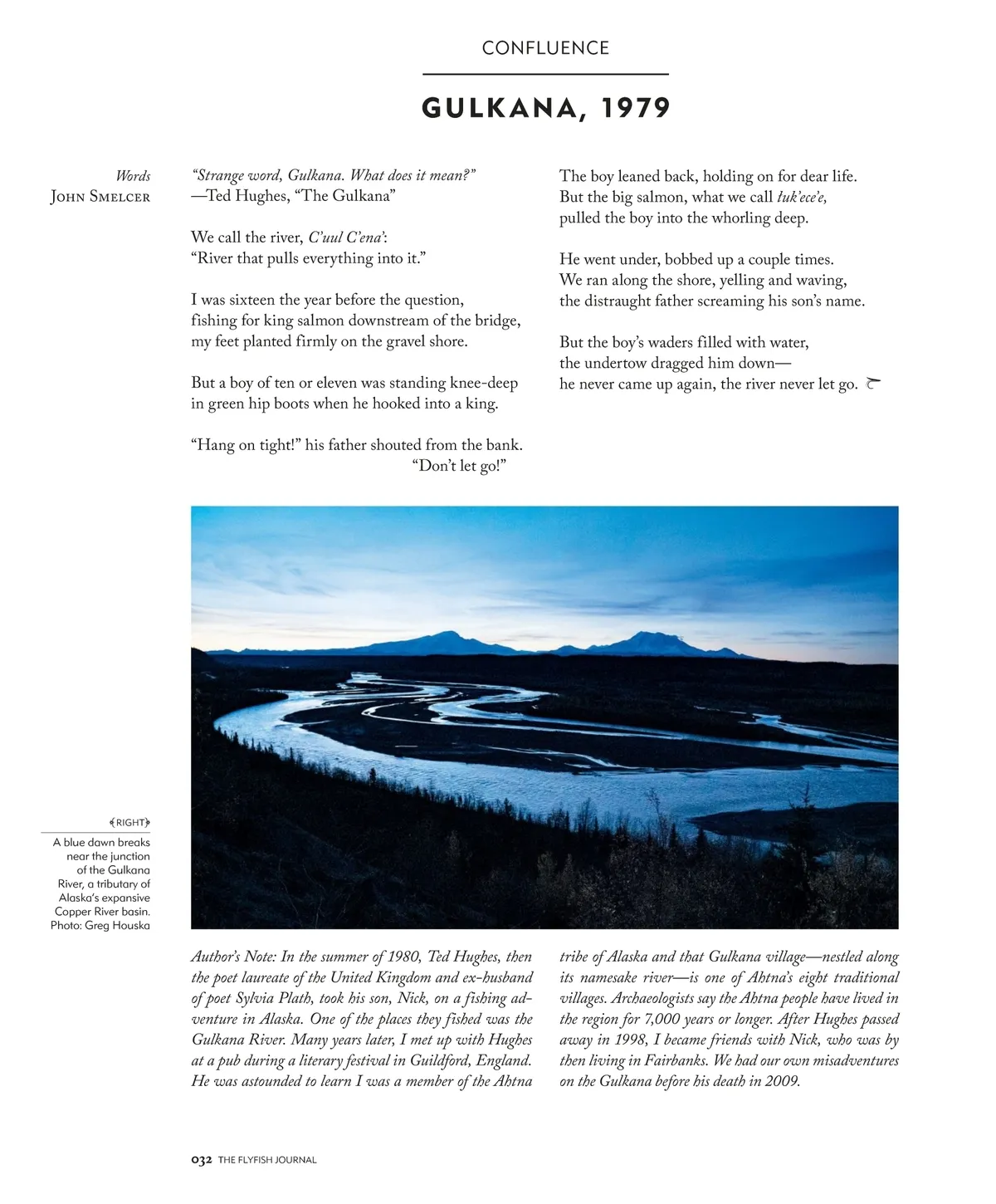
CONFLUENCE GULKANA, 1979 Words John Smelcer “Strange word, Gulkana. What does it mean?” —Ted Hughes, “The Gulkana” We call the river, C’uul C’ena’ : “River that pulls everything into it.” I was sixteen the year before the question, fishing for king salmon downstream of the bridge, my feet planted firmly on the gravel shore. But a boy of ten or eleven was standing knee-deep in green hip boots when he hooked into a king. “Hang on tight!” his father shouted from the bank. “Don’t let go!” The boy leaned back, holding on for dear life. But the big salmon, what we call łuk’ece’e, pulled the boy into the whorling deep. He went under, bobbed up a couple times. We ran along the shore, yelling and waving, the distraught father screaming his son’s name. But the boy’s waders filled with water, the undertow dragged him down— he never came up again, the river never let go. • RIGHT • A blue dawn breaks near the junction of the Gulkana River, a tributary of Alaska’s expansive Copper River basin. Photo: Greg Houska Author’s Note: In the summer of 1980, Ted Hughes, then the poet laureate of the United Kingdom and ex-husband of poet Sylvia Plath, took his son, Nick, on a fishing ad-venture in Alaska. One of the places they fished was the Gulkana River. Many years later, I met up with Hughes at a pub during a literary festival in Guildford, England. He was astounded to learn I was a member of the Ahtna tribe of Alaska and that Gulkana village—nestled along its namesake river—is one of Ahtna’s eight traditional villages. Archaeologists say the Ahtna people have lived in the region for 7,000 years or longer. After Hughes passed away in 1998, I became friends with Nick, who was by then living in Fairbanks. We had our own misadventures on the Gulkana before his death in 2009. 032 THE FLYFISH JOURNAL
The Flyfish Journal The Flyfish Journal 15.3: Page 32