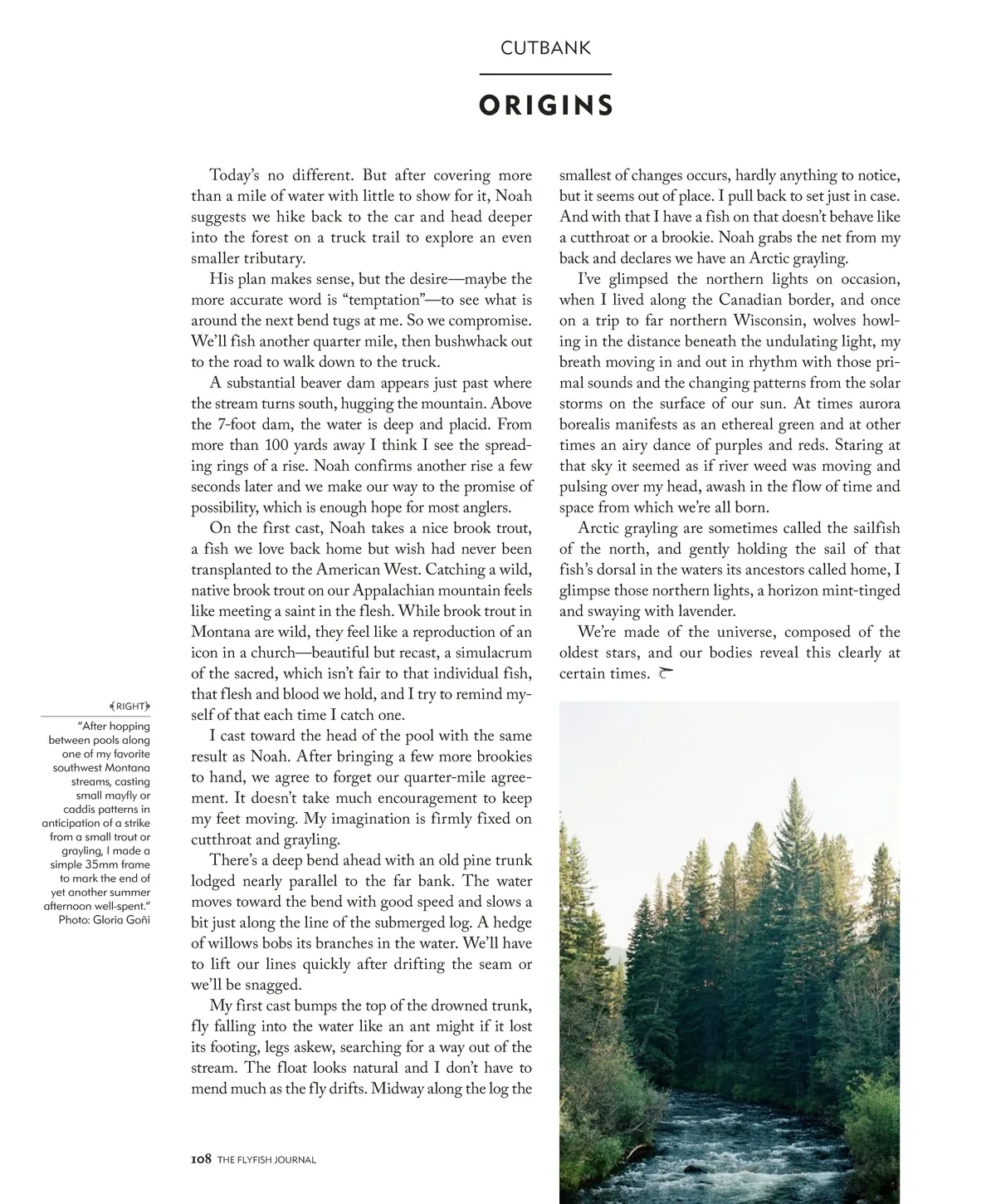
CUTBANK ORIGINS Today’s no different. But after covering more than a mile of water with little to show for it, Noah suggests we hike back to the car and head deeper into the forest on a truck trail to explore an even smaller tributary. His plan makes sense, but the desire—maybe the more accurate word is “temptation”—to see what is around the next bend tugs at me. So we compromise. We’ll fish another quarter mile, then bushwhack out to the road to walk down to the truck. A substantial beaver dam appears just past where the stream turns south, hugging the mountain. Above the 7-foot dam, the water is deep and placid. From more than 100 yards away I think I see the spread-ing rings of a rise. Noah confirms another rise a few seconds later and we make our way to the promise of possibility, which is enough hope for most anglers. On the first cast, Noah takes a nice brook trout, a fish we love back home but wish had never been transplanted to the American West. Catching a wild, native brook trout on our Appalachian mountain feels like meeting a saint in the flesh. While brook trout in Montana are wild, they feel like a reproduction of an icon in a church—beautiful but recast, a simulacrum of the sacred, which isn’t fair to that individual fish, that flesh and blood we hold, and I try to remind my-self of that each time I catch one. I cast toward the head of the pool with the same result as Noah. After bringing a few more brookies to hand, we agree to forget our quarter-mile agree-ment. It doesn’t take much encouragement to keep my feet moving. My imagination is firmly fixed on cutthroat and grayling. There’s a deep bend ahead with an old pine trunk lodged nearly parallel to the far bank. The water moves toward the bend with good speed and slows a bit just along the line of the submerged log. A hedge of willows bobs its branches in the water. We’ll have to lift our lines quickly after drifting the seam or we’ll be snagged. My first cast bumps the top of the drowned trunk, fly falling into the water like an ant might if it lost its footing, legs askew, searching for a way out of the stream. The float looks natural and I don’t have to mend much as the fly drifts. Midway along the log the smallest of changes occurs, hardly anything to notice, but it seems out of place. I pull back to set just in case. And with that I have a fish on that doesn’t behave like a cutthroat or a brookie. Noah grabs the net from my back and declares we have an Arctic grayling. I’ve glimpsed the northern lights on occasion, when I lived along the Canadian border, and once on a trip to far northern Wisconsin, wolves howl-ing in the distance beneath the undulating light, my breath moving in and out in rhythm with those pri-mal sounds and the changing patterns from the solar storms on the surface of our sun. At times aurora borealis manifests as an ethereal green and at other times an airy dance of purples and reds. Staring at that sky it seemed as if river weed was moving and pulsing over my head, awash in the flow of time and space from which we’re all born. Arctic grayling are sometimes called the sailfish of the north, and gently holding the sail of that fish’s dorsal in the waters its ancestors called home, I glimpse those northern lights, a horizon mint-tinged and swaying with lavender. We’re made of the universe, composed of the oldest stars, and our bodies reveal this clearly at certain times. • RIGHT • “After hopping between pools along one of my favorite southwest Montana streams, casting small mayfly or caddis patterns in anticipation of a strike from a small trout or grayling, I made a simple 35mm frame to mark the end of yet another summer afternoon well-spent.” Photo: Gloria Goñi 108 THE FLYFISH JOURNAL
The Flyfish Journal The Flyfish Journal 15.3: Page 108