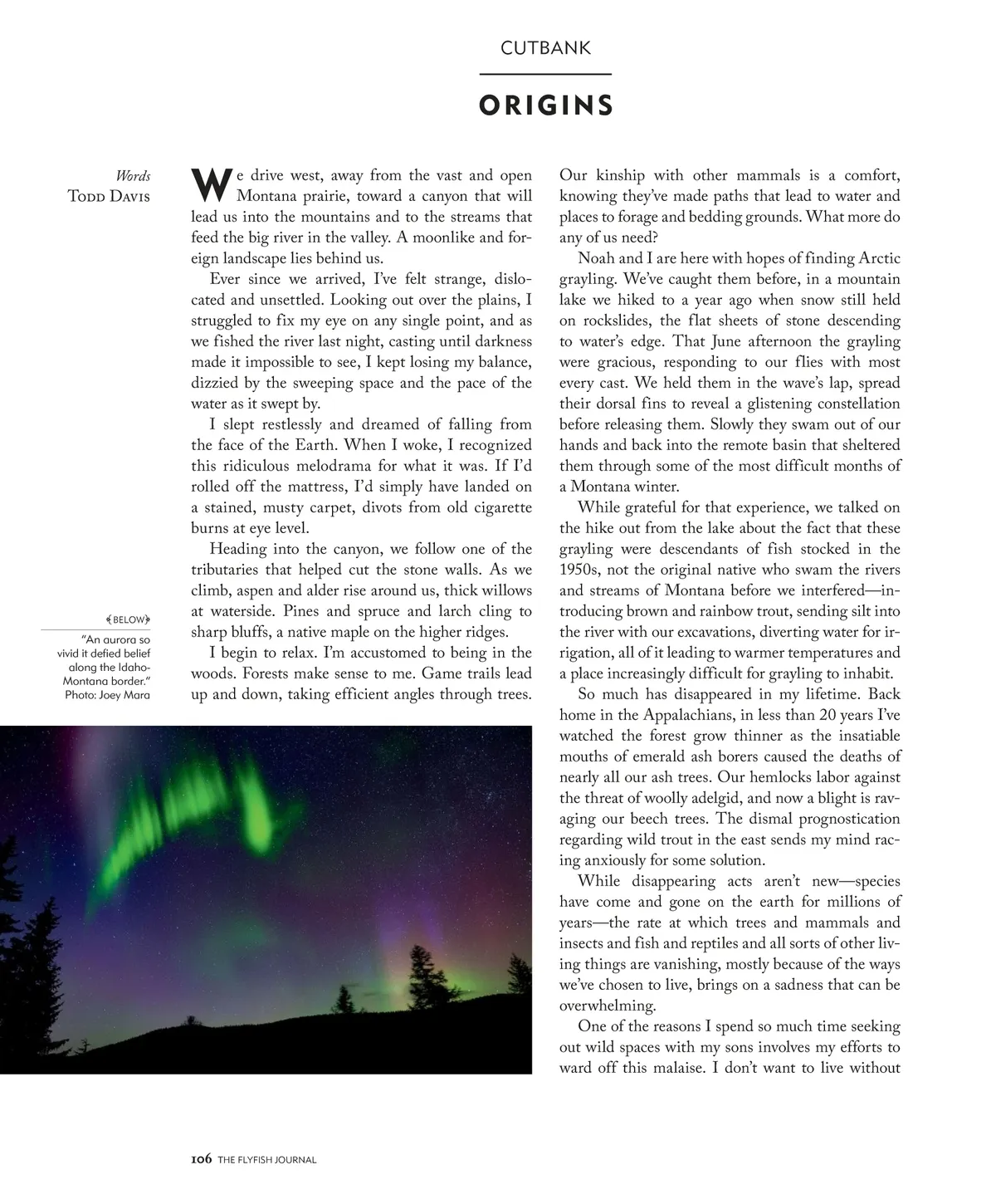
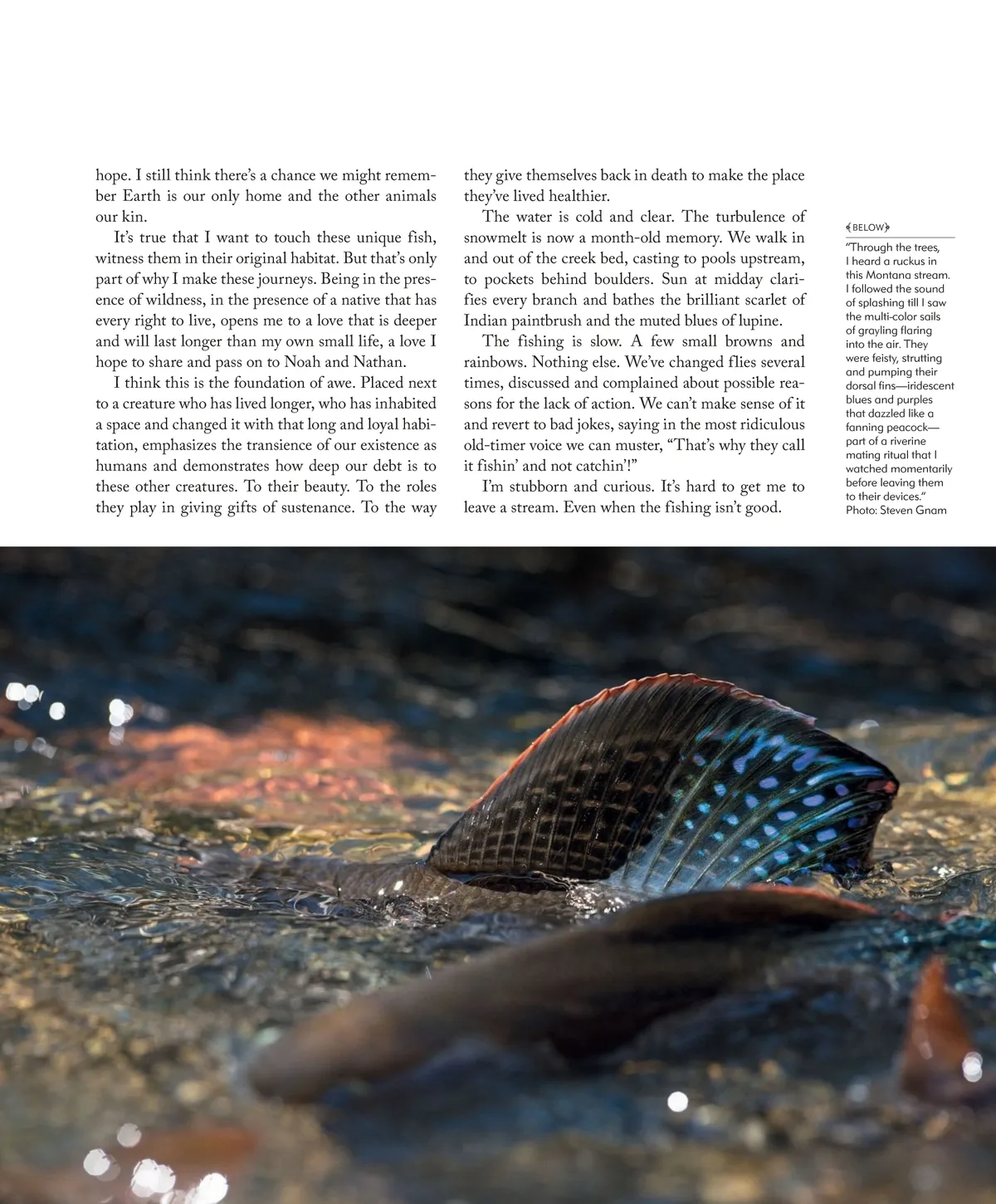
CUTBANK ORIGINS Words Todd Davis • BELOW • “An aurora so vivid it defied belief along the Idaho-Montana border.” Photo: Joey Mara e drive west, away from the vast and open Montana prairie, toward a canyon that will lead us into the mountains and to the streams that feed the big river in the valley. A moonlike and for-eign landscape lies behind us. Ever since we arrived, I’ve felt strange, dislo-cated and unsettled. Looking out over the plains, I struggled to fix my eye on any single point, and as we fished the river last night, casting until darkness made it impossible to see, I kept losing my balance, dizzied by the sweeping space and the pace of the water as it swept by. I slept restlessly and dreamed of falling from the face of the Earth. When I woke, I recognized this ridiculous melodrama for what it was. If I’d rolled off the mattress, I’d simply have landed on a stained, musty carpet, divots from old cigarette burns at eye level. Heading into the canyon, we follow one of the tributaries that helped cut the stone walls. As we climb, aspen and alder rise around us, thick willows at waterside. Pines and spruce and larch cling to sharp bluffs, a native maple on the higher ridges. I begin to relax. I’m accustomed to being in the woods. Forests make sense to me. Game trails lead up and down, taking efficient angles through trees. W Our kinship with other mammals is a comfort, knowing they’ve made paths that lead to water and places to forage and bedding grounds. What more do any of us need? Noah and I are here with hopes of finding Arctic grayling. We’ve caught them before, in a mountain lake we hiked to a year ago when snow still held on rockslides, the flat sheets of stone descending to water’s edge. That June afternoon the grayling were gracious, responding to our flies with most every cast. We held them in the wave’s lap, spread their dorsal fins to reveal a glistening constellation before releasing them. Slowly they swam out of our hands and back into the remote basin that sheltered them through some of the most difficult months of a Montana winter. While grateful for that experience, we talked on the hike out from the lake about the fact that these grayling were descendants of fish stocked in the 1950s, not the original native who swam the rivers and streams of Montana before we interfered—in-troducing brown and rainbow trout, sending silt into the river with our excavations, diverting water for ir-rigation, all of it leading to warmer temperatures and a place increasingly difficult for grayling to inhabit. So much has disappeared in my lifetime. Back home in the Appalachians, in less than 20 years I’ve watched the forest grow thinner as the insatiable mouths of emerald ash borers caused the deaths of nearly all our ash trees. Our hemlocks labor against the threat of woolly adelgid, and now a blight is rav-aging our beech trees. The dismal prognostication regarding wild trout in the east sends my mind rac-ing anxiously for some solution. While disappearing acts aren’t new—species have come and gone on the earth for millions of years—the rate at which trees and mammals and insects and fish and reptiles and all sorts of other liv-ing things are vanishing, mostly because of the ways we’ve chosen to live, brings on a sadness that can be overwhelming. One of the reasons I spend so much time seeking out wild spaces with my sons involves my efforts to ward off this malaise. I don’t want to live without 106 THE FLYFISH JOURNAL
The Flyfish Journal The Flyfish Journal 15.3: Page 106