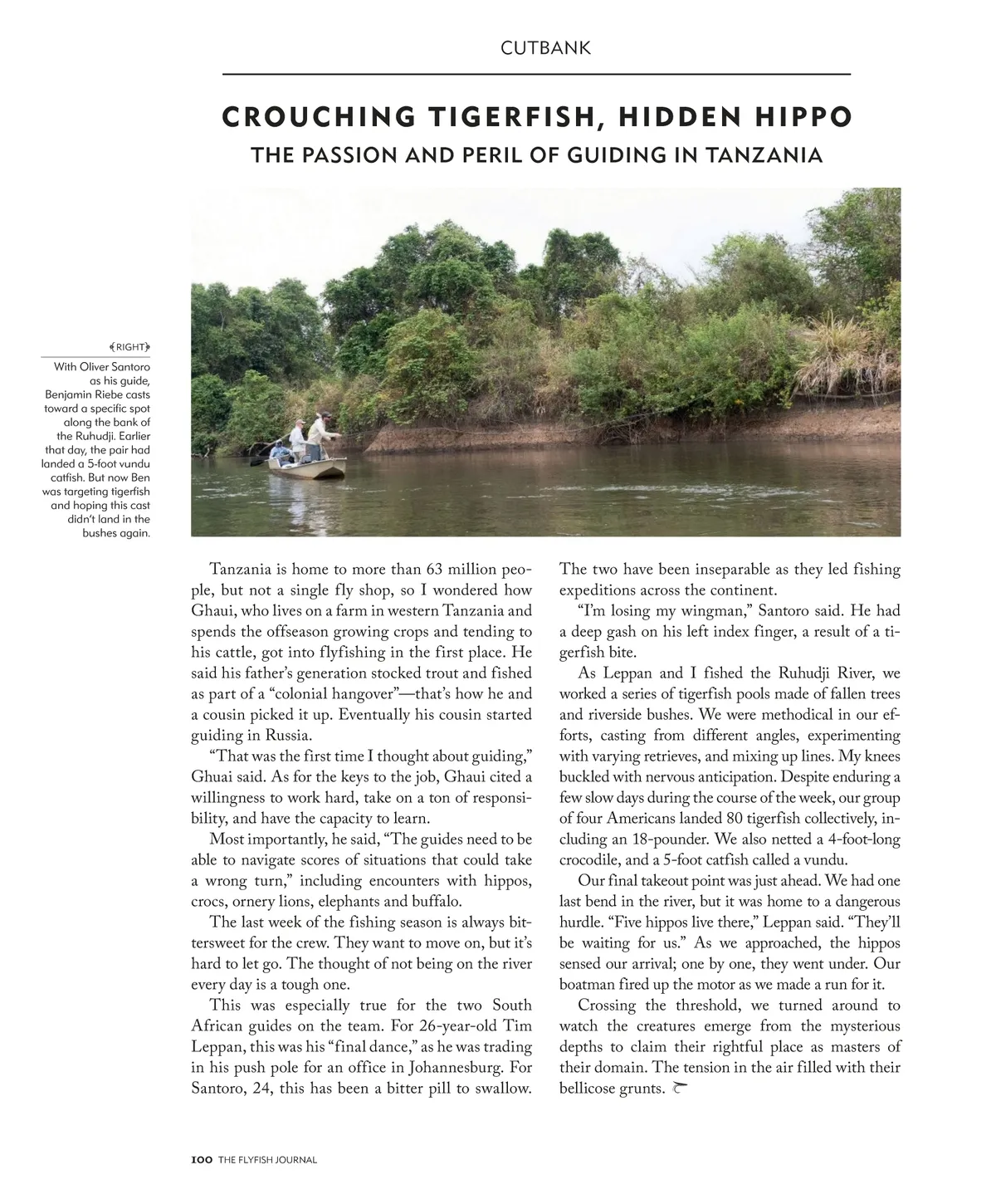
CUTBANK CROUCHING TIGERFISH, HIDDEN HIPPO THE PASSION AND PERIL OF GUIDING IN TANZANIA • RIGHT • With Oliver Santoro as his guide, Benjamin Riebe casts toward a specific spot along the bank of the Ruhudji. Earlier that day, the pair had landed a 5-foot vundu catfish. But now Ben was targeting tigerfish and hoping this cast didn’t land in the bushes again. Tanzania is home to more than 63 million peo-ple, but not a single fly shop, so I wondered how Ghaui, who lives on a farm in western Tanzania and spends the offseason growing crops and tending to his cattle, got into flyfishing in the first place. He said his father’s generation stocked trout and fished as part of a “colonial hangover”—that’s how he and a cousin picked it up. Eventually his cousin started guiding in Russia. “That was the first time I thought about guiding,” Ghuai said. As for the keys to the job, Ghaui cited a willingness to work hard, take on a ton of responsi-bility, and have the capacity to learn. Most importantly, he said, “The guides need to be able to navigate scores of situations that could take a wrong turn,” including encounters with hippos, crocs, ornery lions, elephants and buffalo. The last week of the fishing season is always bit-tersweet for the crew. They want to move on, but it’s hard to let go. The thought of not being on the river every day is a tough one. This was especially true for the two South African guides on the team. For 26-year-old Tim Leppan, this was his “final dance,” as he was trading in his push pole for an office in Johannesburg. For Santoro, 24, this has been a bitter pill to swallow. The two have been inseparable as they led fishing expeditions across the continent. “I’m losing my wingman,” Santoro said. He had a deep gash on his left index finger, a result of a ti-gerfish bite. As Leppan and I fished the Ruhudji River, we worked a series of tigerfish pools made of fallen trees and riverside bushes. We were methodical in our ef-forts, casting from different angles, experimenting with varying retrieves, and mixing up lines. My knees buckled with nervous anticipation. Despite enduring a few slow days during the course of the week, our group of four Americans landed 80 tigerfish collectively, in-cluding an 18-pounder. We also netted a 4-foot-long crocodile, and a 5-foot catfish called a vundu. Our final takeout point was just ahead. We had one last bend in the river, but it was home to a dangerous hurdle. “Five hippos live there,” Leppan said. “They’ll be waiting for us.” As we approached, the hippos sensed our arrival; one by one, they went under. Our boatman fired up the motor as we made a run for it. Crossing the threshold, we turned around to watch the creatures emerge from the mysterious depths to claim their rightful place as masters of their domain. The tension in the air filled with their bellicose grunts. 100 THE FLYFISH JOURNAL
The Flyfish Journal The Flyfish Journal 15.3: Page 100