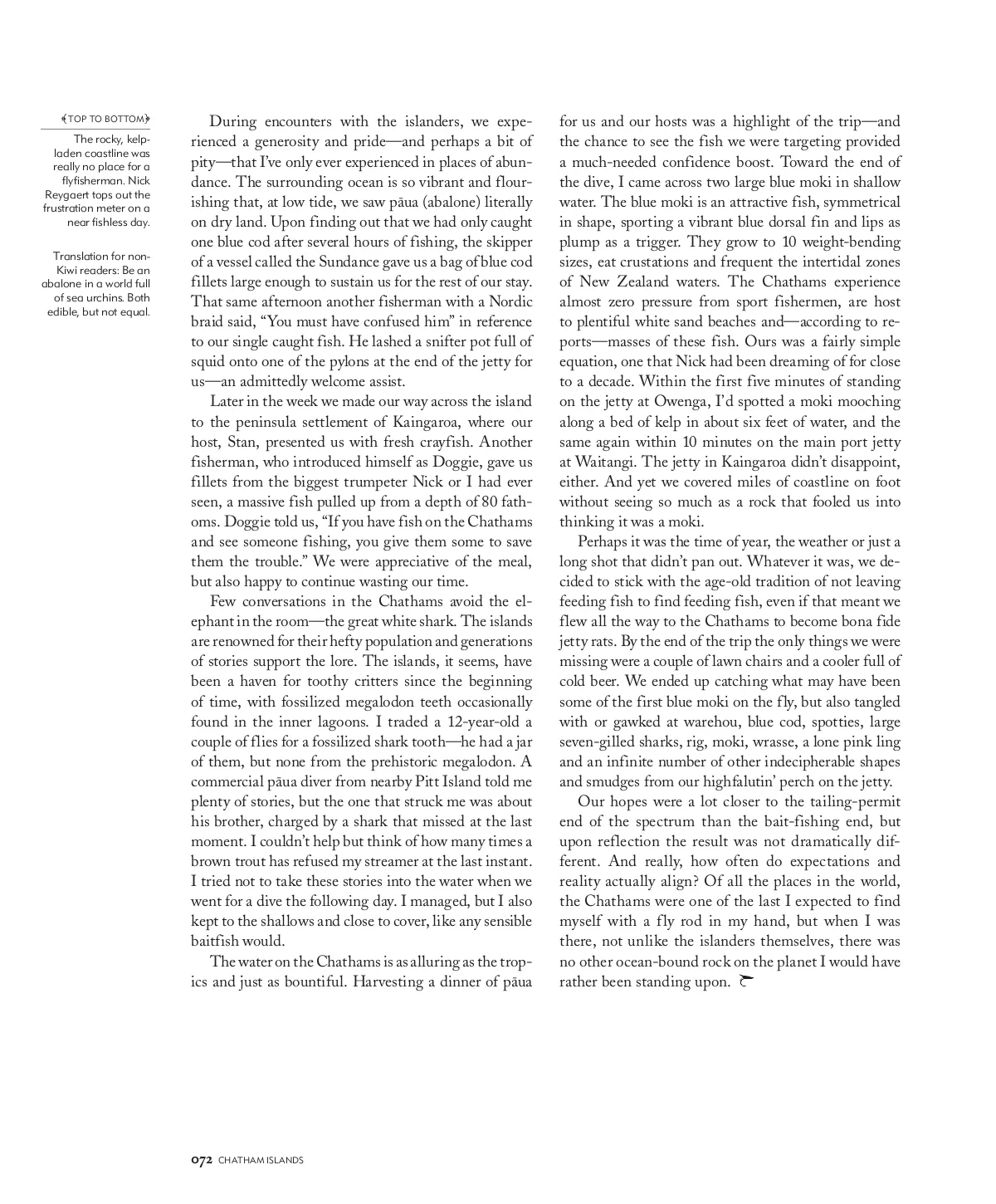
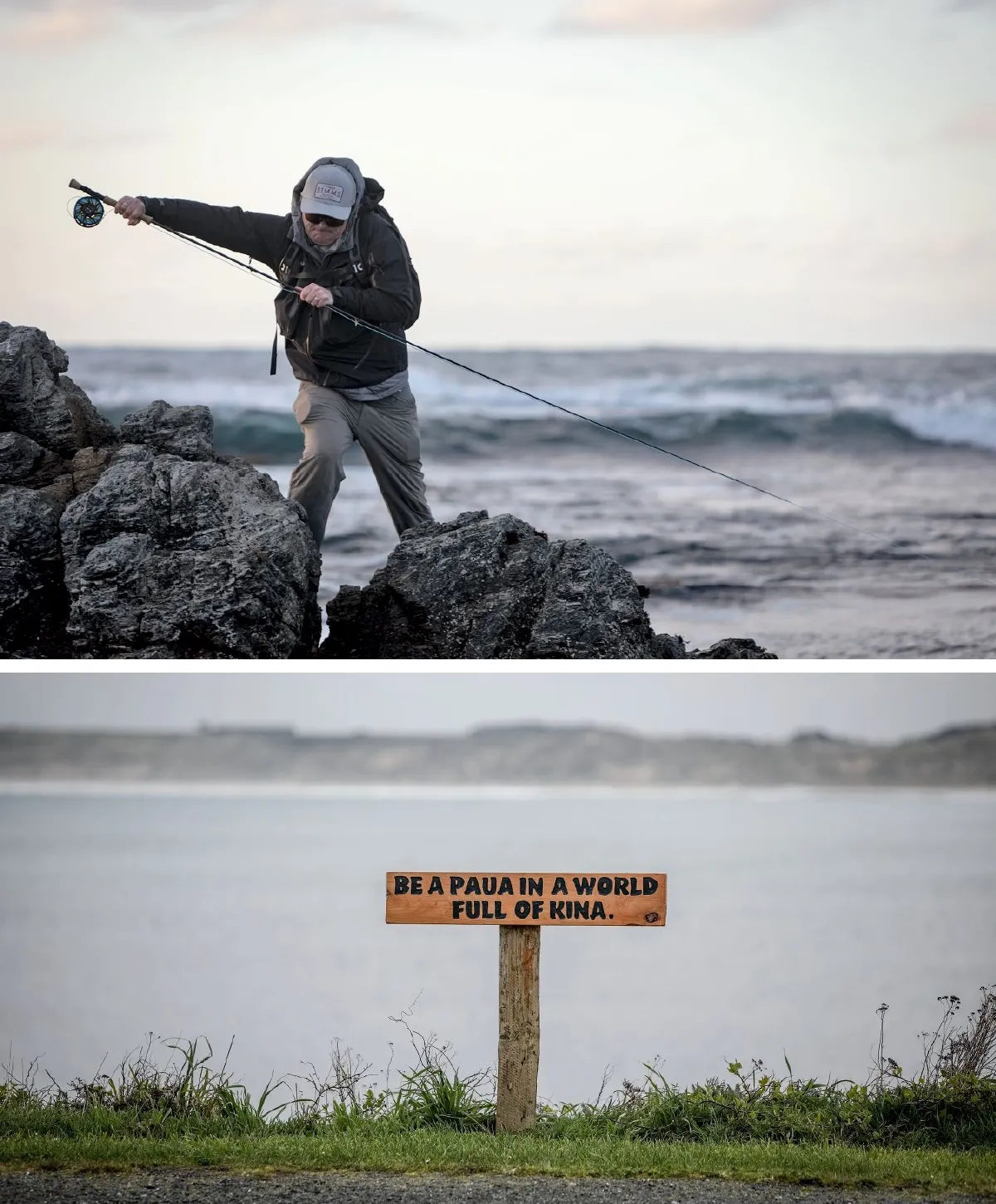
TOP TO BOTTOM The rocky, kelp-laden coastline was really no place for a flyfisherman. Nick Reygaert tops out the frustration meter on a near fishless day. Translation for non-Kiwi readers: Be an abalone in a world full of sea urchins. Both edible, but not equal. During encounters w ith the islanders, we expe-rienced a generosity and pride—and perhaps a bit of pity—that I’ve only ever experienced in places of abun-dance. The surrounding ocean is so vibrant and flour-ishing that, at low tide, we saw pāua (abalone) literally on dry land. Upon finding out that we had only caught one blue cod after several hours of fishing, the skipper of a vessel called the Sundance gave us a bag of blue cod fillets large enough to sustain us for the rest of our stay. That same afternoon another fisherman with a Nordic braid said, “You must have confused him” in reference to our single caught fish. He lashed a snifter pot full of squid onto one of the pylons at the end of the jetty for us—an admittedly welcome assist. Later in the week we made our way across the island to the peninsula settlement of Kaingaroa, where our host, Stan, presented us with fresh crayfish. Another fisherman, who introduced himself as Doggie, gave us fillets from the biggest trumpeter Nick or I had ever seen, a massive fish pulled up from a depth of 80 fath-oms. Doggie told us, “If you have fish on the Chathams and see someone fishing, you give them some to save them the trouble.” We were appreciative of the meal, but also happy to continue wasting our time. Few conversations in the Chathams avoid the el-ephant in the room—the great white shark. The islands are renowned for their hefty population and generations of stories support the lore. The islands, it seems, have been a haven for toothy critters since the beginning of time, with fossilized megalodon teeth occasionally found in the inner lagoons. I traded a 12-year-old a couple of flies for a fossilized shark tooth—he had a jar of them, but none from the prehistoric megalodon. A commercial pāua diver from nearby Pitt Island told me plenty of stories, but the one that struck me was about his brother, charged by a shark that missed at the last moment. I couldn’t help but think of how many times a brown trout has refused my streamer at the last instant. I tried not to take these stories into the water when we went for a dive the following day. I managed, but I also kept to the shallows and close to cover, like any sensible baitfish would. The water on the Chathams is as alluring as the trop-ics and just as bountiful. Harvesting a dinner of pāua for us and our hosts was a highlight of the trip—and the chance to see the fish we were targeting provided a much-needed confidence boost. Toward the end of the dive, I came across two large blue moki in shallow water. The blue moki is an attractive fish, symmetrical in shape, sporting a vibrant blue dorsal fin and lips as plump as a trigger. They grow to 10 weight-bending sizes, eat crustations and frequent the intertidal zones of New Zealand waters. The Chathams experience almost zero pressure from sport fishermen, are host to plentiful white sand beaches and—according to re-ports—masses of these fish. Ours was a fairly simple equation, one that Nick had been dreaming of for close to a decade. Within the first five minutes of standing on the jetty at Owenga, I’d spotted a moki mooching along a bed of kelp in about six feet of water, and the same again within 10 minutes on the main port jetty at Waitangi. The jetty in Kaingaroa didn’t disappoint, either. And yet we covered miles of coastline on foot without seeing so much as a rock that fooled us into thinking it was a moki. Perhaps it was the time of year, the weather or just a long shot that didn’t pan out. Whatever it was, we de-cided to stick with the age-old tradition of not leaving feeding fish to find feeding fish, even if that meant we flew all the way to the Chathams to become bona fide jetty rats. By the end of the trip the only things we were missing were a couple of lawn chairs and a cooler full of cold beer. We ended up catching what may have been some of the first blue moki on the fly, but also tangled with or gawked at warehou, blue cod, spotties, large seven-gilled sharks, rig, moki, wrasse, a lone pink ling and an infinite number of other indecipherable shapes and smudges from our highfalutin’ perch on the jetty. Our hopes were a lot closer to the tailing-permit end of the spectrum than the bait-fishing end, but upon reflection the result was not dramatically dif-ferent. And really, how often do expectations and reality actually align? Of all the places in the world, the Chathams were one of the last I expected to find myself with a fly rod in my hand, but when I was there, not unlike the islanders themselves, there was no other ocean-bound rock on the planet I would have rather been standing upon. 072 CHATHAM ISLANDS
The Flyfish Journal The Flyfish Journal 13.4: Page 72