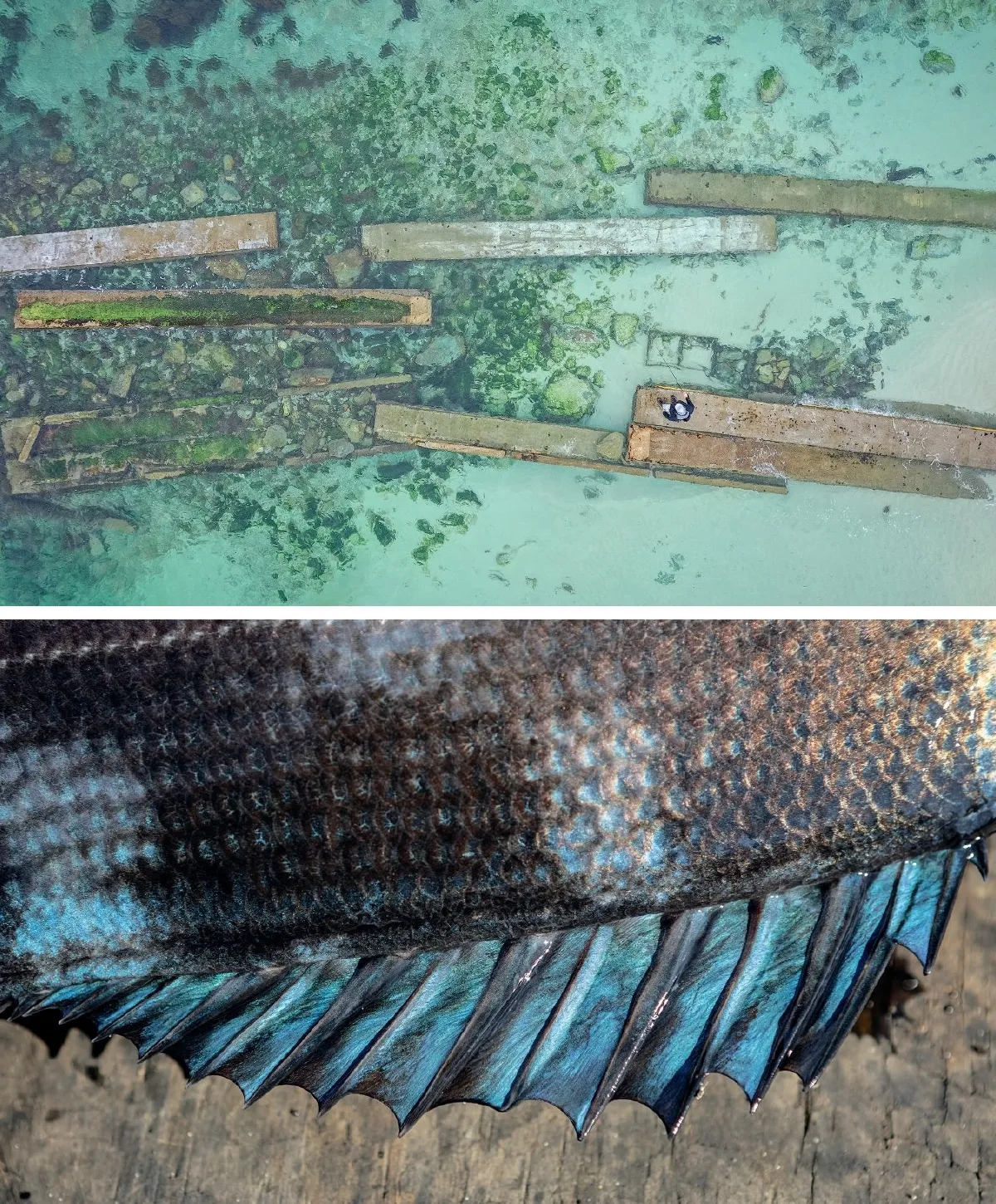
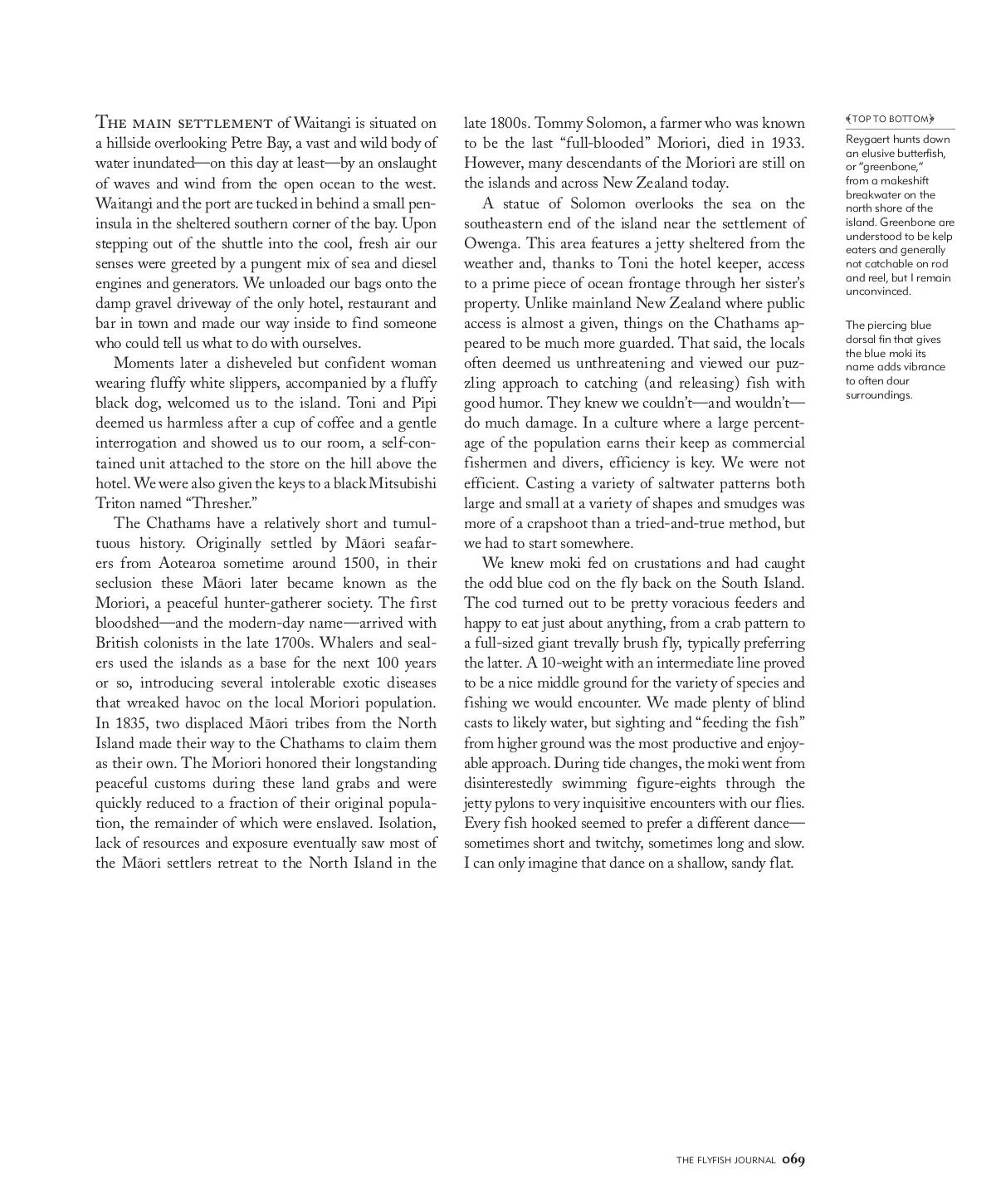
The main settlement of Waitangi is situated on a hillside overlooking Petre Bay, a vast and wild body of water inundated—on this day at least—by an onslaught of waves and wind from the open ocean to the west. Waitangi and the port are tucked in behind a small pen-insula in the sheltered southern corner of the bay. Upon stepping out of the shuttle into the cool, fresh air our senses were greeted by a pungent mix of sea and diesel engines and generators. We unloaded our bags onto the damp gravel driveway of the only hotel, restaurant and bar in town and made our way inside to find someone who could tell us what to do with ourselves. Moments later a disheveled but confident woman wearing fluffy white slippers, accompanied by a fluffy black dog, welcomed us to the island. Toni and Pipi deemed us harmless after a cup of coffee and a gentle interrogation and showed us to our room, a self-con-tained unit attached to the store on the hill above the hotel. We were also given the keys to a black Mitsubishi Triton named “Thresher.” The Chathams have a relatively short and tumul-tuous history. Originally settled by Māori seafar-ers from Aotearoa sometime around 1500, in their seclusion these Māori later became known as the Moriori, a peaceful hunter-gatherer society. The first bloodshed—and the modern-day name—arrived with British colonists in the late 1700s. Whalers and seal-ers used the islands as a base for the next 100 years or so, introducing several intolerable exotic diseases that wreaked havoc on the local Moriori population. In 1835, two displaced Māori tribes from the North Island made their way to the Chathams to claim them as their own. The Moriori honored their longstanding peaceful customs during these land grabs and were quickly reduced to a fraction of their original popula-tion, the remainder of which were enslaved. Isolation, lack of resources and exposure eventually saw most of the Māori settlers retreat to the North Island in the late 1800s. Tommy Solomon, a farmer who was known to be the last “full-blooded” Moriori, died in 1933. However, many descendants of the Moriori are still on the islands and across New Zealand today. A statue of Solomon overlooks the sea on the southeastern end of the island near the settlement of Owenga. This area features a jetty sheltered from the weather and, thanks to Toni the hotel keeper, access to a prime piece of ocean frontage through her sister’s property. Unlike mainland New Zealand where public access is almost a given, things on the Chathams ap-peared to be much more guarded. That said, the locals often deemed us unthreatening and viewed our puz-zling approach to catching (and releasing) fish with good humor. They knew we couldn’t—and wouldn’t— do much damage. In a culture where a large percent-age of the population earns their keep as commercial fishermen and divers, efficiency is key. We were not efficient. Casting a variety of saltwater patterns both large and small at a variety of shapes and smudges was more of a crapshoot than a tried-and-true method, but we had to start somewhere. We knew moki fed on crustations and had caught the odd blue cod on the fly back on the South Island. The cod turned out to be pretty voracious feeders and happy to eat just about anything, from a crab pattern to a full-sized giant trevally brush fly, typically preferring the latter. A 10-weight with an intermediate line proved to be a nice middle ground for the variety of species and fishing we would encounter. We made plenty of blind casts to likely water, but sighting and “feeding the fish” from higher ground was the most productive and enjoy-able approach. During tide changes, the moki went from disinterestedly swimming figure-eights through the jetty pylons to very inquisitive encounters with our flies. Every fish hooked seemed to prefer a different dance— sometimes short and twitchy, sometimes long and slow. I can only imagine that dance on a shallow, sandy flat. TOP TO BOTTOM Reygaert hunts down an elusive butterfish, or “greenbone,” from a makeshift breakwater on the north shore of the island. Greenbone are understood to be kelp eaters and generally not catchable on rod and reel, but I remain unconvinced. The piercing blue dorsal fin that gives the blue moki its name adds vibrance to often dour surroundings. THE FLYFISH JOURNAL 069
The Flyfish Journal The Flyfish Journal 13.4: Page 69