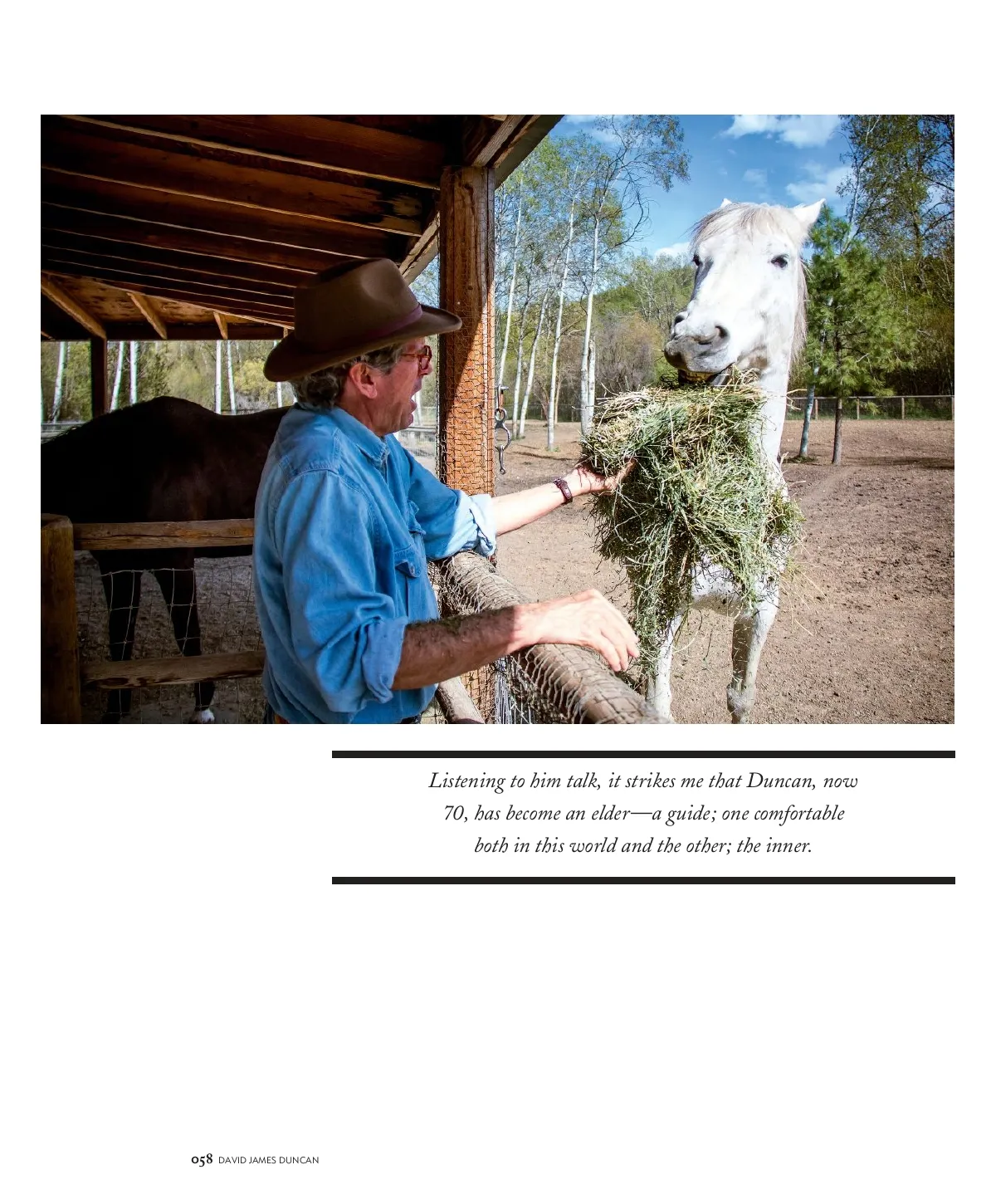
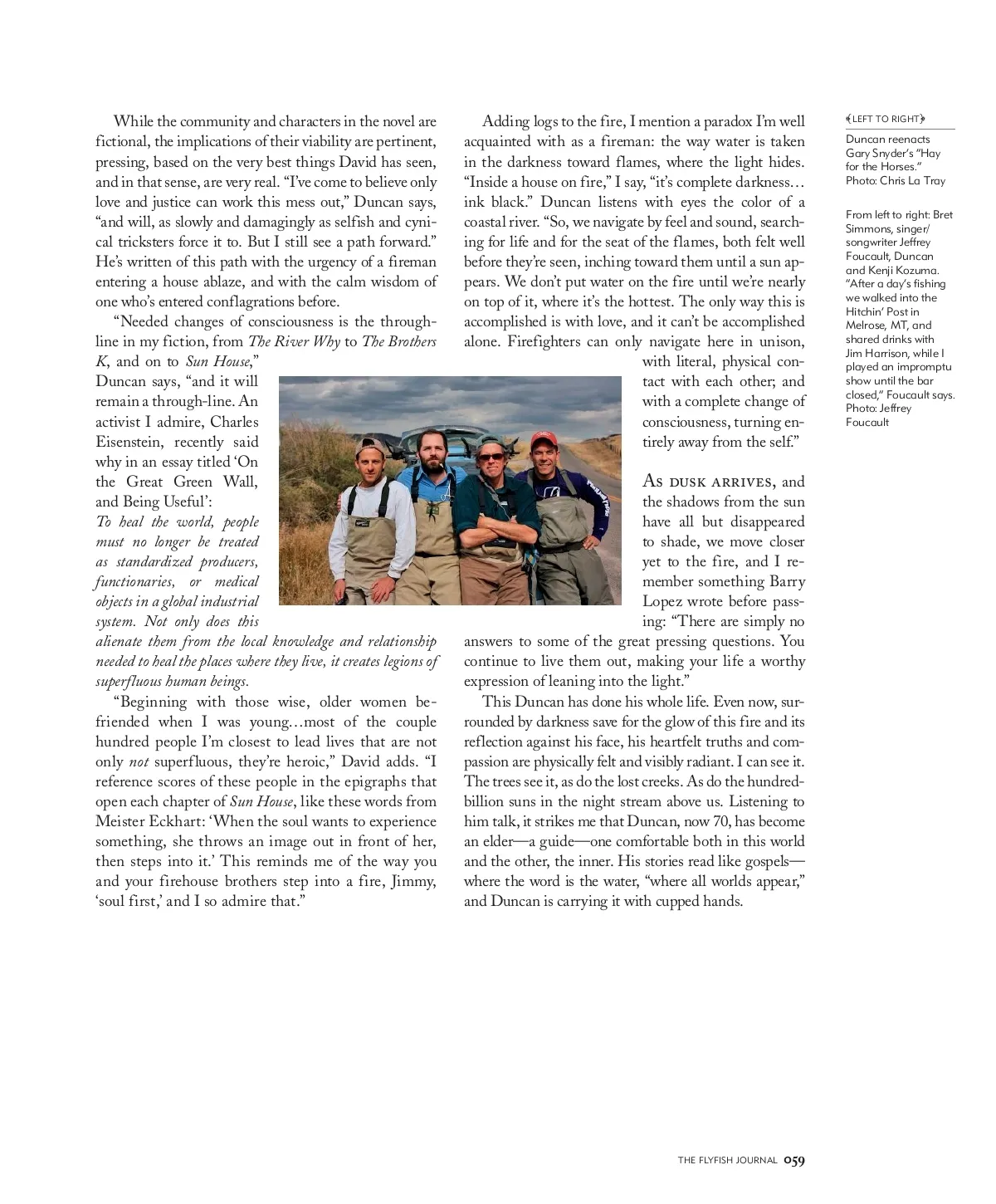
While the community and characters in the novel are fictional, the implications of their viability are pertinent, pressing, based on the very best things David has seen, and in that sense, are very real. “I’ve come to believe only love and justice can work this mess out,” Duncan says, “and will, as slowly and damagingly as selfish and cyni-cal tricksters force it to. But I still see a path forward.” He’s written of this path with the urgency of a fireman entering a house ablaze, and with the calm wisdom of one who’s entered conflagrations before. “Needed changes of consciousness is the through-line in my fiction, from The River Why to The Brothers K , and on to Sun House ,” Duncan says, “and it will remain a through-line. An activist I admire, Charles Eisenstein, recently said why in an essay titled ‘On the Great Green Wall, and Being Useful’: To heal the world, people must no longer be treated as standardized producers, functionaries, or medical objects in a global industrial system. Not only does this alienate them from the local knowledge and relationship needed to heal the places where they live, it creates legions of superfluous human beings. “Beginning with those wise, older women be-friended when I was young…most of the couple hundred people I’m closest to lead lives that are not only not superfluous, they’re heroic,” David adds. “I reference scores of these people in the epigraphs that open each chapter of Sun House , like these words from Meister Eckhart: ‘When the soul wants to experience something, she throws an image out in front of her, then steps into it.’ This reminds me of the way you and your firehouse brothers step into a fire, Jimmy, ‘soul first,’ and I so admire that.” Adding logs to the fire, I mention a paradox I’m well acquainted with as a fireman: the way water is taken in the darkness toward flames, where the light hides. “Inside a house on fire,” I say, “it’s complete darkness… ink black.” Duncan listens with eyes the color of a coastal river. “So, we navigate by feel and sound, search-ing for life and for the seat of the flames, both felt well before they’re seen, inching toward them until a sun ap-pears. We don’t put water on the fire until we’re nearly on top of it, where it’s the hottest. The only way this is accomplished is with love, and it can’t be accomplished alone. Firefighters can only navigate here in unison, with literal, physical con-tact with each other; and with a complete change of consciousness, turning en-tirely away from the self.” LEFT TO RIGHT Duncan reenacts Gary Snyder’s “Hay for the Horses.” Photo: Chris La Tray From left to right: Bret Simmons, singer/ songwriter Jeffrey Foucault, Duncan and Kenji Kozuma. “After a day’s fishing we walked into the Hitchin’ Post in Melrose, MT, and shared drinks with Jim Harrison, while I played an impromptu show until the bar closed,” Foucault says. Photo: Jeffrey Foucault As dusk arrives, and the shadows from the sun have all but disappeared to shade, we move closer yet to the fire, and I re-member something Barry Lopez wrote before pass-ing: “There are simply no answers to some of the great pressing questions. You continue to live them out, making your life a worthy expression of leaning into the light.” This Duncan has done his whole life. Even now, sur-rounded by darkness save for the glow of this fire and its reflection against his face, his heartfelt truths and com-passion are physically felt and visibly radiant. I can see it. The trees see it, as do the lost creeks. As do the hundred-billion suns in the night stream above us. Listening to him talk, it strikes me that Duncan, now 70, has become an elder—a guide—one comfortable both in this world and the other, the inner. His stories read like gospels— where the word is the water, “where all worlds appear,” and Duncan is carrying it with cupped hands. THE FLYFISH JOURNAL 059
The Flyfish Journal The Flyfish Journal 13.4: Page 59