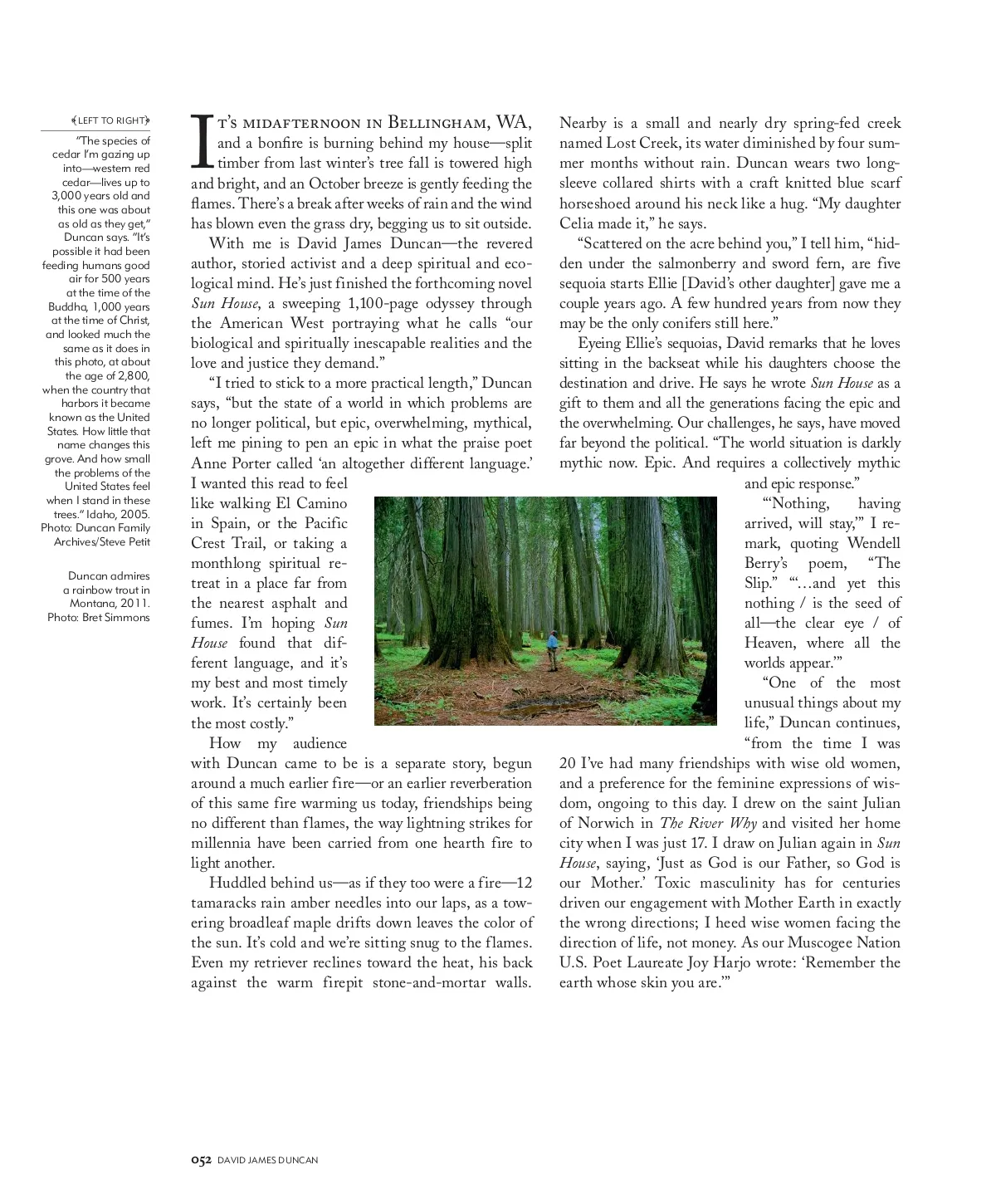
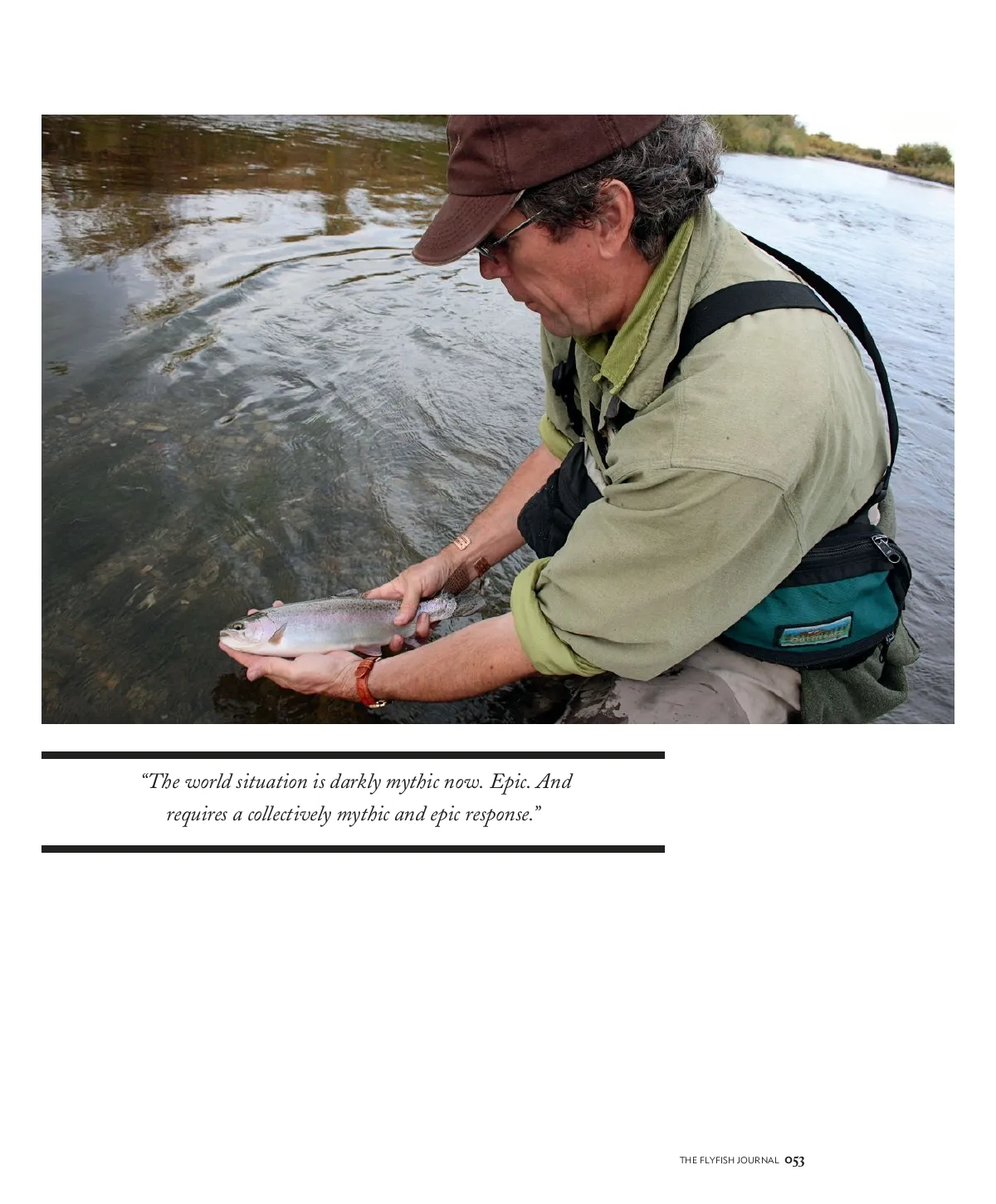
LEFT TO RIGHT “The species of cedar I’m gazing up into—western red cedar—lives up to 3,000 years old and this one was about as old as they get,” Duncan says. “It’s possible it had been feeding humans good air for 500 years at the time of the Buddha, 1,000 years at the time of Christ, and looked much the same as it does in this photo, at about the age of 2,800, when the country that harbors it became known as the United States. How little that name changes this grove. And how small the problems of the United States feel when I stand in these trees.” Idaho, 2005. Photo: Duncan Family Archives/Steve Petit Duncan admires a rainbow trout in Montana, 2011. Photo: Bret Simmons I t’s midafternoon in Bellingham, WA , and a bonfire is burning behind my house—split timber from last winter’s tree fall is towered high and bright, and an October breeze is gently feeding the flames. There’s a break after weeks of rain and the wind has blown even the grass dry, begging us to sit outside. With me is David James Duncan—the revered author, storied activist and a deep spiritual and eco-logical mind. He’s just finished the forthcoming novel Sun House , a sweeping 1,100-page odyssey through t he A mer ica n West por t ray ing what he ca l ls “ou r biological and spiritually inescapable realities and the love and justice they demand.” “I tried to stick to a more practical length,” Duncan says, “but the state of a world in which problems are no longer political, but epic, overwhelming, mythical, left me pining to pen an epic in what the praise poet Anne Porter called ‘an altogether different language.’ I wanted this read to feel like walking El Camino in Spain, or the Pacific Crest Trail, or taking a monthlong spiritual re-treat in a place far from the nearest asphalt and fumes. I’m hoping Sun House found that dif-ferent language, and it’s my best and most timely work. It’s certainly been the most costly.” How my audience with Duncan came to be is a separate story, begun around a much earlier fire—or an earlier reverberation of this same fire warming us today, friendships being no different than flames, the way lightning strikes for millennia have been carried from one hearth fire to light another. Huddled behind us—as if they too were a fire—12 tamaracks rain amber needles into our laps, as a tow-ering broadleaf maple drifts down leaves the color of the sun. It’s cold and we’re sitting snug to the flames. Even my retriever reclines toward the heat, his back against the warm firepit stone-and-mortar walls. Nearby is a small and nearly dry spring-fed creek named Lost Creek, its water diminished by four sum-mer months without rain. Duncan wears two long-sleeve collared shirts with a craft knitted blue scarf horseshoed around his neck like a hug. “My daughter Celia made it,” he says. “Scattered on the acre behind you,” I tell him, “hid-den under the salmonberry and sword fern, are five sequoia starts Ellie [David’s other daughter] gave me a couple years ago. A few hundred years from now they may be the only conifers still here.” Eyeing Ellie’s sequoias, David remarks that he loves sitting in the backseat while his daughters choose the destination and drive. He says he wrote Sun House as a gift to them and all the generations facing the epic and the overwhelming. Our challenges, he says, have moved far beyond the political. “The world situation is darkly mythic now. Epic. And requires a collectively mythic and epic response.” “‘Nothing, having arrived, will stay,’” I re-mark, quoting Wendell Berry’s poem, “The Slip.” “‘…and yet this nothing / is the seed of all—the clear eye / of Heaven, where all the worlds appear.’” “One of the most unusual things about my life,” Duncan continues, “from the time I was 20 I’ve had many friendships with wise old women, and a preference for the feminine expressions of wis-dom, ongoing to this day. I drew on the saint Julian of Norwich in The River Why and visited her home city when I was just 17. I draw on Julian again in Sun House , saying, ‘Just as God is our Father, so God is our Mother.’ Toxic masculinity has for centuries driven our engagement with Mother Earth in exactly the wrong directions; I heed wise women facing the direction of life, not money. As our Muscogee Nation U.S. Poet Laureate Joy Harjo wrote: ‘Remember the earth whose skin you are.’” 052 DAVID JAMES DUNCAN
The Flyfish Journal The Flyfish Journal 13.4: Page 52