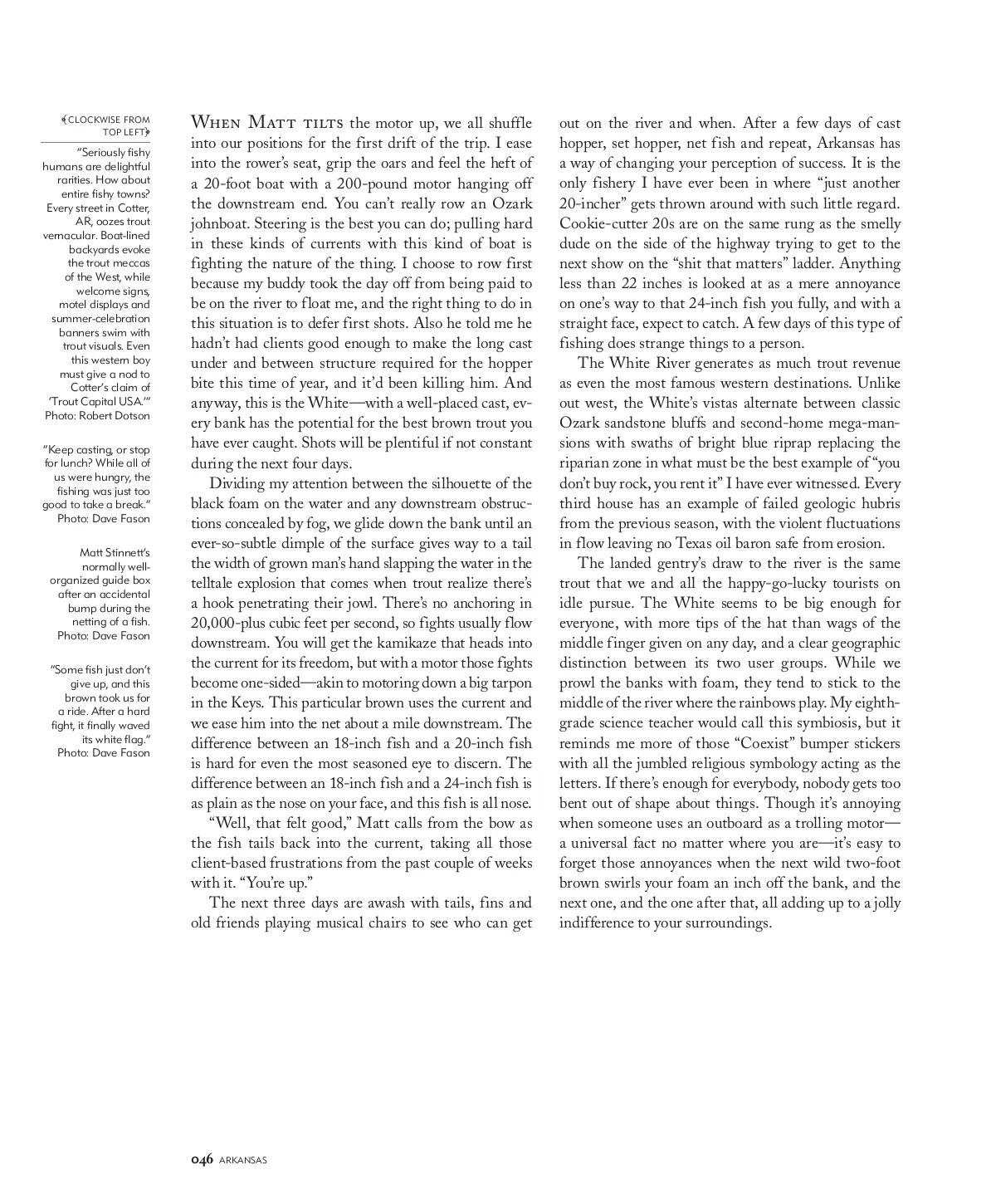
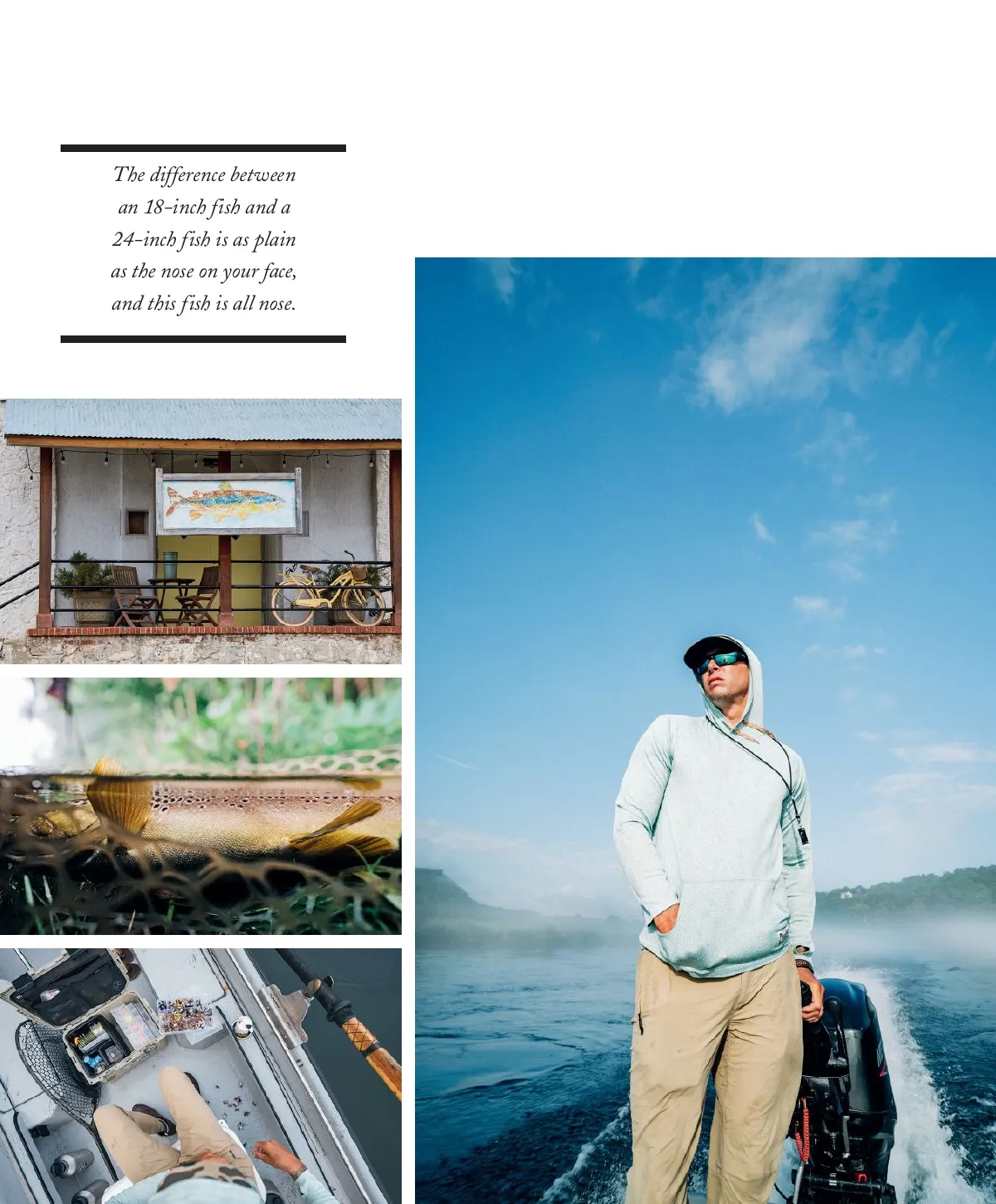
CLOCKWISE FROM TOP LEFT When Matt tilts the motor up, we all shuffle into our positions for the first drift of the trip. I ease into the rower’s seat, grip the oars and feel the heft of a 20-foot boat with a 200-pound motor hanging off the downstream end. You can’t really row an Ozark johnboat. Steering is the best you can do; pulling hard in these kinds of currents with this kind of boat is fighting the nature of the thing. I choose to row first because my buddy took the day off from being paid to be on the river to float me, and the right thing to do in this situation is to defer first shots. Also he told me he hadn’t had clients good enough to make the long cast under and between structure required for the hopper bite this time of year, and it’d been killing him. And anyway, this is the White—with a well-placed cast, ev-ery bank has the potential for the best brown trout you have ever caught. Shots will be plentiful if not constant during the next four days. Dividing my attention between the silhouette of the black foam on the water and any downstream obstruc-tions concealed by fog, we glide down the bank until an ever-so-subtle dimple of the surface gives way to a tail the width of grown man’s hand slapping the water in the telltale explosion that comes when trout realize there’s a hook penetrating their jowl. There’s no anchoring in 20,000-plus cubic feet per second, so fights usually flow downstream. You will get the kamikaze that heads into the current for its freedom, but with a motor those fights become one-sided—akin to motoring down a big tarpon in the Keys. This particular brown uses the current and we ease him into the net about a mile downstream. The difference between an 18-inch fish and a 20-inch fish is hard for even the most seasoned eye to discern. The difference between an 18-inch fish and a 24-inch fish is as plain as the nose on your face, and this fish is all nose. “Well, that felt good,” Matt calls from the bow as the fish tails back into the current, taking all those client-based frustrations from the past couple of weeks with it. “You’re up.” The next three days are awash with tails, fins and old friends playing musical chairs to see who can get “Seriously fishy humans are delightful rarities. How about entire fishy towns? Every street in Cotter, AR, oozes trout vernacular. Boat-lined backyards evoke the trout meccas of the West, while welcome signs, motel displays and summer-celebration banners swim with trout visuals. Even this western boy must give a nod to Cotter’s claim of ‘Trout Capital USA.’” Photo: Robert Dotson “Keep casting, or stop for lunch? While all of us were hungry, the fishing was just too good to take a break.” Photo: Dave Fason Matt Stinnett’s normally well-organized guide box after an accidental bump during the netting of a fish. Photo: Dave Fason “Some fish just don’t give up, and this brown took us for a ride. After a hard fight, it finally waved its white flag.” Photo: Dave Fason out on the river and when. After a few days of cast hopper, set hopper, net fish and repeat, Arkansas has a way of changing your perception of success. It is the only fishery I have ever been in where “just another 20-incher” gets thrown around with such little regard. Cookie-cutter 20s are on the same rung as the smelly dude on the side of the highway trying to get to the next show on the “shit that matters” ladder. Anything less than 22 inches is looked at as a mere annoyance on one’s way to that 24-inch fish you fully, and with a straight face, expect to catch. A few days of this type of fishing does strange things to a person. The White River generates as much trout revenue as even the most famous western destinations. Unlike out west, the White’s vistas alternate between classic Ozark sandstone bluffs and second-home mega-man-sions with swaths of bright blue riprap replacing the riparian zone in what must be the best example of “you don’t buy rock, you rent it” I have ever witnessed. Every third house has an example of failed geologic hubris from the previous season, with the violent fluctuations in flow leaving no Texas oil baron safe from erosion. The landed gentry’s draw to the river is the same trout that we and all the happy-go-lucky tourists on idle pursue. The White seems to be big enough for everyone, with more tips of the hat than wags of the middle finger given on any day, and a clear geographic distinction between its two user groups. While we prowl the banks with foam, they tend to stick to the middle of the river where the rainbows play. My eighth-grade science teacher would call this symbiosis, but it reminds me more of those “Coexist” bumper stickers with all the jumbled religious symbology acting as the letters. If there’s enough for everybody, nobody gets too bent out of shape about things. Though it’s annoying when someone uses an outboard as a trolling motor— a universal fact no matter where you are—it’s easy to forget those annoyances when the next wild two-foot brown swirls your foam an inch off the bank, and the next one, and the one after that, all adding up to a jolly indifference to your surroundings. 046 ARKANSAS
The Flyfish Journal The Flyfish Journal 13.4: Page 46