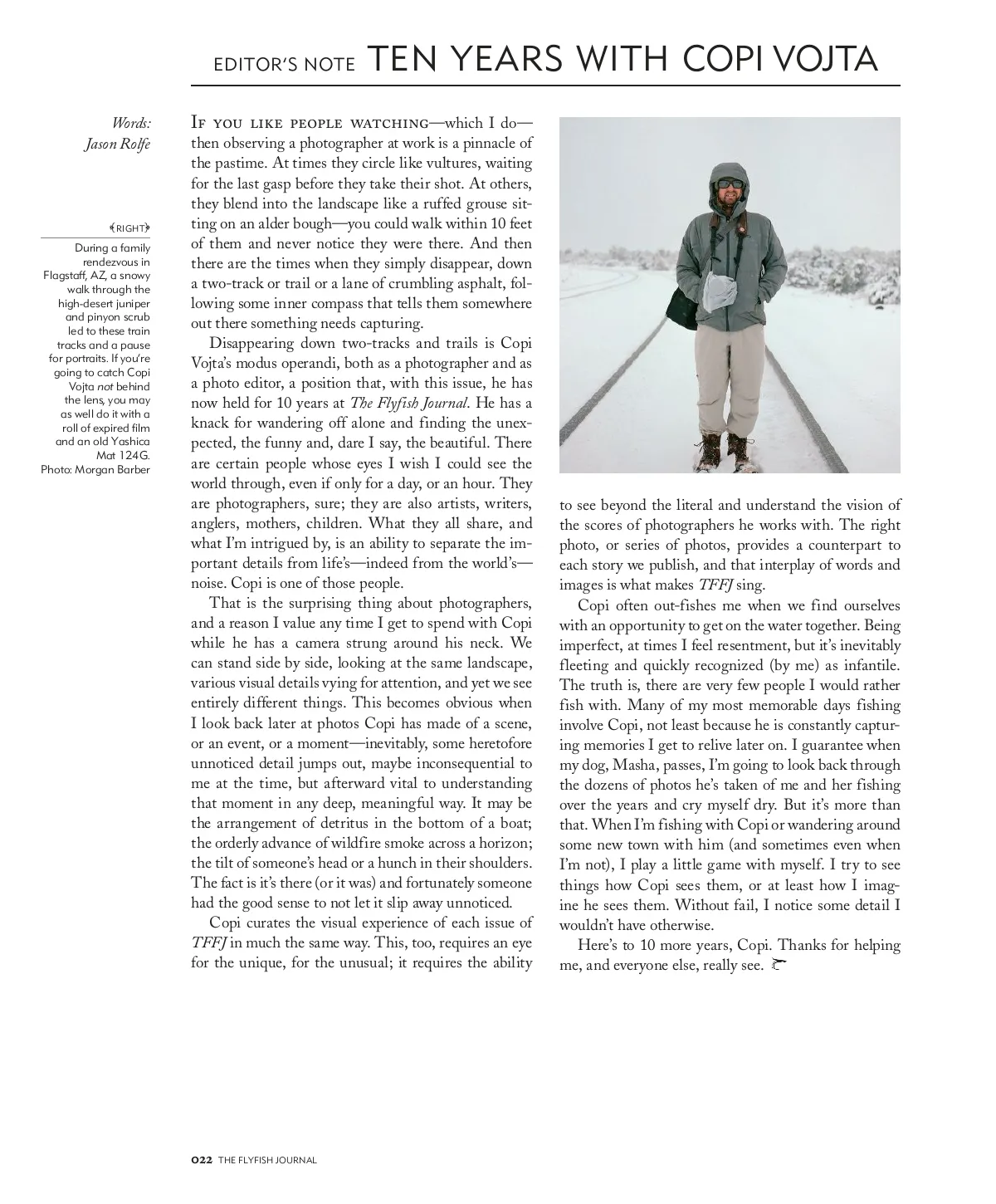
EDITOR’S NOTE Words: Jason Rolfe TEN YEARS WITH COPI VOJTA If you like people watching —which I do— then observing a photographer at work is a pinnacle of the pastime. At times they circle like vultures, waiting for the last gasp before they take their shot. At others, they blend into the landscape like a ruffed grouse sit-ting on an alder bough—you could walk within 10 feet of them and never notice they were there. And then there are the times when they simply disappear, down a two-track or trail or a lane of crumbling asphalt, fol-lowing some inner compass that tells them somewhere out there something needs capturing. Disappearing down two-tracks and trails is Copi Vojta’s modus operandi, both as a photographer and as a photo editor, a position that, with this issue, he has now held for 10 years at The Flyfish Journal . He has a knack for wandering off alone and finding the unex-pected, the funny and, dare I say, the beautiful. There are certain people whose eyes I wish I could see the world through, even if only for a day, or an hour. They are photographers, sure; they are also artists, writers, anglers, mothers, children. What they all share, and what I’m intrigued by, is an ability to separate the im-portant details from life’s—indeed from the world’s— noise. Copi is one of those people. That is the surprising thing about photographers, and a reason I value any time I get to spend with Copi while he has a camera strung around his neck. We can stand side by side, looking at the same landscape, various visual details vying for attention, and yet we see entirely different things. This becomes obvious when I look back later at photos Copi has made of a scene, or an event, or a moment—inevitably, some heretofore unnoticed detail jumps out, maybe inconsequential to me at the time, but afterward vital to understanding that moment in any deep, meaningful way. It may be the arrangement of detritus in the bottom of a boat; the orderly advance of wildfire smoke across a horizon; the tilt of someone’s head or a hunch in their shoulders. The fact is it’s there (or it was) and fortunately someone had the good sense to not let it slip away unnoticed. Copi curates the visual experience of each issue of TFFJ in much the same way. This, too, requires an eye for the unique, for the unusual; it requires the ability RIGHT During a family rendezvous in Flagstaff, AZ, a snowy walk through the high-desert juniper and pinyon scrub led to these train tracks and a pause for portraits. If you’re going to catch Copi Vojta not behind the lens, you may as well do it with a roll of expired film and an old Yashica Mat 124G. Photo: Morgan Barber to see beyond the literal and understand the vision of the scores of photographers he works with. The right photo, or series of photos, provides a counterpart to each story we publish, and that interplay of words and images is what makes TFFJ sing. Copi often out-fishes me when we find ourselves with an opportunity to get on the water together. Being imperfect, at times I feel resentment, but it’s inevitably fleeting and quickly recognized (by me) as infantile. The truth is, there are very few people I would rather fish with. Many of my most memorable days fishing involve Copi, not least because he is constantly captur-ing memories I get to relive later on. I guarantee when my dog, Masha, passes, I’m going to look back through the dozens of photos he’s taken of me and her fishing over the years and cry myself dry. But it’s more than that. When I’m fishing with Copi or wandering around some new town with him (and sometimes even when I’m not), I play a little game with myself. I try to see things how Copi sees them, or at least how I imag-ine he sees them. Without fail, I notice some detail I wouldn’t have otherwise. Here’s to 10 more years, Copi. Thanks for helping me, and everyone else, really see. 022 THE FLYFISH JOURNAL
The Flyfish Journal The Flyfish Journal 13.4: Page 22