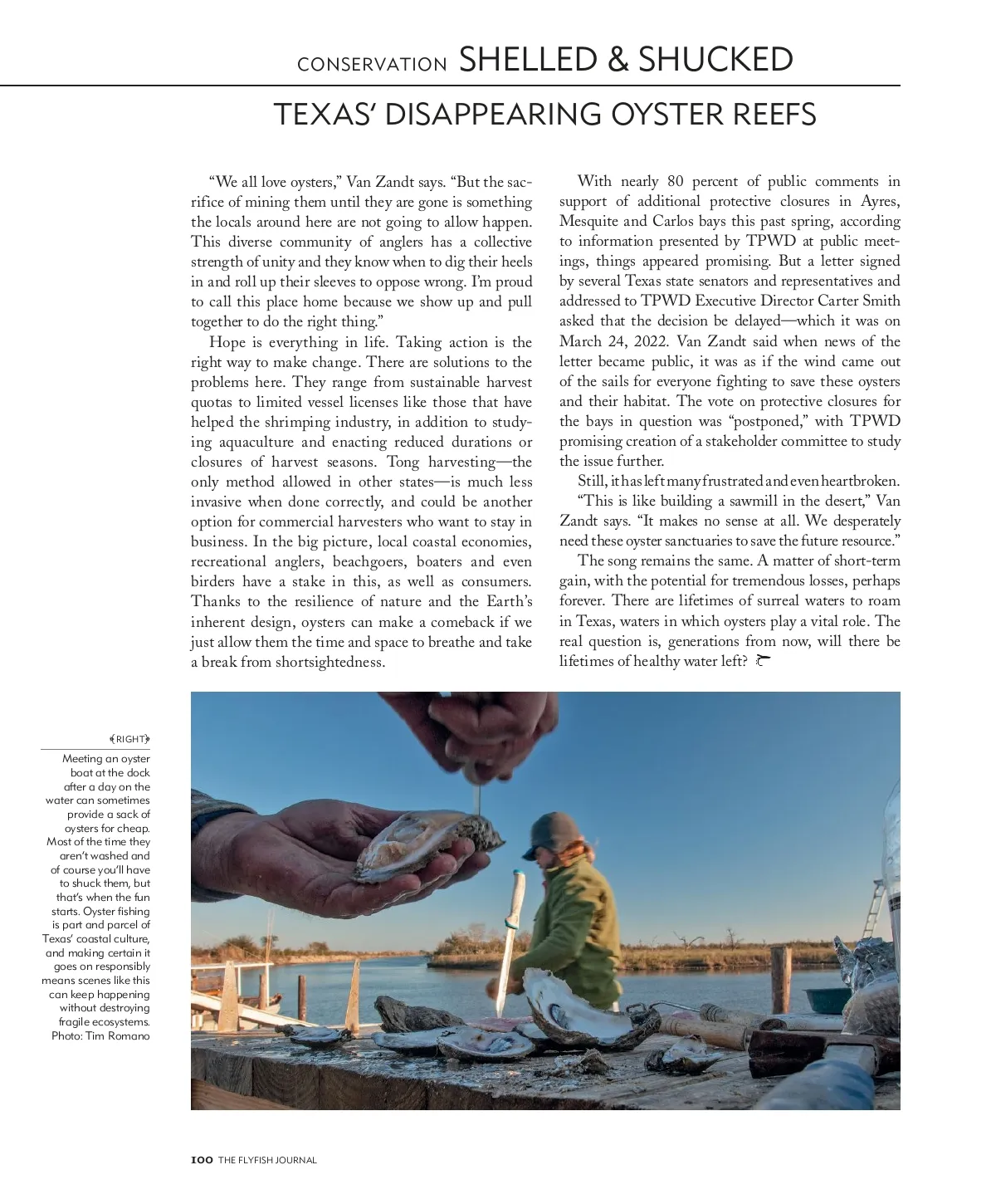
CONSERVATION SHELLED & SHUCKED TEXAS’ DISAPPEARING OYSTER REEFS “We all love oysters,” Van Zandt says. “But the sac-rifice of mining them until they are gone is something the locals around here are not going to allow happen. This diverse community of anglers has a collective strength of unity and they know when to dig their heels in and roll up their sleeves to oppose wrong. I’m proud to call this place home because we show up and pull together to do the right thing.” Hope is everything in life. Taking action is the right way to make change. There are solutions to the problems here. They range from sustainable harvest quotas to limited vessel licenses like those that have helped the shrimping industry, in addition to study-ing aquaculture and enacting reduced durations or closures of harvest seasons. Tong harvesting—the only method allowed in other states—is much less invasive when done correctly, and could be another option for commercial harvesters who want to stay in business. In the big picture, local coastal economies, recreational anglers, beachgoers, boaters and even birders have a stake in this, as well as consumers. Thanks to the resilience of nature and the Earth’s inherent design, oysters can make a comeback if we just allow them the time and space to breathe and take a break from shortsightedness. With nearly 80 percent of public comments in suppor t of additiona l protective closures in Ay res, Mesquite and Carlos bays this past spring, according to information presented by TPWD at public meet-ings, things appeared promising. But a letter signed by several Texas state senators and representatives and addressed to TPWD Executive Director Carter Smith asked that the decision be delayed—which it was on March 24, 2022. Van Zandt said when news of the letter became public, it was as if the wind came out of the sails for everyone fighting to save these oysters and their habitat. The vote on protective closures for the bays in question was “postponed,” with TPWD promising creation of a stakeholder committee to study the issue further. Still, it has left many frustrated and even heartbroken. “This is like building a sawmill in the desert,” Van Zandt says. “It makes no sense at all. We desperately need these oyster sanctuaries to save the future resource.” The song remains the same. A matter of short-term gain, with the potential for tremendous losses, perhaps forever. There are lifetimes of surreal waters to roam in Texas, waters in which oysters play a vital role. The real question is, generations from now, will there be lifetimes of healthy water left? RIGHT Meeting an oyster boat at the dock after a day on the water can sometimes provide a sack of oysters for cheap. Most of the time they aren’t washed and of course you’ll have to shuck them, but that’s when the fun starts. Oyster fishing is part and parcel of Texas’ coastal culture, and making certain it goes on responsibly means scenes like this can keep happening without destroying fragile ecosystems. Photo: Tim Romano 100 THE FLYFISH JOURNAL
The Flyfish Journal The Flyfish Journal 13.4: Page 100